
Principales conclusiones
- A good dive school should clearly explain its certification agency, course structure, training level, and what you can do after completing the course.
- Smaller student-to-instructor ratios are usually better for beginner scuba training because they allow more personal attention, calmer learning, and better support during skill practice.
- Before booking, always check what is included in the course price, such as equipment rental, learning materials, certification fees, confined-water training, open-water dives, boat trips, and insurance where applicable.
- Your instructor can shape your entire diving experience. Look for recent reviews that mention patience, clear communication, calm guidance, and support for nervous beginners.
- Safety procedures should be discussed before you dive. A reliable dive school should ask about medical fitness, give proper briefings, conduct equipment checks, and explain what happens if weather or sea conditions change.
Koh Tao is one of Thailand’s most popular destinations for scuba diving. Whether you’re trying diving for the first time, completing your Open Water certification, or advancing your diving skills, you’ll find dozens of dive schools competing for your attention.
While having so many options is great for travellers, it also raises an important question:
How do you choose the right dive school?
Many people compare only three factors before booking:
- Price
- Location
- Online reviews
While these are useful starting points, they don’t tell the full story.
The dive school you choose can have a significant impact on your safety, confidence, comfort, learning experience, instructor support, equipment quality, and overall enjoyment underwater. This is especially important for first-time divers, nervous beginners, solo travellers, and anyone booking a Discover Scuba Diving experience or Open Water course.
A lower-priced course isn’t necessarily a poor choice. Likewise, the most famous dive school may not be the best fit for your learning style, and a school with hundreds of positive reviews may still feel overcrowded if you prefer a more personal experience.
Before paying a deposit, take the time to evaluate your options carefully.
Use this practical dive school checklist and ask these 10 important questions before booking a dive school in Koh Tao.
How Do I Choose The Best Dive School In Koh Tao? To choose a dive school in Koh Tao, look beyond price and ask about safety, instructor experience, student-to-instructor ratio, course inclusions, equipment quality, medical checks, recent reviews, and beginner support. A good scuba diving school in Koh Tao should:
The best dive school in Koh Tao for you is not always the biggest, cheapest, or most advertised one. It is the one that makes you feel safe, informed, supported, and ready to learn. |
Dive School Checklist Before Booking
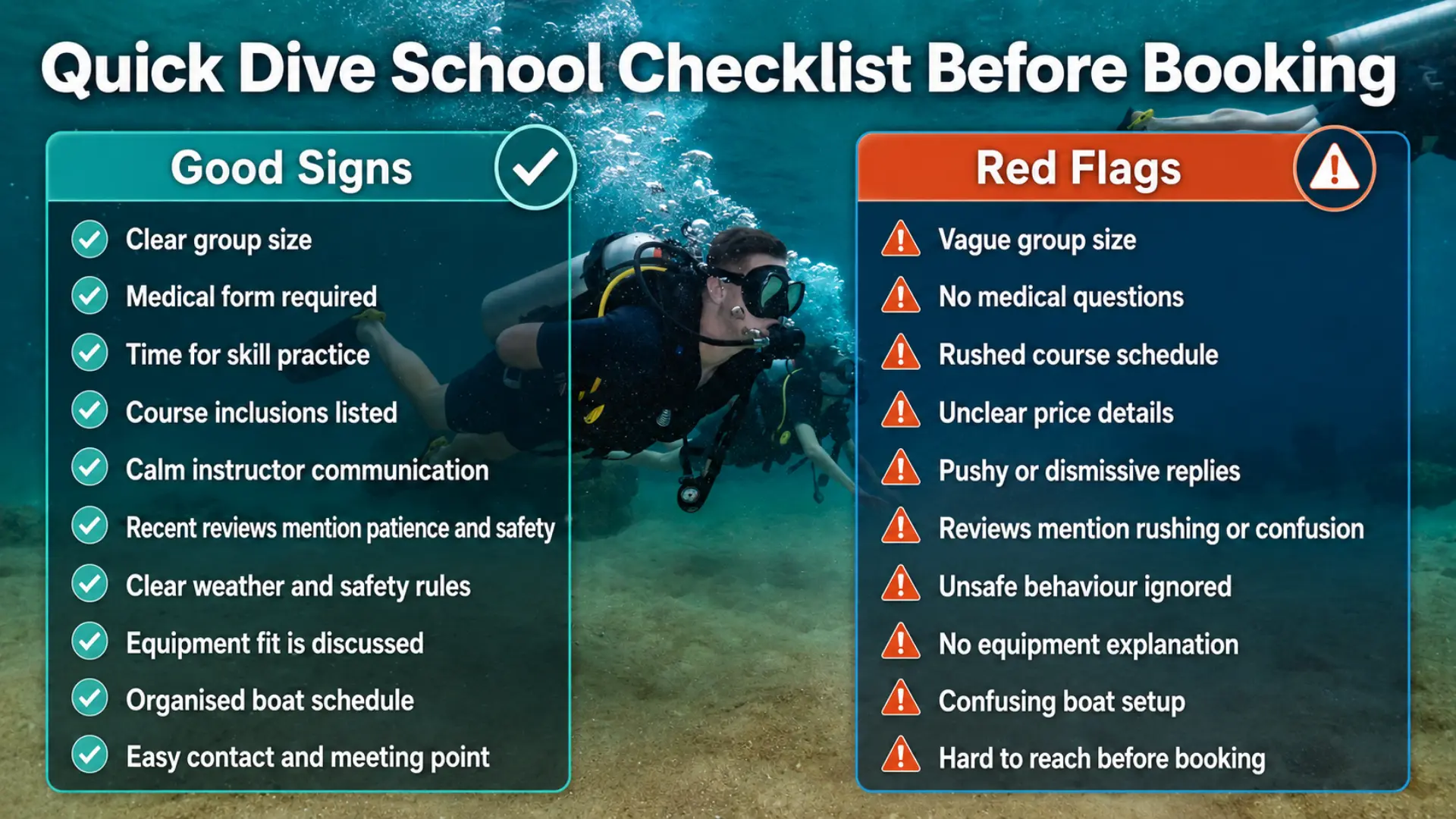
Use this table when doing a dive school comparison in Koh Tao.
What to check | Why it matters | Good sign | Red flag |
Group size | Smaller groups usually mean more attention | The school gives a clear answer | “It depends” with no detail |
Medical process | Diving fitness matters | You are asked to complete a medical form | No medical questions |
Course pace | Rushed training hurts confidence | Pool/confined practice and time to ask questions | “We just get it done fast” |
Inclusions | Prevents hidden costs | Equipment, training materials, certification, and boat inclusions are listed | Cheap headline price, vague details |
Instructor support | Teaching style matters | Calm, clear communication before booking | Pushy or dismissive replies |
Reviews | Recent patterns matter more than stars | Reviews mention patience, safety, clarity, and confidence | Reviews mention rushing or confusion |
Safety culture | Good schools say no when needed | School can explain weather changes and safe-conduct rules | Unsafe bravado |
Equipment | Comfort and fit affect experience | Rental is included, and fit is discussed | No explanation of what you’ll use |
Boat logistics | Boat days are part of the experience | Clear timings, snacks/water, organised plan | Confusing or crowded setup |
Location and contact | Booking should feel easy | WhatsApp, website, and a clear meeting point | Hard to reach or unclear address |
10 Important Questions to Ask Before Choosing a Dive School in Koh Tao
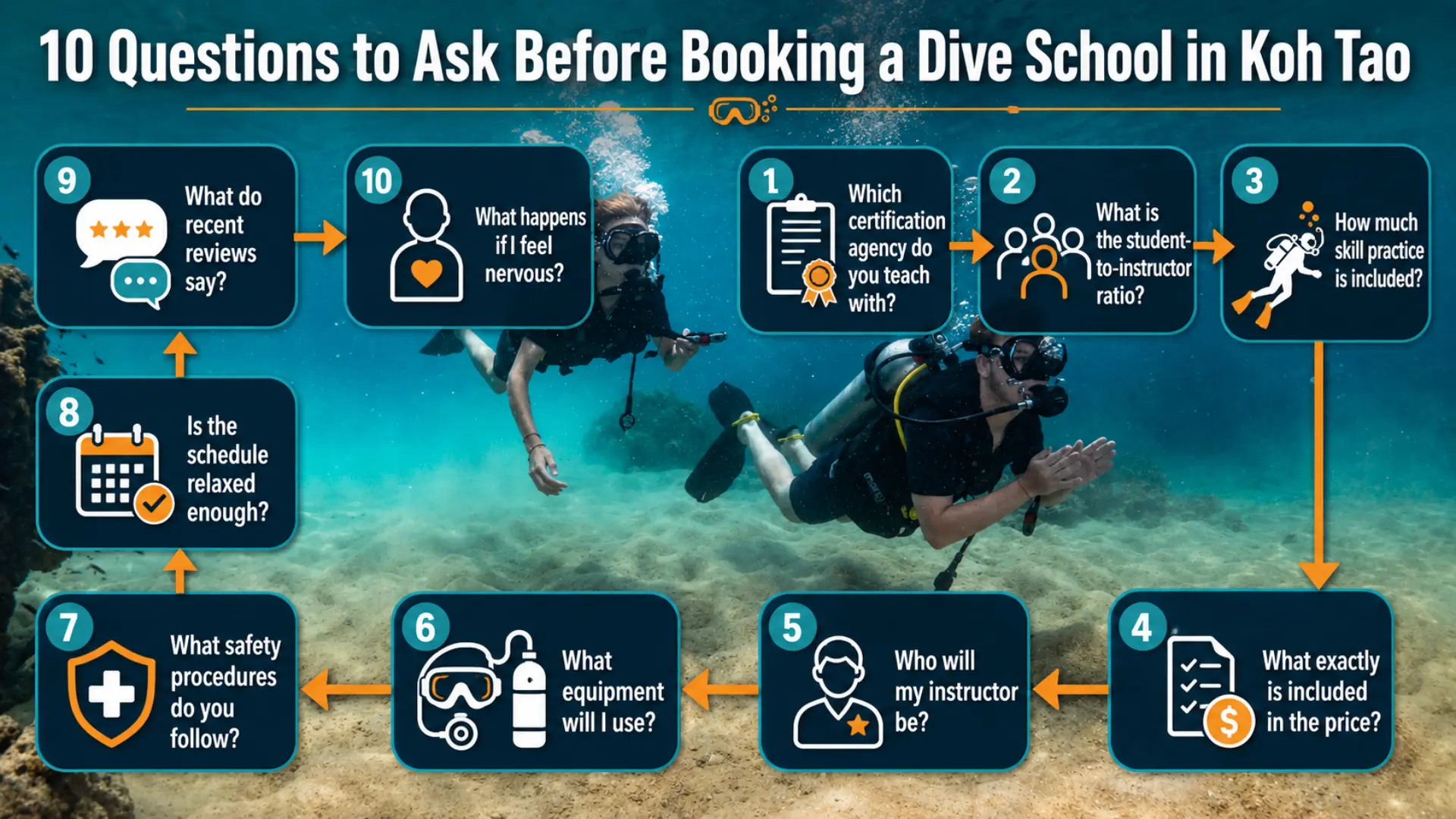
Question 1: What certification agency do you teach with, and is it internationally recognised?
This is one of the first questions to ask before booking a dive school.
Scuba diving courses are taught through certification agencies. The most common names travellers see are PADI, SSI, and RAID. All are widely used in recreational diving, but each school may follow a different training system, course structure, and digital learning process.
The agency matters because your certification tells future dive centres what level you are trained to and what kind of dives you can join.
Why does this question matter?
You want to know:
- What certification will you receive
- Whether it is recognised beyond Koh Tao
- What level will you be certified for
- What the course includes
- What you can do after certification
- Whether the course fits your future diving plans
For example, if you want to continue from Open Water to Advanced, Rescue, Divemaster, or Instructor Development, it helps to choose a school that can explain the full progression clearly.
What does a good answer sound like?
A good dive school should be able to explain:
- Which agency do they teach with
- What does the course level mean
- How many training dives are included
- What skills will you practise
- What depth or experience limits apply
- How your certification can be used later
They should not make you feel confused or silly for asking.
Red flags to watch for
Be careful if a school says:
- “It does not matter, just book.”
- “All certifications are exactly the same.”
- “You do not need to know that.”
- “We will explain later after payment.”
That is not a reassuring start.
How does LB Diving/LA Bombona Diving approach this? LB Diving follows a clear training pathway as a dedicated RAID dive school, offering courses that range from introductory Try Dives and Open Water certifications to advanced and professional-level training. This structured approach allows new divers to start with a beginner-friendly experience and continue their diving education with the same team as their confidence and skills grow. For nervous beginners and first-time divers, this continuity can be particularly valuable. Learning with familiar instructors, procedures, and teaching standards often creates a more comfortable and supportive progression throughout the certification journey. |
Question 2 – What is the student-to-instructor ratio?
Group size can completely change your diving experience.
A class with fewer students usually gives you more time to ask questions, practise skills, receive feedback, and feel looked after. This is especially important if you are nervous, not a strong swimmer, travelling alone, or learning to dive for the first time.
Why this question matters
Scuba diving is not only about understanding theory. You need to practise real skills in the water, such as:
- Clearing your mask
- Recovering your regulator
- Controlling your buoyancy
- Equalising your ears
- Communicating underwater
- Staying calm if something feels uncomfortable
If the group is too large, some students may feel rushed or unnoticed.
What a good answer sounds like
A good answer should be specific.
For example:
- “We keep groups small.”
- “We aim for personal attention during training.”
- “If someone is nervous, the instructor will support them step by step.”
- “We do not rush students through skills.”
The exact number may vary depending on the course, season, instructor availability, and student needs, but the school should be transparent about how they manage group size.
Red flags to watch for
Be careful if:
- The school avoids answering
- The group size sounds very large
- They say, “Everyone learns together; it is fine”
- They cannot explain how nervous students are supported
- Reviews mention rushed instruction or not enough attention
How does LB Diving/LA Bombona Diving approach this? At LB Diving, we focus on small-group training because we believe divers learn best when they receive personal attention and support throughout their course. Smaller groups allow our instructors to spend more time with each student, helping build confidence both in the classroom and underwater. Group sizes can vary depending on the course and season, so if having a small class is important to you, feel free to contact us before booking, and we’ll be happy to confirm the current student-to-instructor ratio for your dates. |
Question 3: How much time is given for pool or confined-water training and skill practice?
One of the most common beginner mistakes is assuming that all Open Water courses are structured the same way. They are not. A course can have the same certification outcome but feel very different depending on how much time you get to settle into the equipment, practise core skills, and build composure before the ocean dives.
Why this question matters
The first time breathing underwater can feel strange.
Even confident swimmers can feel nervous when they first put on a mask, regulator, tank, and fins. That is normal.
Good confined-water training gives you time to:
- Get comfortable with the equipment
- Practise breathing slowly
- Learn emergency skills
- Build water confidence
- Ask questions
- Make mistakes safely
- Repeat skills until they feel natural
What a good answer sounds like
A good dive school should explain:
- When skill practice happens
- Where it happens
- Which skills will you practise
- What happens if you need more time
- How instructors support nervous students
You should feel that the school values comfort and safety, not just finishing the schedule.
Red flags to watch for
Be cautious if:
- The school gives no clear training structure
- The course sounds too rushed
- They treat nervousness as a problem
- They cannot explain where basic skills are practised
- They say “you will be fine” without explaining how they help
How does LB Diving/LA Bombona Diving approach this? At LB Diving, we believe learning to dive should be a gradual and confidence-building experience, not something that feels rushed. Our Open Water course follows a structured progression that combines theory sessions, confined-water skills practice, and open-water dives, allowing students to develop their skills step by step. We encourage prospective divers to check with us directly for the latest course schedule, as training timelines can vary depending on factors such as student progress, course logistics, and seasonal conditions. Our priority is ensuring every diver feels comfortable, confident, and ready before moving on to the next stage of their training. |
Question 4: What exactly is included in the course price?
This is one of the most practical questions to ask before paying.
Two dive schools may advertise similar prices, but the real value can be very different depending on what is included.
Why this question matters
A course price may or may not include:
- Alquiler de equipo completo
- Mask, fins, wetsuit, BCD, regulator, tank, and weights
- Dive computer use
- Online learning materials
- Material didáctico y repasos de los conceptos importantes con tu instructor en persona
- Pool or confined-water training
- Ocean dives
- Certification fee
- Buceo desde barco
- Snacks and refreshments
- Insurance, where applicable
- Transport or accommodation support
- Photos or videos
- Extra dives
- Speciality dive fees
If you do not ask before booking, you may be surprised later.
What a good answer sounds like
A good dive school should give a clear breakdown.
For example:
- “This is included.”
- “This is optional.”
- “This costs extra.”
- “This depends on the course.”
- “Please check the latest course page before booking.”
Clear pricing builds trust.
Red flags to watch for
Be careful if:
- The price sounds too low, but details are missing
- Equipment rental is not clearly included
- Certification fees are unclear
- Learning materials cost extra, but are not mentioned
- You are pressured to pay before understanding the package
- The school avoids written confirmation
How does LB Diving/LA Bombona Diving approach this? We believe divers should know exactly what is included before they book. That’s why we clearly outline course details, inclusions, and certification requirements across our website. For example:
|
Question 5: Who will my instructor be, and how experienced are they?
The instructor matters more than many beginners realise.
A certification logo does not teach you. A person does.
Your instructor’s patience, communication style, experience, and attitude can shape your entire diving experience.
Why this question matters
A good instructor does more than demonstrate skills.
They should:
- Explain clearly
- Notice when you are nervous
- Give calm feedback
- Keep the group organised
- Create a safe learning environment
- Encourage you without pressuring you
- Make sure you understand what you are doing and why
For nervous beginners, instructor personality can be the difference between “I can’t do this” and “I actually feel confident underwater.”
What a good answer sounds like
A good dive school may not always be able to confirm the exact instructor far in advance, especially during busy periods, but they should be able to explain:
- Who teaches beginner courses
- How instructors are assigned
- What languages may be available
- How are nervous students supported
- Whether the same instructor stays with the group where possible
Red flags to watch for
Be careful if:
- The school cannot explain the instructor’s experience
- Reviews mention inconsistent teaching
- The instructor seems impatient during your first questions
- The team makes you feel rushed before you even book
- You are told not to worry without getting real answers
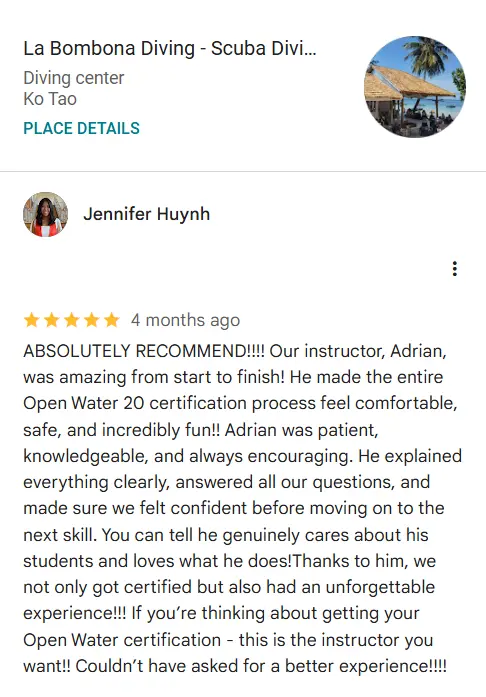
How does LB Diving/LA Bombona Diving approach this? At LB Diving, we believe that great dive instruction goes beyond certifications and experience. The best instructors are those who can explain concepts clearly, adapt to different learning styles, and help students feel safe and confident throughout their diving journey. Many of our guests specifically mention these qualities in their reviews, highlighting instructors for their patience, professionalism, calm guidance, and supportive teaching approach. Whether it’s helping a nervous first-time diver feel comfortable underwater or guiding a student through their Open Water certification, our goal is to create a positive and confidence-building learning experience for every diver. What Divers Say About Our Instructors:
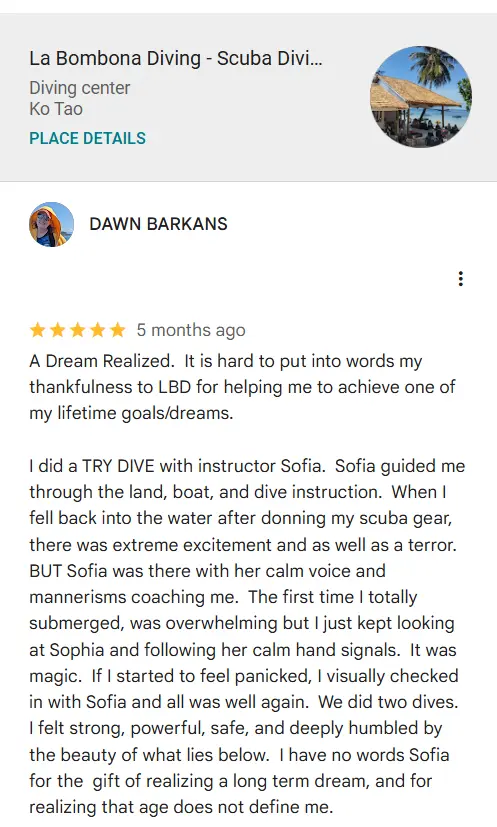
Students frequently praise our instructors for their patience, encouragement, and ability to build confidence throughout the certification process. Read the full review of Jennifer Huynh’s experience with LA Bombona Diving.
For many first-time divers, calm guidance and reassurance can make all the difference. Reviews often highlight the supportive approach of our instructors during Try Dives and beginner courses. Read the full review of Dawn Barkans’ experience with LA Bombona Diving. |
Question 6: What equipment will I use, and how is it maintained?
Scuba equipment is your life-support system underwater.
You do not need to be a gear expert before your first dive, but you should feel comfortable asking about equipment quality, fit, and maintenance.
Why this question matters
Your equipment affects:
- Comfort
- Safety
- Buoyancy
- Breathing ease
- Confidence
- Skill practice
- Overall enjoyment
Poorly fitting gear can make a beginner feel stressed. A leaking mask, uncomfortable fins, oversized BCD, or badly fitting wetsuit can distract you during training.
Equipment to ask about
Before booking, ask about:
- Mask fit
- Fin sizes
- Wetsuit sizes
- BCD fit
- Regulator checks
- Tank handling
- Dive computer use
- Whether equipment is included
- What happens if something does not fit comfortably
What a good answer sounds like
A good dive school should say:
- Equipment is included where applicable
- The gear is checked before use
- Instructors help with fitting
- You can ask for adjustments
- Safety checks are done before dives
Red flags to watch for
Be careful if:
- The equipment looks poorly stored
- Staff seem annoyed when you ask about fit
- You are not shown how your gear works
- Buddy checks are rushed or skipped
- Reviews mention old or uncomfortable equipment repeatedly
How does LB Diving/LA Bombona Diving approach this? Comfort and confidence underwater often start with having the right equipment. Standard diving equipment is included with our courses and fun dives, and equipment rental details are clearly outlined across our course and activity pages. If equipment quality, fit, specific brands, or servicing procedures are important to you, feel free to póngase en contacto con our team before booking. We’re always happy to answer your questions. |
Question 7: What safety procedures do you follow before and during dives?
Safety should never feel like an afterthought.
A trustworthy dive school should be comfortable talking about medical forms, dive briefings, equipment checks, weather decisions, emergency planning, and safe diving behaviour.
Why this question matters
Scuba diving is generally safe when taught and supervised properly, but it is still an adventure activity. That means safety procedures matter.
Before diving, you should understand:
- Whether you need to complete a medical form
- What happens if you answer “yes” to a medical question
- How dive briefings work
- How buddy checks are done
- What signals will you use underwater
- What the instructor does if someone feels uncomfortable
- How the school responds to weather or sea conditions
- What behaviour is not allowed before or between dives
What a good answer sounds like
A good dive school should explain:
- Medical screening before courses
- Briefings before dives
- Buddy checks
- Instructor supervision
- Emergency planning
- Weather-related schedule changes
- Respect for marine life
- No alcohol or drugs before diving
Clear safety rules are not a negative thing. They are a sign of professionalism.
Red flags to watch for
Avoid schools that:
- Do not ask medical questions
- Laugh off safety concerns
- Rush briefings
- Ignore weather concerns
- Allow unsafe behaviour
- Pressure you to dive when you are uncomfortable
- Cannot explain their emergency procedures
How does LB Diving/LA Bombona Diving approach this? At LB Diving, safety starts before anyone enters the water. Before a course or dive, we ask divers to complete a standard diving medical questionnaire, and when needed, we require clearance from a licensed diving doctor in Thailand. As explained in our Terms & Conditions, we may also modify or cancel dives if weather, sea conditions, or local circumstances could affect safety. We expect every diver to follow instructor guidance, respect marine life, and avoid unsafe behaviour such as alcohol or drug use before or between dives. Independent third-party sources also highlight that our beginner experiences include a detailed safety briefing before entering the water. We also recommend asking any dive school directly about its emergency setup, including oxygen, first-aid equipment, boat procedures, and staff training. A responsible dive centre should be open and clear about how it manages safety above and below the water. |
Question 8: Is the course schedule relaxed enough for real learning?
Not every beginner learns at the same pace.
Some people feel comfortable quickly. Others need more time to adjust to breathing underwater, equalising, controlling buoyancy, or trusting the equipment.
Why this question matters
A rushed schedule can leave beginners feeling:
- Overwhelmed
- Embarrassed to ask questions
- Unsure about skills
- Nervous before ocean dives
- Less confident after certification
A relaxed schedule gives you time to understand what you are learning.
What a good answer sounds like
A good school should explain:
- How many days does the course take
- When theory happens
- When pool or confined-water practice happens
- When ocean dives happen
- What happens if you need more support
- Whether the schedule can be adjusted if conditions change
Red flags to watch for
Be careful if:
- The course sounds rushed
- There is little time for skill practice
- The school focuses only on finishing quickly
- You are told nervousness is not a problem without any support plan
- The schedule is unclear before payment
How does LB Diving/LA Bombona Diving approach this? Learning to dive shouldn’t feel rushed. Our courses are designed to help students build skills and confidence step by step, with dedicated time for theory, skill development, and open-water practice. Many divers tell us they appreciate the supportive pace of our training and the time our instructors take to answer questions, explain concepts clearly, and help them feel comfortable throughout the learning process. |
Question 9: What do recent reviews say about beginner experience and instructor support?
Reviews are useful, but only if you read them properly.
Do not look only at the star rating. Read what people actually say.
Why this question matters
Reviews reveal patterns.
Look for repeated comments about:
- Patient instructors
- Feeling safe
- Clear explanations
- Support for nervous beginners
- Good equipment
- Organised scheduling
- Helpful communication
- Fair pricing
- Honest expectations
- Friendly atmosphere
One random review does not prove much. But repeated themes across recent reviews can tell you what the school is really known for.
How to read reviews properly
When reading reviews, ask:
- Are the reviews recent?
- Do beginners mention feeling supported?
- Do instructors get named positively?
- Do reviews mention safety and comfort?
- Do people say they felt rushed?
- Are complaints handled professionally?
- Do certified divers and first-time divers both leave good feedback?
A review saying “great vibes” is nice.
A review saying “I was nervous, but the instructor stayed calm, explained everything clearly, and helped me feel safe” is more useful.
Red flags to watch for
Be careful if reviews repeatedly mention:
- Rushed teaching
- Poor communication
- Crowded groups
- Disorganised scheduling
- Equipment discomfort
- Feeling ignored
- Confusion over pricing
- Pressure to continue
How does LB Diving/LA Bombona Diving approach this? When choosing a dive school, it is easy to focus only on the course name, price, certification agency, or dive sites. But for beginners, nervous divers, or anyone learning a new skill underwater, the instructor can make just as much difference as the course itself. At LB Diving, we believe good instruction starts with calm communication, patience, clear briefings, and in-water support that helps divers feel safe instead of rushed. Our team page gives divers a chance to see who they may be learning with before they book, while independent Google reviews often highlight the qualities we care about most: patience, clarity, support, and confidence-building. |
Question 10: What happens if I feel nervous, uncomfortable, seasick, or need extra support?
This may be the most important question for first-time divers.
Many beginners worry about:
- Breathing underwater
- Panicking
- Not being a strong swimmer
- Getting seasick
- Equalising their ears
- Mask flooding
- Holding the group back
- Not being able to finish the course
These are normal concerns.
A good dive school should be able to talk about them calmly.
Why this question matters
Emotional safety is part of dive training.
You should never feel ashamed for being nervous. Diving is new, and the ocean is a different environment. Good instructors know how to slow things down, repeat explanations, and help you take one step at a time.
What a good answer sounds like
A good answer may include:
- “Tell your instructor before you start.”
- “We will go step by step.”
- “You can pause if you need to.”
- “We will not force you to continue if you are uncomfortable.”
- “We will help you understand what to expect.”
- “If conditions are not suitable, we may adjust the plan.”
Red flags to watch for
Be cautious if:
- Staff dismiss your anxiety
- You are told “everyone is nervous” without support
- The school pressures you to book quickly
- No one explains what happens if you cannot continue
- Reviews mention students feeling pushed
How does LB Diving/LA Bombona Diving approach this? At LB Diving, we understand that feeling nervous, uncomfortable, seasick, or unsure is completely normal, especially if it is your first time diving. Our aim is not to rush you through the experience, but to help you feel calm, informed, and supported at each step. If a course or dive no longer feels right for you midway through, our Preguntas frecuentes explain that our team can discuss suitable options with you. This is important because beginner diving should feel flexible, not forced. You should be able to ask questions, repeat skills when needed, pause if you feel uncomfortable, and speak honestly with your instructor. |
Final Dive School Checklist Before You Pay
Before you book any scuba diving school in Koh Tao, make sure you can say yes to these points:
- I know which training agency the school teaches with.
- I know what certification or experience I am booking.
- I have asked about current group size for my dates.
- I understand the latest course schedule.
- I know what pool or skill-practice sessions are included.
- I know exactly what the quoted price includes.
- I know whether equipment is included.
- I know whether certification fees and learning materials are included.
- I understand the medical form process.
- I know what happens if the weather changes the plan.
- I know what support I can expect if I feel nervous.
- I have read recent reviews from beginners, not just the star rating.
- I know how to contact the school quickly before booking.
- I understand the cancellation and deposit terms.
- I feel comfortable with how the school communicates with me.
If a school cannot answer most of these clearly, keep comparing.
Summing Up
Choosing a dive school in Koh Tao is not only about finding the lowest price or the most famous name. It is about choosing a team that teaches safely, explains things clearly, answers your questions properly, and helps you feel comfortable in the water. For many beginners, the real concern is not just “Which course should I book?” but “Will I feel safe, supported, and looked after if I feel nervous?”
Before booking, take time to compare more than the course price. Look at group size, instructor support, safety rules, medical requirements, course inclusions, equipment standards, booking flexibility, and what past students say about their experience. A good dive school should make you feel informed before you pay, supported during training, and confident enough to ask questions without feeling rushed or judged.
The best choice is usually the school that gives you clear answers, realistic expectations, and honest guidance based on your comfort level, time, budget, and diving goals. Whether you are planning a one-day Try Dive, a full Open Water course, a Refresh Dive, a Night Dive, a Sail Rock trip, or future Divemaster training, the right dive school should help you choose what genuinely fits you.
Still comparing dive schools in Koh Tao? Message LA Bombona Diving on WhatsApp o Instagram and ask your questions before you book. If you are unsure which diving experience is right for you, the team can help you compare your options clearly and choose the path that feels safest, most suitable, and most enjoyable for you.
Frequently Asked Questions (FAQs)
 ES
ES  EN
EN