

Modified 12th June 2025
Table of Contents
Principales conclusiones
|
Koh Tao, often called ‘Turtle Island,’ is a popular getaway famous for its diving and snorkeling spots. However, the relaxed island vibe, beautiful scenery, and lively nightlife can make it easy to forget that Thailand operates under an exceptionally strict legal framework. And violating these rules can lead to serious legal problems. Adding to that, recent government updates have strengthened enforcement across the country, especially in areas such as immigration, tourist conduct, and marine conservation. Because of these stricter measures, understanding the rules before you arrive is more important than ever. This detailed guide explains all the essential legal guidelines so that you can stay safe, lawful, and respectful without getting into any legal trouble.
Important Laws to Follow in Koh Tao to Stay Out of Any Trouble
In Koh Tao, Thailand, even minor violations can result in fines, penalties, or legal complications that can easily ruin your trip. Taking a few minutes to familiarise yourself with the rules will help you avoid unnecessary trouble and ensure a smooth, stress-free stay.
Below are the most important laws every visitor should keep in mind.
1. Entry, Visa & Immigration Rules
All Thai immigration rules, including visa exemption, Visa on Arrival, tourist visas, extensions, entry conditions, and overstay penalties, apply in Koh Tao in the same way they apply elsewhere in Thailand.
Since 1 May 2025, foreign travellers entering Thailand by air, land, or sea must complete the free Thailand Digital Arrival Card online within three days before arrival.
IMPORTANT NOTICE – Complete the TDAC only through the official Immigration Bureau website. If you arrive without completing the required form, you should expect delays or processing problems at immigration. The TDAC itself does not guarantee entry, because the final decision remains with the immigration officer at the checkpoint. |
Passport Requirements – Your passport should generally be valid for at least six months from the date you arrive in Thailand and should contain at least two blank pages. Although some Thai consulates mention one blank visa page, several official Thai embassy pages require two pages for visa processing and immigration stamps. Two is therefore the safer general recommendation.
Airlines and immigration officers may refuse travel or entry when a passport does not meet the applicable requirements.
Visa Exemption – As of July 2026, travellers holding passports from eligible countries can still enter Thailand for tourism without obtaining a visa in advance and may generally stay for up to 60 days. They may also apply for an extension of up to 30 additional days, although approval is entirely at the discretion of Thai Immigration.
However, Thailand’s Cabinet approved changes on 19 May 2026 that would end the existing 60-day visa-exemption scheme. Under the approved framework, citizens of 54 eligible countries and territories would generally receive a 30-day visa-exempt stay, while travellers from three other eligible countries or territories would receive 15 days. En BBC also reported the planned reduction in visa-free stays.
IMPORTANT NOTE – The revised rules are not effective immediately. According to Thailand’s Ministry of Foreign Affairs, they will take effect 15 days after the relevant Ministry of Interior announcements are published in the Royal Gazette. Until that happens, the existing 60-day rule remains applicable. Travellers should check the latest requirements for their nationality with an official Thai embassy, consulate or government source shortly before departure. |
Visa on Arrival – Visa on Arrival is available only to passport holders from eligible countries. The permitted stay, application fee, required documents, and entry conditions can change, so travellers should confirm their eligibility through an official Royal Thai Embassy or Consulate before travelling.
NOTE – Visa on Arrival is different from visa-exempt entry.
Thailand Tourist Visa – If you’re not eligible for Visa Exemption or Visa on Arrival, or you want a longer stay, you need to apply for a Tourist Visa before you travel.
Applications should be made through the official Thailand e-Visa portal or the Royal Thai Embassy or Consulate responsible for your place of application. Documents and eligibility requirements can vary by nationality and application location.
These are of two types:
- Single-Entry Tourist Visa
- Valid for one entry.
- Allows you to stay for 60 days.
- You may be able to apply for an additional 30-day extension.
IMPORTANT NOTE – If you leave Thailand during the visa period without the appropriate re-entry permission, the remaining permission may no longer be valid. |
- Multiple-Entry Tourist Visa
- Generally valid for six months.
- Allows multiple entries during the visa’s validity period.
- Each permitted stay is normally determined at immigration.
- Usually requires additional financial and supporting documents for multiple entries.
Proof of Funds for Entering Thailand – On 6 July 2026, the Tourism Authority of Thailand issued a reminder that foreign visitors may be asked to show evidence that they have sufficient funds during immigration screening. TAT NEWS clarified that this is a long-standing immigration requirement and not a newly introduced rule.
The proof-of-funds requirement has existed under Thai immigration regulations since 1980, while the currently listed financial amounts were established under a later Ministry of Interior announcement in 2000. Immigration officers may apply the requirement when assessing whether a visitor meets Thailand’s entry conditions.
The required amounts depend on the traveller’s entry category:
- Transit Visa and certain visa-exempt cases: 10,000 THB per person or 20,000 THB per family
- Visa on Arrival: 10,000 THB per person or 20,000 THB per family
- Tourist Visa: 20,000 THB per person or 40,000 THB per family
- Non-Immigrant Visa: 20,000 THB per person or 40,000 THB per family
IMPORTANT NOTE – This requirement does not apply to children under 12. Travellers may be asked to show the required funds in Thai Baht, the equivalent amount in another currency, or documents that demonstrate access to or payment of the equivalent amount. Any supporting documents should be kept readily accessible during immigration screening. Visa-exempt travellers should check the latest rules for their nationality and place of departure before travelling, as published proof-of-funds requirements may differ depending on the applicable visa-exemption category. Not every visitor will necessarily be asked to provide proof of funds. However, the final decision on admission rests with Immigration Bureau officers at the entry checkpoint, and each traveller is assessed according to the applicable immigration laws and regulations. |
Accommodation and Onward Travel – Immigration officers may also ask for accommodation details, onward-travel evidence, or other documents relevant to the traveller’s entry category. The final decision on admission always rests with the Immigration Bureau officer at the checkpoint.
The Risk of Overstaying – Remaining in Thailand after your permitted stay expires is an offence under Thai immigration law and may result in fines, detention, deportation, and restrictions on returning to Thailand.
The standard overstay fine is 500 THB per day, up to a maximum of 20,000 THB. The re-entry ban depends on the length of the overstay and whether the traveller voluntarily reports the overstay when leaving Thailand or is arrested and prosecuted.
Length of overstay | If the traveller voluntarily surrenders or reports it when leaving | If the traveller is arrested and prosecuted |
Less than 90 days | Fine of 500 THB per day, up to 20,000 THB; normally no automatic re-entry ban | If the total overstay is less than one year, a five-year re-entry ban may apply |
More than 90 days but not more than one year | Fine up to 20,000 THB and a one-year re-entry ban | Five-year re-entry ban |
More than one year but not more than three years | Fine up to 20,000 THB and a three-year re-entry ban | Ten-year re-entry ban |
More than three years but not more than five years | Fine up to 20,000 THB and a five-year re-entry ban | Ten-year re-entry ban |
More than five years | Fine up to 20,000 THB and a ten-year re-entry ban | Ten-year re-entry ban |
NOTE – The re-entry ban period generally begins from the date the traveller departs Thailand. A person who is discovered or arrested while overstaying may also face detention and deportation at their own expense.
ADVISE – Always carry valid travel documents, including copies of your passport and entry stamp. Also, check your visa validity before taking any dive or boat trips around Koh Tao. For more information on travelling to Koh Tao from Thailand, please refer to the guide – Cómo llegar a Koh Tao desde cualquier lugar de Tailandia. To find out more about what to pack for Koh Tao – Check out our essential packing tips! |
2. Drug Laws & Controlled Substances
Thailand enforces strict laws relating to illegal drugs, controlled substances, cannabis, and electronic cigarettes. Penalties can include substantial fines, imprisonment, detention, and, for certain serious drug offences, the death penalty.
Is Cannabis Legal for Tourists in Thailand?
Cannabis flower in Thailand has been classified as a controlled substance since 23 June 2025, and recreational use, purchase and possession remain illegal. Tourists may buy, use, carry or transport cannabis flower only when they have a valid prescription issued in Thailand by an authorised medical professional. The quantity supplied must be medically necessary and cannot exceed a 30-day supply.
The official tourist guidance does not specify one universal fine or prison sentence for every case of unauthorised cannabis purchase, possession or use. The charge and penalty can depend on the product, its THC content, the amount involved and the circumstances. Therefore, tourists should not assume that cannabis is legal simply because it is openly displayed or offered by a shop.
Penalty for Smoking Cannabis in Public – Smoking cannabis in public is prohibited and may be treated as causing a public nuisance. The published penalty may include:
- Imprisonment for up to three months
- A fine of up to 25,000 THB
- Or both imprisonment and a fine
This can apply when cannabis smoke or odour disturbs other people in streets, beaches, parks, markets, accommodation or other shared public areas.
Penalties for Taking Cannabis Out of Thailand – It is illegal to take cannabis out of Thailand without the required export permission, even when it was purchased in Thailand or obtained for medical purposes.
Current government travel guidance warns that attempting to export cannabis can lead to confiscation and fines starting at 30,000 THB per kilogram. A person who cannot pay may be detained or imprisoned and may also be placed on an immigration watchlist, affecting future travel to Thailand.
NOTE – Cannabis may also be illegal in the traveller’s destination country or at an international transit airport. Carrying it across an international border can result in arrest, prosecution and lengthy imprisonment under the laws of the destination or transit country.
ADVISE – Unless you have a valid Thai-issued medical prescription, do not buy, possess, consume, smoke, carry or transport cannabis flower. Do not take cannabis flowers, oils, extracts, edibles or other cannabis products to an airport or across an international border. |
Narcotics and Other Controlled Drugs
Thailand’s narcotics laws apply to substances such as heroin, cocaine, methamphetamine, including yaba tablets and crystal methamphetamine or “ice” and MDMA or ecstasy. Possession, consumption, production, importation, exportation and distribution are separate offences, and the penalty depends on the drug’s legal schedule, quantity, intended purpose and circumstances.
Under Thailand’s Narcotics Code:
- Unauthorised consumption of covered narcotic drugs or controlled psychotropic substances can result in imprisonment for up to one year, a fine of up to 20,000 THB, or both.
- Possessing a covered narcotic or psychotropic substance for personal consumption can result in imprisonment for up to two years, a fine of up to 40,000 THB, or both.
NOTE – Thai courts may consider treatment or rehabilitation in some personal-use cases, but tourists should not interpret this as immunity from arrest, prosecution or punishment. The court considers factors including the substance, amount, frequency of use, the person’s conduct and the circumstances of the case.
Penalties for Serious Possession and Drug Trafficking – Penalties become significantly more severe when possession is not treated as possession for personal consumption or when the offence involves production, sale, importation, exportation or distribution.
For Schedule I narcotics, the Narcotics Code provides:
- For unauthorised production, import, export, distribution or possession: imprisonment for up to 15 years or a fine of up to 1.5 million THB.
- Where the offence involves trade, widespread distribution, supplying a person under 18, distribution at a school, religious place or government office, violence or a weapon: imprisonment from two to 20 years and a fine from 200,000 to 2 million THB.
- Where the offender is a leader or manager of a criminal syndicate, or the conduct affects national security or public safety: imprisonment from five years to life with a fine of 500,000 to 5 million THB, or the death penalty.
NOTE – The death penalty does not apply automatically to ordinary possession or every drug-trafficking conviction. It is legally available for the most serious aggravated offences described in the Narcotics Code.
ADVISE – Do not possess, consume, transport or accept illegal drugs from another person. Never agree to carry someone else’s luggage, parcel or package through an airport, ferry terminal or border checkpoint. Prescription medicines containing narcotics or psychotropic substances can also require medical documentation or prior permission from the Thai Food and Drug Administration. Travellers should check each medicine by its active ingredient before entering or leaving Thailand. |
Are E-Cigarettes and Vapes Legal in Thailand?
E-cigarettes and vaping products should be treated as illegal in Thailand. The restrictions apply to devices carried for personal use and include vapes, disposable e-cigarettes, refillable devices, pods, e-liquids, refills and heat-not-burn devices. There is no tourist or personal-use exemption.
Bringing a Vape into Thailand – Electronic cigarettes and related products are prohibited imports. A tourist carrying one into Thailand may be investigated as an importer, even when the device is intended only for personal use.
Depending on the law and charge applied, illegal importation may result in:
- Imprisonment for up to 10 years
- A fine of up to five times the product’s value
- A Customs Act fine of up to 500,000 THB
- Confiscation of the device, containers and, in serious cases, a vehicle used to transport the products
Possessing a Vape in Thailand – Possession may be prosecuted under customs law when the person knew that the product had entered Thailand without completing the required customs formalities.
The statutory penalty can include:
- Imprisonment for up to five years
- A fine of up to four times the value of the goods
- Or both imprisonment and a fine
Using a Vape in Public – Using an electronic cigarette containing nicotine in a prohibited public-smoking area can result in a fine of up to 5,000 THB. Other customs or possession charges may also apply separately.
Selling or Supplying Vaping Products – Selling e-cigarettes, e-liquids or related services can result in:
- Imprisonment for up to three years
- A fine of up to 600,000 THB
- Or both imprisonment and a fine
ADVISE – Do not bring a vape, e-cigarette, pod, e-liquid, refill or heat-not-burn device into Thailand. Do not buy one after arriving, even when it is sold openly by a shop, market stall or online seller. Open availability does not make the product legal. |
IMPORTANT NOTE – Penalties for breaking the law are applied to anyone under 18 years of age. And, the penalties for children can include detention in a juvenile and sometimes in an adult prison. |
3. Alcohol & Drinking Regulations
Koh Tao is lively, but alcohol use is strictly regulated, especially regarding age and sale times.
Legal Drinking Age – The legal age for purchasing and consuming alcohol is 20 years old. Visitors are advised to carry valid identification for age verification.
Purchase and Sales Hours – Effective 29 May 2026, alcoholic beverages may generally be sold in Thailand from 11:00 to 24:00. The change made the former 14:00–17:00 trial period part of the regular permitted sales window, allowing licensed retailers, restaurants and authorised venues to sell alcohol continuously from late morning until midnight.
Sales outside these hours remain restricted unless a specific legal exemption applies. Different operating conditions may apply to hotels, licensed entertainment venues, approved event spaces and areas serving international passengers at airports. Permitted hours can vary depending on the venue’s licence, location and applicable law.
NOTE – Alcohol sales may also be temporarily prohibited during elections, major Buddhist religious days or other officially announced periods. Additional temporary alcohol restrictions may apply during elections, major religious holidays, and other officially announced periods. Tourists should check notices from local authorities, shops, bars, and accommodation providers rather than assuming that normal operating hours apply every day.
IMPORTANT NOTE – Alcohol sales or consumption can still be restricted in certain places, including:
|
4. Respecting the Monarchy – “Lèse‑Majesté” Law
This is one of the most serious laws for visitors. The Lèse-Majesté law, Section 112, is a major criminal law in Thailand.
The law forbids:
- Defaming the monarchy
- Insulting or threatening the King or Queen
- Insulting or threatening the Heir-Apparent or Regent
Take care not to commit offences against the monarchy, including on social media.
Online Conduct – The law can be interpreted broadly and can apply to online posts, comments, shared articles, images, and other digital activity. Tourists should avoid posting, sharing, commenting on, or reacting to material that could be interpreted as insulting or making accusations about the monarchy.
IMPORTANT NOTE – Do not make insulting or defamatory comments about the monarchy in person, online, or on social media. Never damage or disrespect royal images, portraits, statues, or Thai currency carrying the King’s image. |
5. Gambling, Cards & Prohibited Games
Gambling is generally illegal in Thailand, and the law applies to tourists as well as residents. Prohibited gambling can include casino-style games, poker, roulette, dominoes, coin-toss betting and card games played for money or other valuables. Limited authorised exceptions include Thailand’s official government lottery and licensed betting at certain racecourses. Thailand’s Gambling Act prohibits participation in listed gambling activities unless the particular activity has been legally authorised or licensed.
Playing Cards – Thailand also restricts the possession of playing cards. Under Section 8 of the Playing Cards Act, a person must not possess more than 120 playing cards unless the cards were produced by or carry the official seal of Thailand’s Excise Department.
Violating this provision can result in
- imprisonment for up to three years,
- a fine calculated at four times the official value of comparable cards, with a minimum fine of 500 THB or both.
ADVISE – Do not participate in gambling involving money, property or prizes, including informal card games or online betting. Travellers should also avoid bringing more than 120 playing cards into Thailand. |
6. Scooter and Motorbike Rental Rules in Thailand
Thailand’s motorcycle laws apply nationwide, including in Koh Tao. Tourists may be able to rent scooters or motorbikes easily, but a rental business handing over a vehicle does not automatically mean that the traveller is legally licensed, properly insured or competent to ride it.
For licensing purposes, the scooters commonly rented in Thailand are treated as motorcycles. A driving licence that permits only cars is not sufficient.
What Documents Do Tourists Need to Ride Legally in Thailand?
A foreign visitor riding a scooter or motorbike in Thailand should carry:
- A valid driving licence issued by their home country
- A licence category that specifically authorises them to ride motorcycles
- A valid International Driving Permit recognised in Thailand and showing the appropriate motorcycle category
- Their passport or suitable identification as required during an official check
IMPORTANT NOTE – An International Driving Permit does not replace the traveller’s domestic licence. The rider should carry both documents. Thailand recognises qualifying IDPs issued under the 1949 Geneva Convention and the 1968 Vienna Convention, although the version available to a traveller depends on their country of licence issuance. Visitors should obtain the correct IDP before travelling. Some rental businesses may provide a scooter to a customer who has only a car licence, no motorcycle endorsement or no valid IDP. This does not make the customer legally licensed to ride. Official travel guidance warns that travellers without the correct motorcycle licence may face legal consequences and may not be covered by their insurance following an accident. |
Helmet Rules and Penalties – Thai law requires both the motorcycle rider and any passenger to wear a helmet. The rule applies even to short journeys and regardless of whether local riders appear to follow it.
A rider or passenger who does not wear a helmet may face a fine of up to 2,000 THB. A driver carrying a passenger who is not wearing a helmet may face an increased penalty.
Before accepting a rental helmet:
- Check that it fits securely
- Fasten the chin strap correctly
- Look for cracks, damaged straps or signs of a previous impact
- Request another helmet if the one provided is damaged or does not fit
NOTE – Wearing a poorly fitting or unfastened helmet may provide little protection during an accident.
Insurance and Accident Liability – Travel insurance is not a substitute for a valid motorcycle licence or IDP. It is also not, by itself, a legal authorisation to ride.
Travellers should check that their insurance policy specifically covers:
- Riding a motorcycle or scooter in Thailand
- The engine size of the rented motorcycle
- Riding as a driver rather than only as a passenger
- Medical treatment following a motorcycle accident
- Emergency evacuation where necessary
- Third-party injury and property-damage liability, where available
Many travel-insurance policies exclude claims when the rider does not hold the correct motorcycle licence, is not wearing a helmet, is intoxicated or is riding a motorcycle with an engine capacity above the policy’s permitted limit.
ADVISE – Visitors should also ask the rental business whether the motorcycle has valid insurance and whether that insurance includes comprehensive cover and third-party liability. Some rental vehicles may have little or no meaningful insurance beyond limited compulsory cover. After an accident, the renter may be personally responsible for vehicle damage, medical costs, damage to other property and compensation for injuries caused to another person. |
Ask the rental company to explain:
- What the vehicle’s insurance covers
- What it does not cover
- The insurance excess
- Who pays for repairs after an accident
- Whether theft is covered
- Whether damage to tyres, wheels, mirrors or the underside of the scooter is excluded
Do not rely only on a verbal statement that the vehicle is “fully insured.” Ask for the terms in writing
Before Renting a Scooter or Motorbike – Before accepting the vehicle:
- Read the rental agreement carefully
- Confirm the rental price, deposit and return time
- Photograph or video the scooter from every side
- Record existing scratches, dents, broken lights and damaged mirrors
- Make sure all existing damage is written into the agreement
- Check the brakes, tyres, lights, indicators, horn and fuel level
- Confirm what happens if the scooter breaks down
- Check the insurance terms and accident excess
- Keep copies of the agreement, payment receipt and vehicle details
Photographs and videos should be taken in the rental company’s presence before the scooter is moved.
IMPORTANT NOTE – Do not leave your passport as a deposit. Travellers should not leave their original passport with a scooter, motorcycle or jet-ski rental business as security.
Government travel advisories warn that rental operators may retain a customer’s passport during a dispute over alleged vehicle damage. This can prevent the traveller from leaving Thailand or continuing their journey until payment is made. This is primarily a traveller-safety recommendation rather than a statement that every request for a passport deposit is automatically a separate criminal offence. Offer another agreed form of security, such as a cash deposit or card authorisation, and keep the original passport under your control. |
Alcohol and Unsafe Riding – Do not drink alcohol or use drugs before riding. Insurance may be invalidated when alcohol, drugs, reckless riding or another legal violation contributed to an accident.
Riders should also avoid:
- Using a mobile phone while riding
- Carrying more passengers than the motorcycle is designed for
- Riding without previous motorcycle experience
- Speeding or riding aggressively
- Riding in heavy rain or poor visibility
- Using an unfamiliar road after dark
NOTE – For official licensing information, travellers can consult Thailand’s Department of Land Transport or contact the relevant Royal Thai Embassy before departure.
7. Environmental Laws, Littering & Wildlife / Marine Protection
Protecting coral reefs, marine life and beaches is particularly important in Koh Tao. Travellers should follow Thailand’s national marine-conservation rules as well as any additional instructions issued by national parks, protected areas, local authorities, dive operators and boat crews.
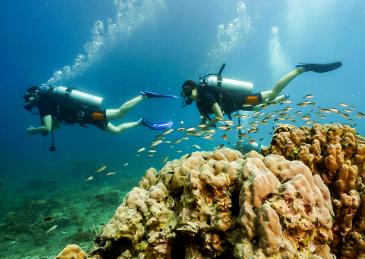
Marine Protection for Divers and Snorkellers – Since 22 April 2025, Thailand has applied nationwide regulations to diving and snorkelling activities in coral-reef areas. The measures are legally enforceable under the Marine and Coastal Resources Management Act and are scheduled to remain in force for five years.
In coral-reef areas, prohibited activities include:
- Touching or making contact with coral and other marine organisms
- Moving, handling or displaying coral, marine animals or other sea life
- Feeding fish
- Standing on, kicking or otherwise damaging coral
- Stirring up sediment in a way that can damage or smother coral
- Littering or otherwise disturbing reef habitats
- Participating in underwater walking or Sea Walker activities in coral zones
Divers near coral reefs are also expected to remain at least two metres above coral heads unless their skills and supervision allow a safe approach without damaging the reef.
A tourist who ignores instructions, for example, by touching coral or refusing to comply with required safety measures, must have the activity stopped and may be reported to marine or national-park authorities. Dive operators and supervisors can also face licensing or certification consequences if they fail to enforce the rules.
These regulations apply to coral-reef activities nationwide, including relevant dive and snorkelling activities around Koh Tao.
NOTE – These rules should not, however, be described as one blanket law applying identically to every beach, bay, and land area across the entire island. National parks, designated marine zones and other protected locations may impose additional rules.
For more information, read the Marine Conservation Koh Tao: Complete Guide to Ocean Protection.
Sunscreen Restrictions in National Parks – Bringing or using sunscreen containing certain chemicals is prohibited inside Thailand’s national parks.
The prohibited chemicals are:
- Oxybenzone, also called Benzophenone-3 or BP-3
- Octinoxate, also called Ethylhexyl Methoxycinnamate
- 4-Methylbenzylidene Camphor, or 4-MBC
- Butylparaben
A person who brings or uses sunscreen containing any of these chemicals inside a Thai national park may face a fine of up to 100,000 THB. The restriction followed an announcement by Thailand’s Department of National Parks, Wildlife and Plant Conservation published in the Royal Thai Government Gazette on 3 August 2021.
Travellers visiting a national park should check the sunscreen’s full ingredients list before entering. Thailand’s Tourism Authority recommends considering mineral-based sunscreen containing ingredients such as zinc oxide, along with protective clothing and other measures that reduce the need for excessive sunscreen use.
This is a national park restriction. It should not be presented as a universal sunscreen law covering every part of Koh Tao.
Waste, Littering and Single-Use Plastics – Since 6 April 2022, bringing or using specified single-use plastic products and foam containers has been prohibited in Thailand’s national parks.
Restricted items include:
- Single-use plastic food containers
- Plastic cups or glasses
- Plastic straws
- Plastic spoons and forks
- Certain disposable plastic packaging and handles
- Foam or Styrofoam food containers
Violations inside a national park can carry a fine of up to 100,000 THB under Thailand’s National Parks Act.
This restriction applies inside Thailand’s national parks and should not be described as an automatic island-wide plastic ban covering every part of Koh Tao. Other protected areas, beaches, boat operators and local sites may have their own additional waste rules.
Visitors should follow signs and instructions at the specific site they are visiting, use reusable bottles and containers where possible, and never leave rubbish on beaches, boats, dive sites or in the sea. Littering in coral-reef zones is expressly prohibited under Thailand’s current diving and snorkelling regulations.
8. Dress Code, Public Decency & Cultural Respect
Thai cultural norms place strong emphasis on respectful behaviour and appropriate clothing, particularly at temples, religious buildings, royal sites, memorials and government premises. Dress requirements vary by venue, so visitors should check signs and follow instructions given by staff.
Visitors may be asked to:
- Cover their shoulders and knees
- Avoid swimwear, transparent clothing and very short clothing
- Remove shoes before entering certain religious buildings
- Remove hats or sunglasses where requested
- Avoid loud, disruptive or disrespectful behaviour
The Grand Palace in Bangkok, for example, does not permit visitors to enter wearing items such as sleeveless shirts, vests, short or transparent tops, short trousers, torn or tight trousers, cycling pants and miniskirts. These are venue-specific entry requirements and should not be described as the exact dress code for every temple in Thailand.
What happens if you are dressed inappropriately in temples in Thailand?
There is no universal criminal fine for arriving at a temple or official attraction in unsuitable clothing. Depending on the venue, visitors may:
- Be refused entry
- Be asked to cover their shoulders or knees
- Be required to change or rent suitable clothing
- Be instructed to leave the premises
Public nudity or clearly obscene public conduct is a separate legal matter. Under Section 388 of Thailand’s Criminal Code, publicly exposing the body or committing another obscene act may result in a fine of up to 5,000 THB. This penalty does not apply automatically to ordinary clothing mistakes, such as arriving at a temple in shorts or a sleeveless top.
ADVISE – Pack clothes suitable for Koh Tao’s beaches and diving activities, but also bring modest clothing for temples, government offices, shops and local communities. Useful items include lightweight long trousers, a long skirt, a shirt with sleeves, and a sarong or shawl for covering the shoulders or knees. Avoid entering temples, restaurants, shops or villages wearing only swimwear. Follow the rules displayed at each location, as entry can be refused when clothing is considered inappropriate. To learn what else to bring, read our essential packing tips for Koh Tao. |
Practical Advice for Divers & Tourists on Koh Tao
A few basic precautions can help visitors avoid legal, financial and safety problems while enjoying Koh Tao’s beaches, dive sites and nightlife.
Before Diving or Snorkelling
Listen carefully to the dive or snorkelling briefing and follow the instructions of the instructor, divemaster, boat crew and relevant authorities.
When diving or snorkelling:
- Maintain proper buoyancy and control of your fins and equipment.
- Do not touch, stand on, kick, break or collect coral.
- Do not handle, chase, move or feed fish and other marine animals.
- Do not leave rubbish in the sea or disturb reef habitats.
- Follow any additional national-park, protected-area or site-specific rules.
Under Thailand’s regulations for diving in coral-reef areas, scuba divers must generally remain at least two metres above coral heads to prevent accidental contact. Supervisors must also ensure that only divers with sufficient control are allowed to approach coral areas safely. Contact with coral and other marine organisms, feeding fish, stirring up damaging sediment and littering are prohibited in coral-reef zones.
Documents and Information to Carry
Keep a photocopy or secure digital copy of:
- Your passport photograph page
- Your visa or immigration entry details
- Your travel insurance information
- Your accommodation address and contact number
- Your dive certification, where applicable
- Your dive operator’s contact details
Current UK government travel advice states that police may ask to inspect a traveller’s passport. A copy of the passport photograph page is usually sufficient for routine identification, but a person who does not have the original may be instructed to produce it at a police station within 24 hours.
NOTE – A passport copy is not sufficient in every situation. Foreign passengers must present their original passport for domestic flights within Thailand, and the original may also be required for immigration, banking, medical or other official procedures. Keep the original passport in a secure place when it is not required, and never leave it with a scooter, motorbike or jet-ski rental business as a deposit.
Nightlife and Personal-Safety Awareness
Koh Tao has bars, restaurants and beach parties, but travellers should remain aware of Thailand’s alcohol laws and general personal-safety risks.
Official travel advice recommends that visitors:
- Do not leave drinks unattended.
- Do not accept open drinks from strangers.
- Stay with trusted companions at parties and bars.
- Arrange safe transport before drinking.
- Avoid carrying unnecessary cash or valuables.
- Secure passports, money and electronics inside their accommodation.
- Do not drink alcohol before riding a scooter or motorbike.
Drink spiking, theft, assault and alcohol-related accidents can occur in Thai tourist areas, particularly around bars and late-night events. Money and passports have also been stolen from budget hotel and hostel rooms.
IMPORTANT LEGAL REMINDER – Foreign tourists are subject to Thai law and do not receive an exemption because they are visitors or were unaware of a rule. Under Section 64 of Thailand’s Criminal Code, ignorance of the law generally does not excuse criminal liability. A court may have limited discretion to reduce a sentence where it accepts that, because of the particular circumstances, the offender genuinely could not have known that the conduct was illegal. Travellers should therefore not rely on a lack of knowledge as protection against arrest, fines or prosecution. |
What to Do if Things Go Wrong – Legal or Medical Help & Resources
Even with the best intentions, emergencies can still happen. Having the right contact numbers ready can make a big difference in how quickly you get help.
If you end up in trouble, stay calm, cooperate, and get professional assistance right away. Don’t try to handle serious legal issues on your own.
Emergency and Tourist-Assistance Numbers in Thailand
Service | Phone number | When to use it |
Tourist Police | 1155 | Contact the Tourist Police for tourist-related assistance, crime reporting, disputes, lost property, translation support or help communicating with local authorities. Multilingual assistance may be available. |
Police Emergency | 191 | Call for an immediate police response, such as during a crime, assault, serious threat or other urgent security incident. |
Fire and Rescue | 199 | Call to report a fire or request urgent fire-and-rescue assistance. |
Emergency Medical Services | 1669 | Call for a serious illness, major injury, road accident or other medical emergency requiring an ambulance or emergency medical response. |
Immigration Bureau Call Centre | 1178 | Use for immigration information, including questions about visas, permitted stays, extensions and immigration procedures. This is an information service, not an emergency number. |
NOTE – For an immediate medical emergency, call 1669 rather than contacting the Tourist Police first. For an ongoing crime or immediate threat, call 191. The Tourist Police on 1155 can be especially helpful when a foreign visitor needs tourist-focused assistance or help communicating with other authorities.
Conclusión
Travellers should save these numbers before arriving in Thailand and also keep the contact details of their accommodation, travel insurer and dive operator readily accessible.
Travelling to Koh Tao promises an unforgettable experience with world-class diving, warm tropical weather, and welcoming local culture. But enjoying this dream trip fully depends on respecting local laws and cultural expectations.
There are eight key areas every visitor should pay close attention to:
- entry, visa, TDAC, and overstay requirements
- strict drug laws
- regulated alcohol rules
- the sensitive Lèse-Majesté law
- gambling restrictions
- legal scooter and motorbike requirements
- strict environmental protection laws and local customs
- Dress code, public decency & cultural respect
By following Thai entry rules, respecting local laws, protecting the marine environment, and choosing a responsible dive centre such as Buceo en La Bombona, you can enjoy Koh Tao safely and responsibly while helping preserve the environment and culture that make the island unique.
Frequently Asked Questions (FAQs)
Do I need a visa to travel to Koh Tao?
Koh Tao does not have separate visa rules from the rest of Thailand. Whether you need a visa depends on your nationality, travel purpose, and intended length of stay. Many eligible tourists can enter under a visa-exemption scheme, while other travellers need a Visa on Arrival or a tourist visa. Check the official Thailand e-Visa portal or the Royal Thai Embassy responsible for your country before departure.
Is it safe to travel to Koh Tao?
Koh Tao is generally safe for tourists, particularly for diving and snorkeling. However, visitors should remain cautious and take basic precautions. Be mindful of risks such as drink spiking, alcohol-related incidents, scams, theft, road accidents, and unsafe rental arrangements.
What is the best time to visit Koh Tao?
The best time to dive in Koh Tao is generally from March to September, when conditions often include calmer seas and good underwater visibility. Whale shark sightings are possible during the year but are never guaranteed. Diving can continue during wetter periods when conditions and site selection allow.
What is the legal drinking age in Koh Tao?
The legal age for buying and drinking alcohol in Koh Tao and elsewhere in Thailand is 20 years old.
Are there any dress codes in Koh Tao?
There is no single island-wide tourist dress code, but visitors should dress respectfully at temples, religious buildings, memorials, and official sites. Individual venues may require covered shoulders and knees or prohibit swimwear, very short clothing, or inappropriate footwear. Follow the rules displayed at each site.
What are the emergency contact numbers in Koh Tao?
Call Tourist Police on 1155, general police on 191, the fire service on 199, and ambulance or medical emergency services on 1669. For immigration questions, call the Immigration Bureau on 1178. Save these numbers before travelling.
Can tourists rent and ride scooters legally in Koh Tao?
Yes, tourists can rent scooters and motorbikes in Koh Tao, but they must be legally licensed to ride them. A rider should carry a valid home-country motorcycle licence and an International Driving Permit covering motorcycles. Riders and passengers must wear helmets, and travellers should confirm that both the rental company and their travel insurance provide appropriate cover. Never leave your passport as a rental deposit.
What are the entry requirements for visiting Koh Tao in 2026?
Visitors should have a passport that is generally valid for at least six months, the correct visa or visa-exempt status, and a completed TDAC submitted within three days before entering Thailand. Immigration officers may also request accommodation details, onward-travel evidence, and proof of sufficient funds. Entry requirements apply when entering Thailand, not when travelling onward to Koh Tao.
How much Thai Baht should I carry to travel in Koh Tao?
The amount needed for daily expenses depends on accommodation, diving, transport, food, and nightlife plans. Travellers should also understand that immigration proof-of-funds amounts are different from a daily travel budget. Depending on the entry category, immigration officers may request evidence ranging from 10,000 THB per person to 20,000 THB per person, with separate family thresholds.
What laws should tourists know before visiting Koh Tao?
Tourists should know Thailand’s TDAC and immigration rules, visa-overstay penalties, cannabis and narcotics laws, the ban on e-cigarettes and vapes, alcohol restrictions, gambling laws, monarchy-related offences, scooter licensing requirements, and marine-conservation rules. These are national Thai laws and requirements, so they apply in Koh Tao as they do elsewhere in the country.
Can tourists drink alcohol in public in Koh Tao?
Tourists cannot assume that drinking is allowed in every public place. Alcohol may generally be sold from 11:00 to 24:00, but restrictions apply at locations such as temples, government offices, petrol stations, public parks, and public transport areas. Additional alcohol bans may apply during elections, major religious holidays, or other officially announced periods.
What happens if you overstay your visa in Thailand?
Overstaying results in a fine of 500 THB per day, up to a maximum of 20,000 THB. An overstayer may also be detained, deported at their own expense, and banned from returning to Thailand for up to 10 years. Travellers should check the date stamped or recorded by immigration rather than relying only on flight dates or visa validity.
What are the rules for diving and marine conservation in Koh Tao?
Divers and snorkellers should follow all dive briefings and protected-area instructions, maintain control of their equipment, and avoid touching, feeding, collecting, standing on, or damaging marine life and coral. Sunscreens containing Oxybenzone, Octinoxate, 4-MBC, or Butylparaben are banned inside Thailand’s national parks and can result in fines of up to 100,000 THB.
Is gambling legal in Thailand for tourists?
Gambling is generally illegal in Thailand, including for tourists, except in limited legally authorised circumstances. Illegal gambling can include casino games, poker, roulette, certain card games, dominoes, and informal games involving money. Carrying more than 120 playing cards can also lead to prosecution under Thailand’s Playing Cards Act.
What should tourists know about Thailand’s monarchy laws?
Tourists should treat Thailand’s monarchy laws with extreme caution. Criticising, insulting, threatening, or making accusations about members of the monarchy can be treated as a criminal offence. The law can apply to social-media posts, comments, shared articles, images, and online reactions. Severe prison sentences may apply.
Bucea con LBD: tu puerta a la exploración submarina
Tanto si eres un principiante curioso como un profesional experimentado, nuestra escuela es tu portal a las maravillas del submarinismo. Únete a nosotros en el mundo bajo las olas.
¿LISTO PARA EMPEZAR?
Consulta nuestros cursos de buceo en Koh Tao
 ES
ES  EN
EN