

Principales conclusiones
- Koh Tao is one of the best places for beginner scuba divers because of its warm water, shallow dive sites, calm beginner-friendly conditions, regular dive boats, and a wide choice of professional dive schools.
- First-time divers can choose between a Try Dive and an Open Water Course depending on their goal. A Try Dive is best for one-day beginners who only want to experience scuba, while the Open Water Course is better for those who want an internationally recognised certification.
- You do not need to be a strong swimmer to try scuba diving, but you should be reasonably comfortable in the water. Certification courses usually require basic swimming and floating ability, while Try Dives are more closely supervised.
- Beginner dive safety depends on simple but important rules, including never holding your breath, equalising early and often, staying close to your instructor, ascending slowly, and avoiding contact with coral or marine life.
- Feeling nervous before your first dive is completely normal, and a good instructor should help you slow down, practise breathing, understand hand signals, and continue only when you feel comfortable.
Taking your first scuba dive is an exciting experience, but it is natural to have questions before getting started. Many first-time divers want to know whether scuba diving is safe, if they need to be strong swimmers, what it feels like to breathe underwater, how deep beginners typically dive, and whether a Try Dive or Open Water Course is the better option.
As one of the world’s leading destinations for entry-level diver training, Koh Tao attracts thousands of beginners each year. The island is renowned for its warm waters, accessible dive sites, favourable conditions, and extensive choice of professional dive schools. These factors have made it a popular location for both introductory dives and internationally recognised scuba certifications.
This guide provides a practical overview of scuba diving in Koh Tao for beginners. Whether you are simply curious about scuba diving or planning to earn your first certification, this guide will help you make an informed decision before entering the water.
Why Koh Tao Is One of the World’s Most Popular Places to Learn Scuba Diving
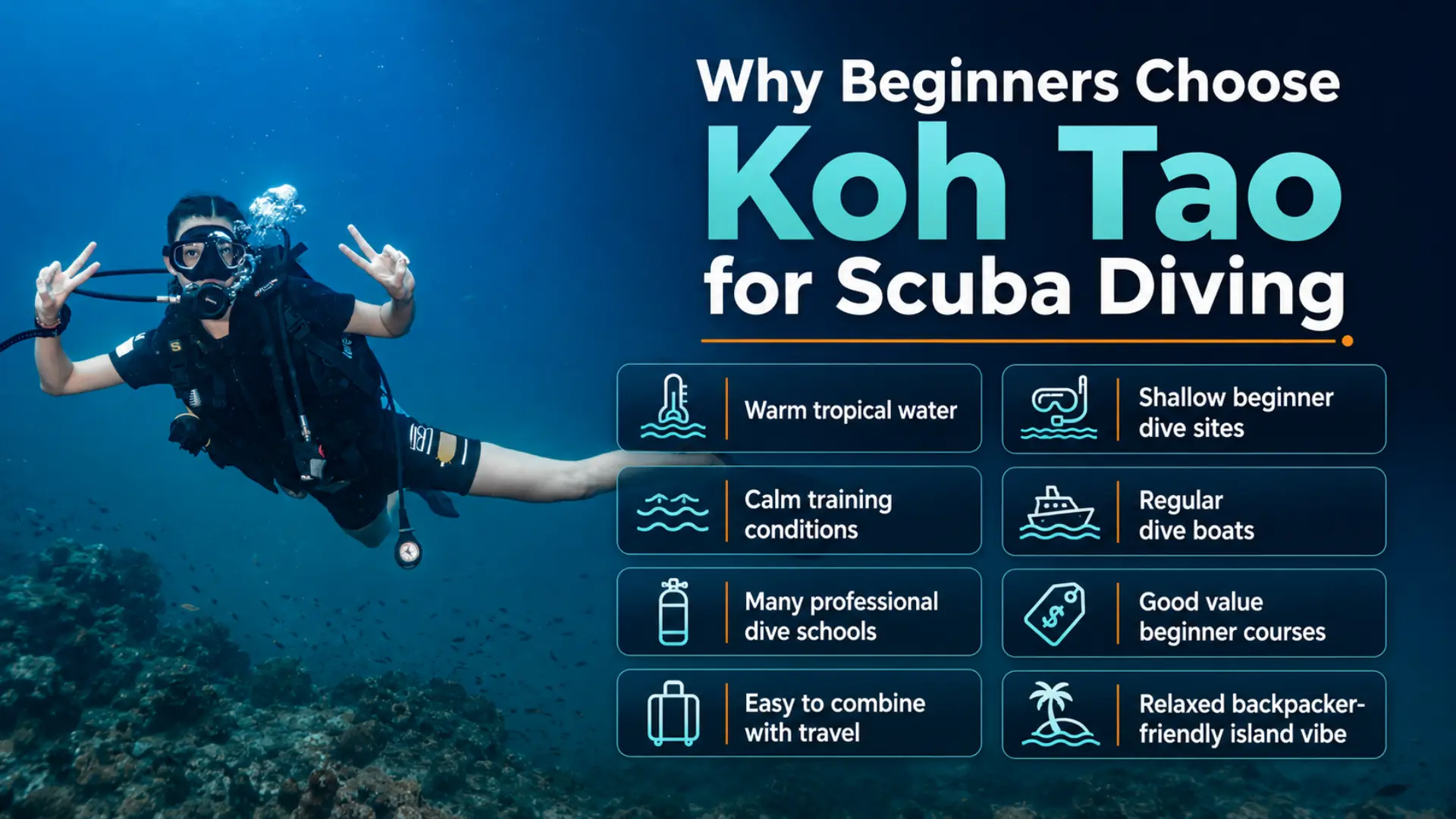
Koh Tao has earned a reputation as one of the best places in the world for beginner divers.
The island offers warm tropical water year-round, accessible dive sites, a large selection of professional dive schools, and beginner-friendly conditions that make learning less intimidating than in many other destinations.
For beginners, the main advantages are:
Why Beginners Like Koh Tao | Why It Helps |
Warm water | Easier to relax and focus on learning |
Shallow dive sites | Good for first dives and beginner skills |
Regular dive boats | Flexible course and Try Dive schedules |
Many dive schools | More choice for training style and language |
Popular backpacker destination | Easy to combine diving with travel |
Calm beginner sites | Helps nervous divers build confidence |
Good value courses | Helpful for travellers on a budget |
Also, Koh Tao works well for beginners because you can usually choose between:
Beginner Option | Best For | Typical Time Needed | Certification? |
Bautizo | First-time divers who want to explore the underwater world with an instructor | 1 day | No |
Curso Open Water | Beginners who want to become certified divers | Around 3 days | Yes |
Refresh Dive | Certified divers who have not dived recently | Half day or 1 day | No new certification, your existing certification(s), if any, will work. |
Fun Dives | Already-certified divers | Half day or full day | Already certified required |
If you have never dived before and only have one day, a Try Dive is usually the best starting point. If you want to learn properly and continue diving around the world, the Open Water Course is the better choice.
What Does Your First Scuba Dive Actually Feel Like?
Most beginners are surprised by how comfortable scuba diving feels once they’re underwater. Before the dive, your instructor will guide you through the equipment, safety procedures, and basic skills needed for the experience.
A typical first dive includes:
- A medical questionnaire and check-in
- A beginner-friendly dive briefing
- Scuba equipment fitting and setup
- Basic skill practice in shallow water
- A slow, guided descent with your instructor
- Exploring the reef under close supervision
What most beginners notice:
- Breathing underwater feels more natural than expected
- The first few minutes are spent getting comfortable with the regulator
- Confidence builds quickly once you settle into a steady breathing rhythm
- The focus soon shifts from the equipment to the marine life and underwater scenery
Try Dive vs Open Water Course in Koh Tao: Which One Should You Choose?
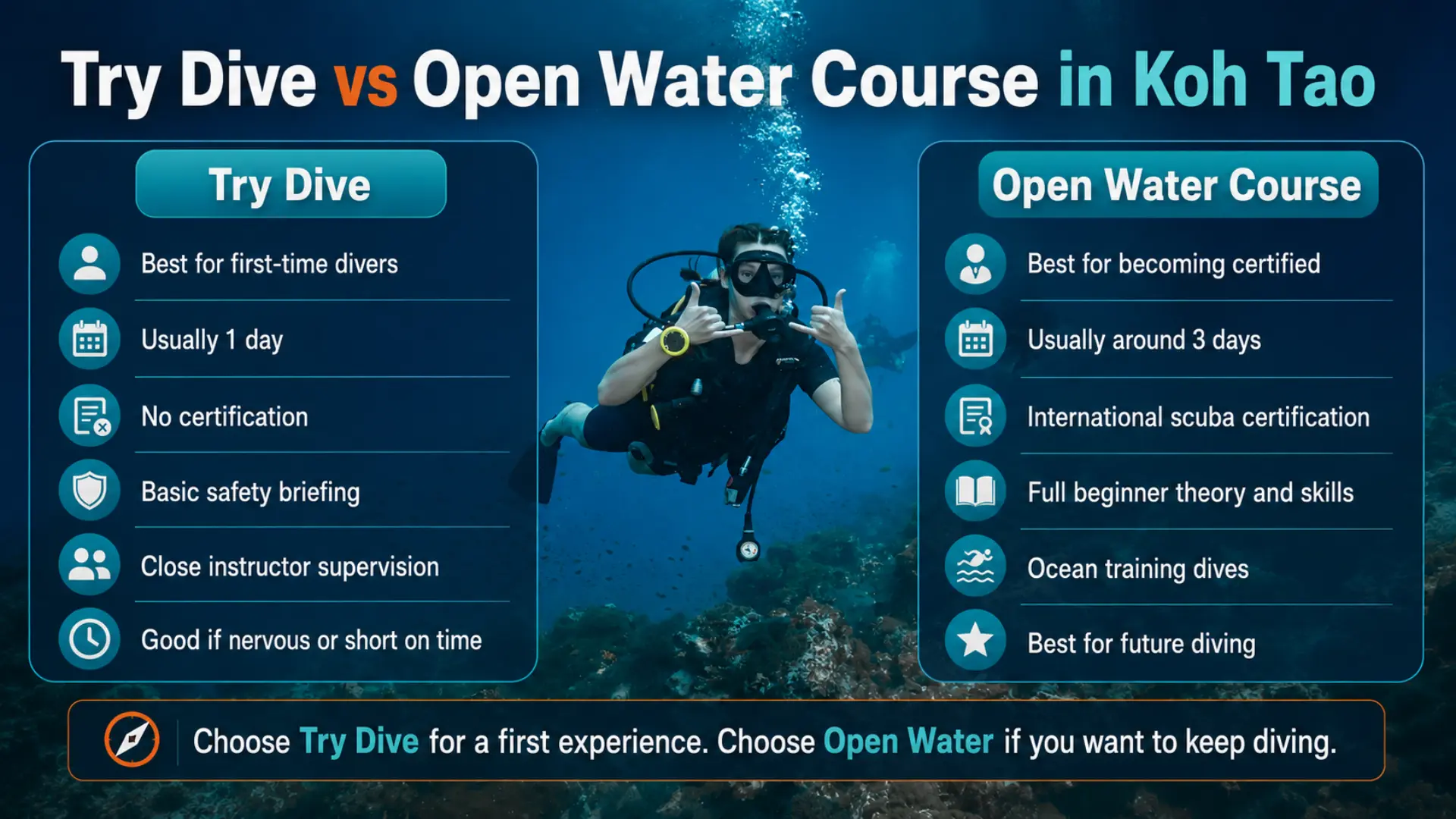
One of the biggest beginner questions is whether to book a Try Dive or an Open Water Course. Both are beginner-friendly, but they serve different purposes.
Try Dive: Best for One-Day First-Time Divers
A Try Dive is a one-day introductory scuba experience for people who want to try breathing underwater without committing to a full course. It is ideal if you are curious, nervous, short on time, or unsure whether scuba diving is for you.
You do not become certified after a Try Dive. You dive under close instructor supervision and stay within beginner limits.
Choose a Try Dive if:
- You have never dived before
- You only have one day in Koh Tao
- You want to see how scuba feels before booking a course
- You feel nervous and want a gentle introduction
- You are travelling with friends and want a shared experience
- You do not want exams, homework, or a multi-day schedule
Open Water Course: Best for Becoming a Certified Diver
The Open Water Course is the entry-level scuba certification. After completing it, you can dive with a buddy within your certification limits anywhere in the world, as long as conditions are similar to your training and you stay within safe recreational-diving practices.
Choose an Open Water Course if:
- You want to become a certified diver
- You have around 3 days in Koh Tao
- You want proper skills, theory, and ocean training
- You plan to dive again in Thailand or abroad
- You want to understand safety, buoyancy, dive planning, and equipment
- You want more than just a one-time experience
Try Dive vs Open Water Course: Quick Comparison
Question | Bautizo | Curso Open Water |
Is it for complete beginners? | Yes | Yes |
Do I need previous experience? | No | No |
How long does it take? | Usually 1 day | Usually around 3 days |
Do I get certified? | No | Yes |
Is there a theory? | Basic safety briefing | Full beginner theory |
Are there skills? | Basic beginner skills | Full required training skills |
How deep can I go? | Usually up to beginner Try Dive limits | Depends on agency and course standards |
Best for nervous beginners? | Yes, especially if unsure | Yes, if you want full training |
Best for future diving? | Good first step | Best long-term choice |
How Does a First Scuba Dive in Koh Tao Work?
A good first dive is not just “jump in and hope for the best.” It should follow a clear, calm process that helps beginners understand what is happening before they enter the water.
1. Booking and Medical Form
Before diving, you normally complete a medical questionnaire. This is not meant to scare you. It helps the dive school understand whether you are fit to dive or whether you need medical clearance before entering the water.
Be honest when completing the form. Diving is safe for many people, but certain medical conditions, medications, surgeries, respiratory issues, heart conditions, or pregnancy can affect whether scuba is appropriate.
2. Beginner Theory Briefing
Before your first dive, your instructor should explain the basics clearly. This usually includes:
- How scuba equipment works
- How to breathe underwater
- How to equalize your ears
- How to clear your mask
- What hand signals mean
- What to do if you feel uncomfortable
- How to stay close to your instructor
- How to protect coral and marine life
This briefing is important because beginners feel calmer when they know what to expect.
3. Equipment Fitting
Your dive team will help you with your wetsuit, mask, fins, buoyancy control device, tank, weights, and regulator. You do not need to understand every technical detail immediately, but you should know the basics of what each piece does.
The most important beginner equipment points are:
Equipment | What It Does |
Mask | Helps you see underwater |
Fins | Help you move efficiently |
Regulator | Lets you breathe from the tank |
BCD | Helps control buoyancy |
Tank | Holds compressed breathing gas |
Weights | Help you descend safely |
Wetsuit | Keeps you comfortable and protected |
4. Safety Check
Before entering the water, your instructor or dive team should help with an equipment and buddy check. This helps confirm that your air is on, your equipment is secure, your weights are correct, and your releases and gauges are working.
For beginners, this step builds trust because you know someone has checked the important details before the dive begins.
5. Shallow-Water Practice
Many beginner dives start with simple practice in shallow water or a controlled area. This gives you time to get used to breathing through the regulator, putting your face underwater, clearing your mask, and using hand signals.
This is often the moment when nervous beginners realise, “Okay, I can do this.”
6. The Guided Dive
Once you are comfortable, your instructor guides you slowly underwater. You do not need to swim quickly or chase marine life. Most beginner dives are calm, slow, and closely supervised.
You will focus on:
- Breathing slowly
- Equalising your ears
- Staying near your instructor
- Watching your depth
- Moving gently
- Looking without touching
7. After the Dive
After the dive, you return to the boat or dive centre, remove your equipment, drink water, and talk about what you saw. If you enjoyed the experience, you may be able to do a second dive or continue toward a full Open Water Course.
Do You Need to Know Swimming for Scuba Diving?
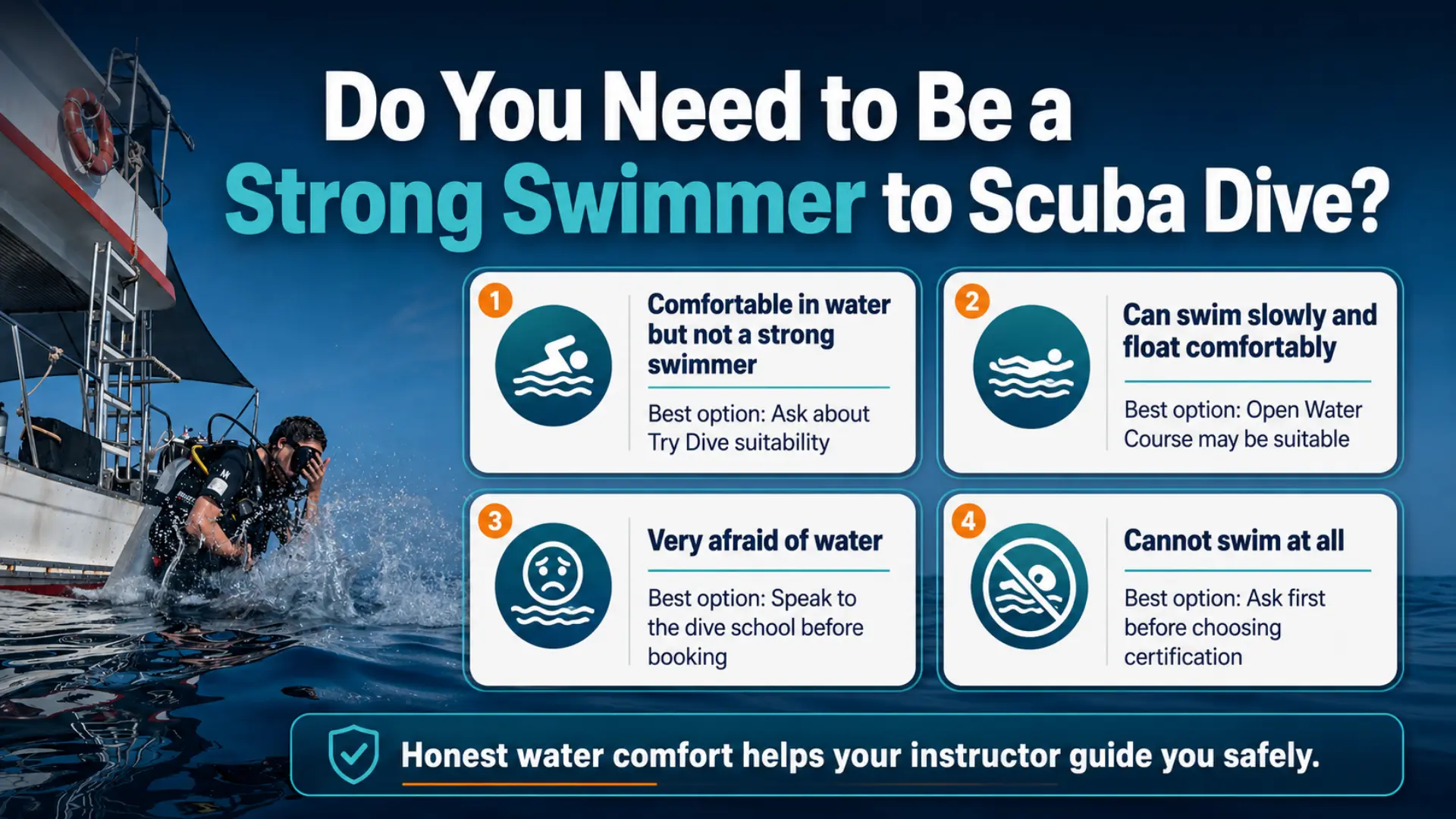
You do not need to be an athlete or a perfect swimmer to try scuba diving, but you should be reasonably comfortable in the water.
For a Try Dive, requirements are usually lighter because you are closely supervised by an instructor and not earning an independent certification. For an Open Water Course, you normally need to demonstrate basic water comfort, such as swimming a set distance and floating or treading water.
A simple way to think about it:
Your Water Comfort | Best Beginner Option |
Comfortable putting your face in water, but not a strong swimmer | Ask about Try Dive suitability |
Can swim slowly and float comfortably | Open Water may be suitable |
Very afraid of water | Speak to the dive school before booking |
Cannot swim at all | Ask first; a full certification may not be suitable yet |
Being honest about your swimming ability helps the dive school guide you properly.
Basic Safety Rules Beginners Should Know
Safety Rule | Why It Matters |
Never hold your breath | Continuous breathing is one of the most important scuba rules |
Equalise early and often | Helps prevent ear discomfort |
Stay close to your instructor or buddy | Makes communication and support easier |
Ascend slowly | Helps keep the dive safe and controlled |
Do not touch coral or marine life | Protects you and the reef |
Tell your instructor if you feel nervous | Problems are easier to solve early |
Listen carefully during briefings | Most beginner stress comes from not knowing what to expect |
A good instructor will not expect you to be confident immediately. Their job is to help you build comfort step by step.
What If You Feel Nervous or Panic During Scuba Diving?
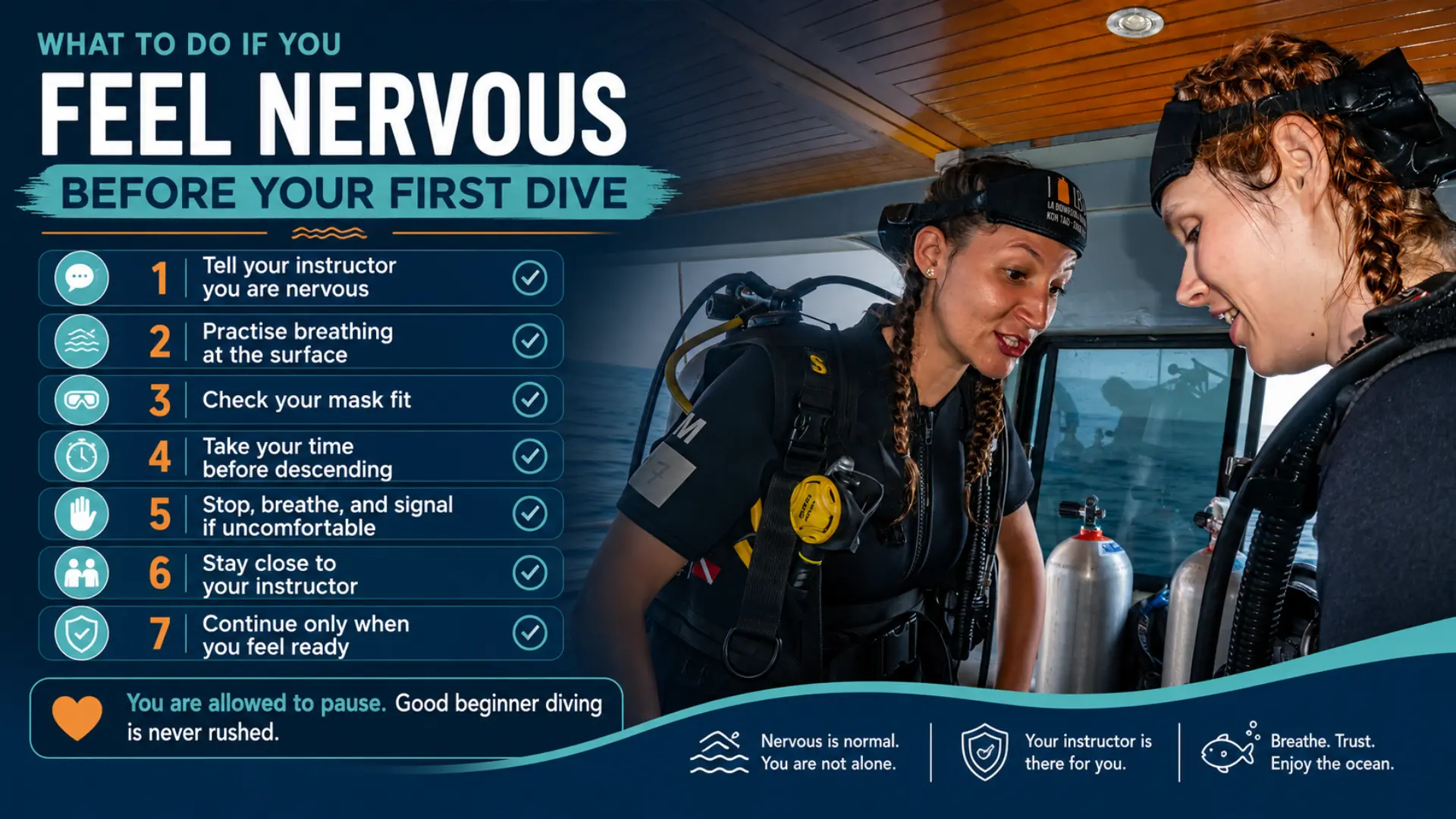
Feeling nervous before your first scuba dive is very common. Many beginners worry about breathing underwater, going too deep, clearing the mask, or feeling trapped. This does not mean you cannot dive. It means you need calm instruction, clear explanations, and time to adjust.
What to Do If You Feel Nervous Before the Dive
Before entering the water:
- Tell your instructor you are nervous
- Ask them to explain the first few minutes clearly
- Check that your mask fits comfortably
- Practise breathing through the regulator at the surface
- Take your time before descending
- Do not compare yourself with other divers
What Happens If You Panic Underwater?
If you feel panic underwater, the most important thing is to stop, breathe, and signal your instructor. You do not need to solve everything alone. Instructors are trained to calm beginners, make eye contact, help control buoyancy, and guide you safely.
A simple beginner panic plan:
- Stop moving.
- Hold your position or your instructor’s hand if offered.
- Breathe slowly through the regulator.
- Signal “not okay.”
- Let your instructor help you.
- Continue only if you feel comfortable.
You are allowed to pause. You are allowed to feel nervous. You are allowed to end the dive if you are not comfortable. Good beginner diving is not about pressure; it is about confidence. For more information, check the detailed guide on – Koh Tao Diving Anxiety Management: First Dive Techniques & Tips
Beginner Checklist Before Booking Scuba Diving in Koh Tao
Use this checklist before booking your first dive or Open Water Course:
Question to Ask | Why It Matters |
Is the experience suitable for complete beginners? | Confirms the dive is beginner-friendly |
What is included in the price? | Avoids surprise fees |
Will I complete a medical form? | Shows that safety procedures are taken seriously |
How many students are with each instructor? | Smaller groups can mean more support |
How much shallow-water practice is included? | Helps nervous beginners build comfort |
What happens if I feel anxious? | Shows whether the school supports nervous divers |
Is equipment rental included? | Important for budgeting |
What language will the instructor speak? | Clear communication matters underwater |
How long does the day or course take? | Helps you plan travel days |
Which dive sites are used for beginners? | Conditions should match your level |
Can I upgrade from Try Dive to a course? | Helpful if you enjoy the first dive |
What is the cancellation or weather policy? | Important for travel planning |
How Much Does Beginner Scuba Diving Cost in Koh Tao?
Prices vary by dive school, certification agency, inclusions, and season. As a general guide, beginner scuba diving in Koh Tao often falls into these ranges:
Diving Option | Typical Koh Tao Price Range | Notes |
Around ฿2,500–฿3,500 | Usually, one beginner experience, no certification | |
Around ฿11,000–฿13,500 | Usually includes training, equipment, and certification materials | |
Varies by school, but usually around ฿2,500–฿3,500 | For already-certified divers who need practice | |
Around ฿2,000–฿3,500 | For certified divers only |
When comparing dive schools, look beyond the headline price. At LA Bombona Diving, beginner courses are structured to include the training, equipment, and support needed for a safe and enjoyable first diving experience.
What Should Be Included in a Beginner Course Price?
Before booking, ask whether the price includes:
- Equipment rental
- Instructor fees
- Theory materials or e-learning
- Confined-water or shallow-water training
- Ocean dives
- Certification fees
- Buceo desde barco
- Insurance, if offered
- Refreshments on the boat
- Photos or videos, if available
- Transport, if applicable
For beginner divers, value is not only about price. It is about safety, comfort, instructor attention, and honest guidance.
Common Beginner Scuba Diving Mistakes to Avoid
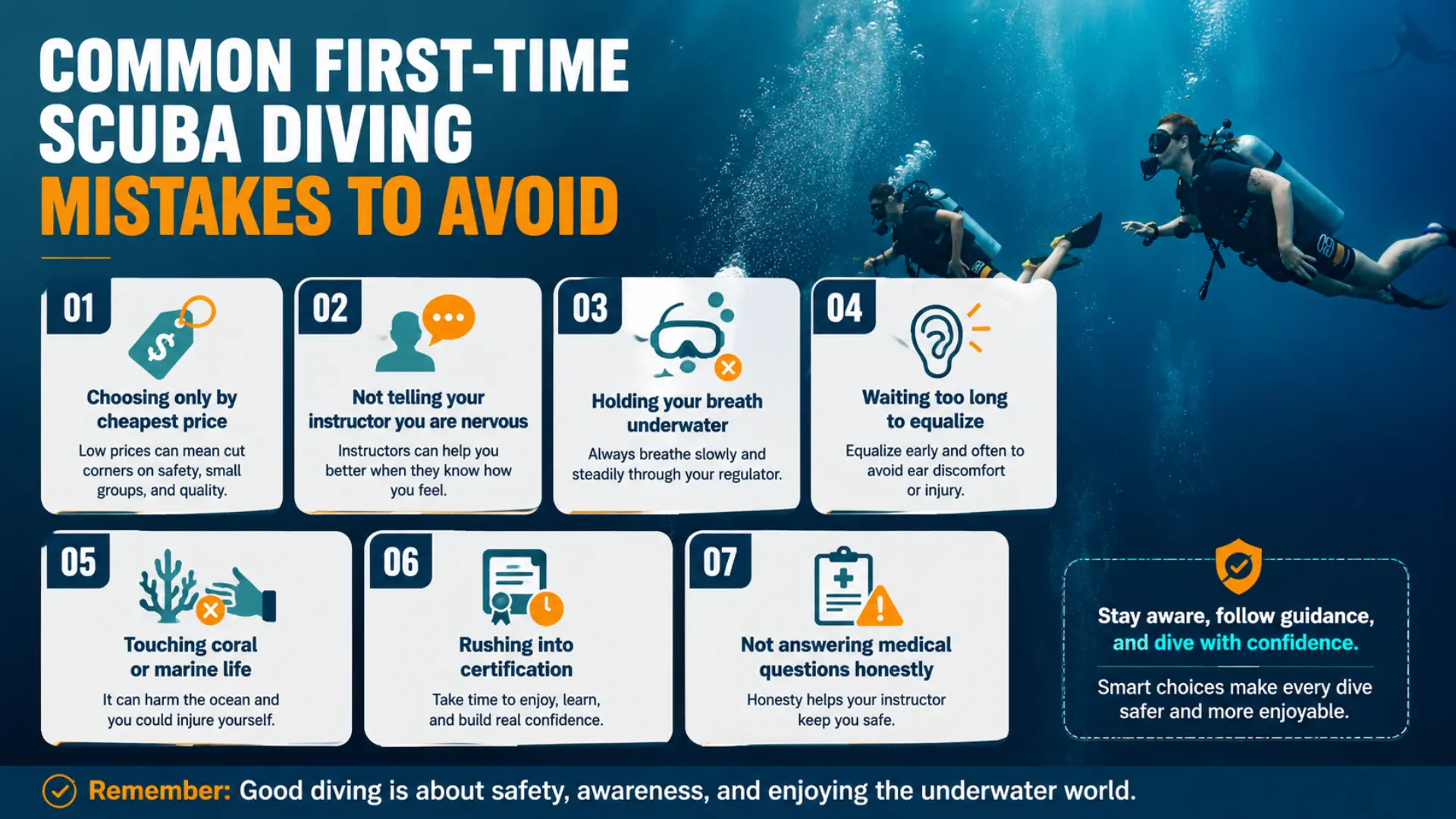
Most first-time divers have similar concerns and make similar mistakes. The good news is that they’re easy to avoid with the right preparation and guidance.
1. Choosing a Dive School Based Only on Price
It’s tempting to book the cheapest option, but scuba diving is not something where price should be the only factor. Consider instructor experience, safety standards, group sizes, and what is included in the package. A slightly higher price often provides a better overall experience.
2. Not Telling Your Instructor You’re Nervous
Many beginners feel anxious before their first dive, especially about breathing underwater or descending below the surface. Letting your instructor know how you feel allows them to adapt the pace, provide extra reassurance, and help you feel more comfortable throughout the experience.
3. Holding Your Breath Underwater
One of the most important rules in scuba diving is to breathe continuously. New divers sometimes instinctively hold their breath when concentrating or feeling uncertain. Focus on slow, relaxed breathing and follow your instructor’s guidance at all times.
4. Waiting Too Long to Equalise
Pressure changes are a normal part of diving. Equalising your ears early and often during descent is much easier than trying to fix discomfort once it starts. If you experience pain or difficulty equalising, stop and communicate with your instructor immediately.
5. Touching Coral or Marine Life
Coral reefs are living ecosystems that can be easily damaged by contact. Some marine animals may also sting, bite, or become stressed when disturbed. The best approach is to observe marine life from a respectful distance and avoid touching anything underwater.
6. Rushing Into a Certification Course
If you’re short on time or unsure whether diving is right for you, a Try Dive can be a better starting point than immediately enrolling in a full certification course. Taking the option that matches your goals often leads to a more enjoyable experience.
7. Not Answering Medical Questions Honestly
Medical questionnaires are an important part of dive safety. Certain health conditions may require additional medical clearance before diving. Providing accurate information helps ensure that diving is safe and appropriate for you.
How to Choose a Dive School in Koh Tao as a Beginner
Choosing a dive school is one of the most important decisions you will make. For beginners, the best dive school is not always the biggest, cheapest, or most famous. It is the one that helps you feel safe, informed, and supported.
Look for:
- Clear beginner explanations
- Transparent pricing
- Small or manageable groups
- Patient instructors
- Proper medical screening
- Equipment checks
- Good reviews from beginner divers
- A relaxed course schedule
- Honest advice between Try Dive and Open Water
- Clear cancellation and weather policies
- Support for nervous first-time divers
- Respect for marine life and reef protection
Red Flags Before Booking
Be careful if a dive school:
- Pushes you to book without answering questions
- Avoids explaining safety procedures
- Does not mention medical forms
- Is unclear about what the price includes
- Uses very large groups without enough staff
- Rushes nervous beginners
- Promises guaranteed marine life sightings
- Makes you feel embarrassed for asking basic questions
- Cannot explain what happens if you feel uncomfortable underwater
A good dive school will welcome beginner questions. You should never feel silly for asking how the day works, how deep you will go, or what happens if you panic. For more information, you can check the detailed guide on – How to Choose the Best Dive School in Koh Tao
Ready to Take Your First Dive in Koh Tao?
Scuba diving may seem intimidating at first, but for most beginners, the experience is far more comfortable and enjoyable than expected. With the right instruction, proper safety procedures, and realistic expectations, your first dive can be both safe and memorable.
Whether you choose a Try Dive to experience breathing underwater for the first time or an Open Water Course to become a certified diver, Koh Tao offers an excellent environment to begin your diving journey.
En LA Bombona Diving, we specialise in helping first-time divers feel comfortable, confident, and excited about exploring the underwater world. Our experienced instructors provide personalised guidance, patient support, and a relaxed learning environment designed specifically for beginners.
If you’re ready to discover what scuba diving is really like, get in touch with our team today. We’ll help you choose the right option for your experience level, answer your questions, and make your first diving experience in Koh Tao one to remember.
Frequently Asked Questions (FAQs)
 ES
ES  EN
EN