Koh Tao Scuba Certification Guide: PADI vs RAID vs SSI (2026)
Por Bryan Roseman
20 July 2026
Table of Contents
Key Takeaways –
PADI, RAID and SSI are all recognised scuba certification agencies that provide structured training pathways from beginner courses to advanced recreational, professional and technical diving. No single agency is automatically the best choice for every diver.
The quality of your scuba course depends more on the instructor, dive centre, group size, training time, safety practices and skill development approach than the certification logo on your card.
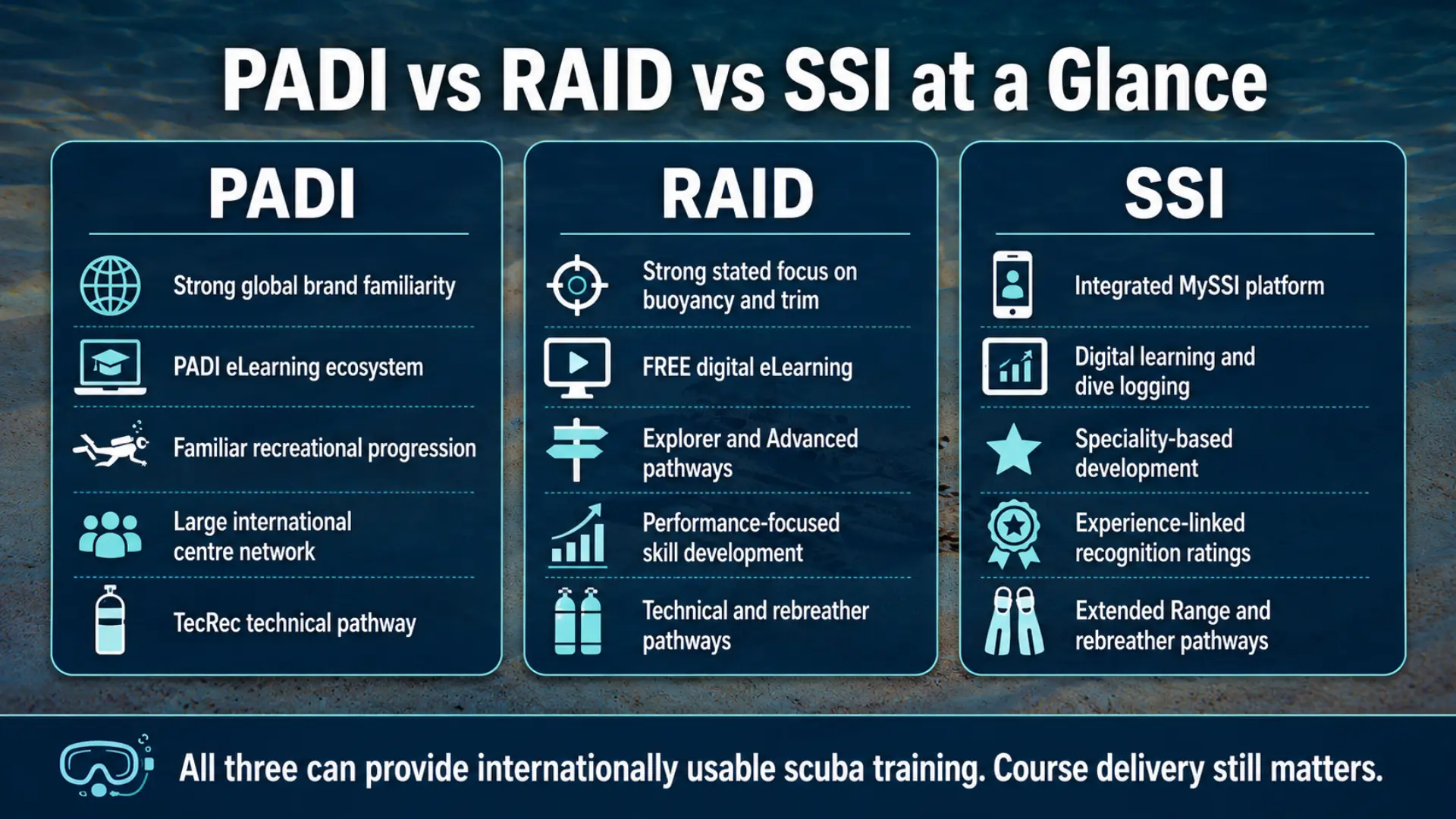
PADI offers strong global brand recognition and a large international network; RAID emphasises buoyancy, trim and performance-based skill development, while SSI focuses on digital learning, dive logging and experience-linked progression.
A scuba certification is not just about completing online theory or attending scheduled dives. Proper training should include equipment knowledge, confined-water practice, buoyancy development, emergency skills, open-water experience and confidence-building before certification.
Recreational certifications from PADI, RAID and SSI are generally transferable, allowing divers to continue training or join suitable fun dives with centres affiliated with different agencies, provided they meet experience and course requirements.
Choosing a scuba certification in Koh Tao often begins with three names: PADI, RAID and SSI. All three provide structured scuba education, digital learning, practical water training, continuing-education courses and professional pathways. However, they organise their programs differently, use different course names and may place emphasis on different parts of a diver’s development.
For most beginners, there is no single certification agency that is automatically best. A well-taught PADI, RAID or SSI course can provide a strong foundation for recreational diving. The more useful question is whether the course gives you sufficient theory, supervised water practice, equipment familiarity, buoyancy development, safety awareness and individual support.
The certification agency matters, but so do the instructor, dive centre, group size, schedule, equipment, training environment and time available for skill development.
This guide compares PADI, RAID and SSI across the full scuba-training pathway, from Open Water and advanced courses to rescue, specialities, Divemaster, instructor and technical training, so you can choose the option that suits your goals in Koh Tao and beyond.
What Is a Scuba Certification Agency?
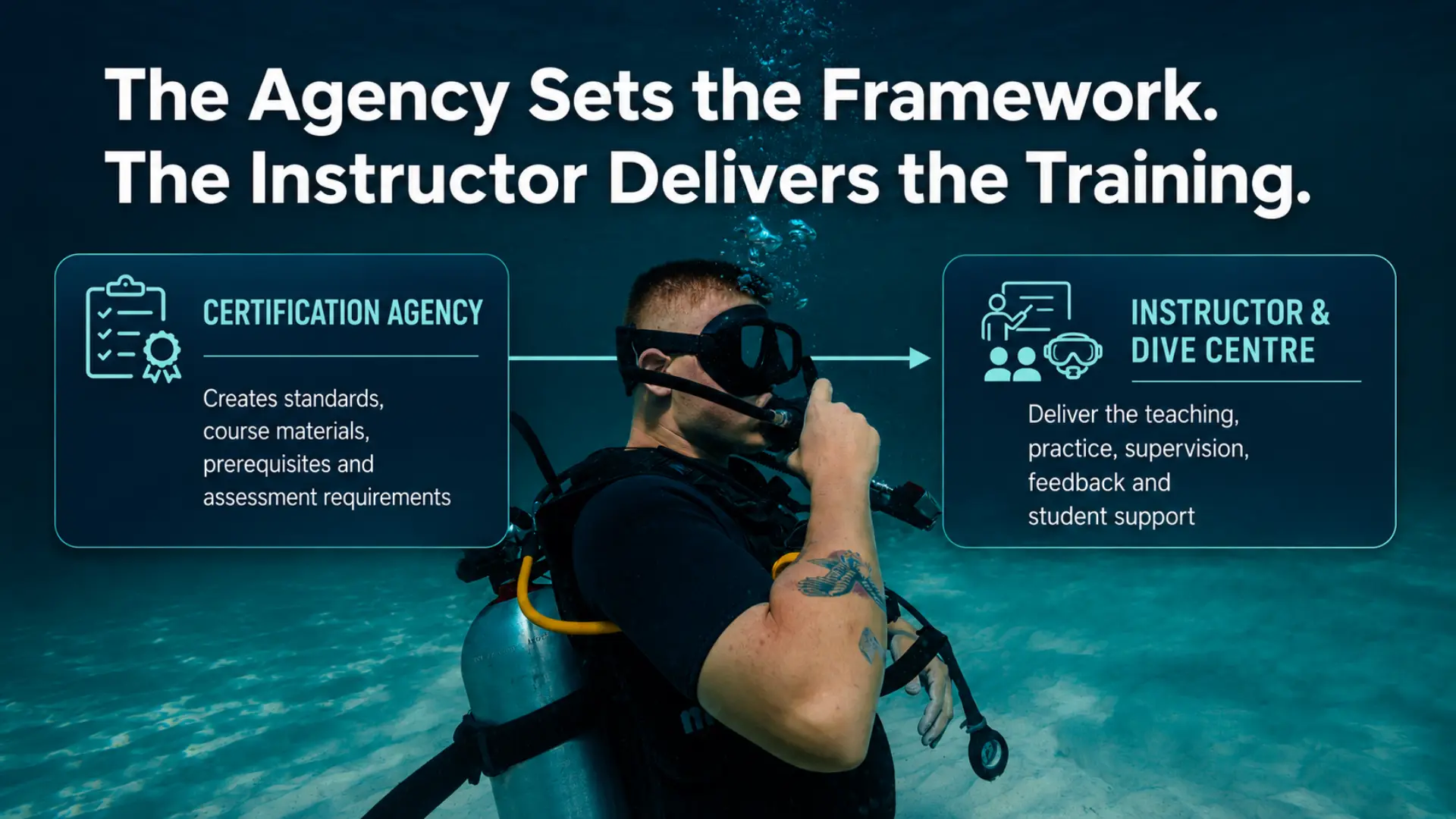
A scuba certification agency is an organisation that develops diver-training programs and authorises qualified professionals to deliver them.
The agency typically determines:
The knowledge students must understand
The skills students must demonstrate
Course prerequisites
Instructor qualification requirements
Training materials
Assessment procedures
Certification records
Continuing-education routes
Professional and technical pathways
IMPORTANT NOTE
The agency does not personally teach every student. Your training is delivered by an authorised instructor working independently or through an affiliated dive centre.
This distinction is important because two schools teaching through the same agency can provide noticeably different experiences. They may use different schedules, group sizes, equipment, training locations and teaching approaches while still working within the same agency framework.
PADI, RAID and SSI are represented within the Recreational Scuba Training Council system. The WRSTC develops minimum training standards for recreational diving, while each member agency builds its own courses, materials and procedures around applicable standards.
PADI vs RAID vs SSI: Quick Comparison
Comparison area
PADI
RAID
SSI
Entry-level certification
Buceador de aguas abiertas
Open Water
Buceador de aguas abiertas
Main advanced route
Advanced Open Water Diver and specialities
Explorer, Advanced and specialty programs
Advanced Open Water Diver, specialities, and experience-based recognition ratings
Rescue-level training
Rescue Diver
Master Rescue
Diver Stress & Rescue
Recreational achievement level
Master Scuba Diver rating
Master Diver
Master Diver recognition
First major professional level
Divemaster
Divemaster
Dive Guide or Divemaster pathway
Instructor pathway
Assistant Instructor and Open Water Scuba Instructor
Open Circuit Instructor and further instructor ratings
Assistant Instructor, Instructor Training Course and Open Water Instructor
Technical pathway
TecRec and related technical programs
Open-circuit, closed-circuit and rebreather programs
Extended Range and rebreather programs
Digital learning
PADI eLearning and PADI App
Free RAID eLearning Platform and Digital Student Account
MySSI app and digital learning platform
Digital certification
Available through the PADI ecosystem
Electronic certification issued through RAID
Digital certification stored in MySSI
Distinctive structural feature
Large global training and dive-centre network
Strong stated emphasis on buoyancy, trim and performance skills
Integrated app, digital logbook and recognition ratings linked to training and logged experience
Best considered by
Travellers who value widespread brand familiarity
Divers attracted to a performance- and buoyancy-focused training philosophy
Divers who value app-based learning, logging and an experience-linked progression system
What Is PADI?
PADI stands for the Professional Association of Diving Instructors. It is one of the most widely recognised consumer brands in recreational scuba diving and offers training for beginners, continuing recreational divers, dive professionals and technical divers. PADI states that it has certified more than 30 million divers through its worldwide network.
PADI Open Water Diver
The PADI Open Water Diver course is its principal entry-level scuba certification. It combines:
Independent knowledge development or eLearning
Instructor-led theory review
Confined-water training
Open-water training dives
Knowledge assessment
Practical skill assessment
PADI describes Open Water, Advanced Open Water and Rescue Diver as its three core recreational courses.
PADI Advanced Open Water Diver
The PADI Advanced Open Water Diver course is designed to develop experience rather than certify only highly experienced divers.
It normally includes:
A navigation-focused dive
A deep adventure dive
Additional adventure dives selected from available options
The optional dives can introduce activities such as wreck diving, underwater photography, fish identification or other speciality areas. The course is therefore often used as a practical introduction to several types of diving rather than as complete speciality training in each subject.
PADI Rescue Diver
PADI Rescue Diver moves the focus beyond personal skills and towards:
Recognising diver stress
Preventing problems
Assisting tired or distressed divers
Responding to simulated emergencies
Improving situational awareness
Becoming a more capable dive buddy
Rescue-level training usually requires suitable first-aid and CPR preparation, either before or alongside the scuba course.
PADI Speciality Courses
PADI offers speciality programs covering areas such as:
Enriched air nitrox
Peak performance buoyancy
Buceo en pecios
Night diving
Navigation
Deep diving
Drift diving
Underwater photography
Search and recovery
Equipment
Conservation
A speciality course normally provides more focused training than a single adventure dive completed during Advanced Open Water.
PADI Master Scuba Diver
PADI Master Scuba Diver is a recreational achievement rating rather than a professional qualification.
It combines:
Core recreational certifications
Multiple speciality certifications
Logged diving experience
PADI requires Open Water Diver, Advanced Open Water Diver, Rescue Diver, five speciality certifications and at least 50 logged dives for this rating.
It should not be confused with PADI Divemaster. Master Scuba Diver is a recreational recognition, while Divemaster is the first major professional training level.
PADI Professional Training
The PADI professional pathway begins with Divemaster and can progress through instructor and senior instructor-development levels.
The broad pathway includes:
Divemaster
Assistant Instructor
Open Water Scuba Instructor
Speciality Instructor ratings
Master Scuba Diver Trainer
IDC Staff Instructor
Master Instructor
Course Director
PADI describes Divemaster as the first professional step, followed by instructor-level education for those who want to teach and certify divers.
Who May Prefer PADI?
PADI may suit divers who:
Place high value on consumer brand familiarity
Expect to travel frequently
Want access to a large network of PADI-affiliated centres
Prefer a widely understood course-naming system
Want a clear recreational-to-professional progression route
Already use the PADI App or eLearning ecosystem
Its global visibility is an advantage for travellers who feel more comfortable choosing a brand they have already encountered. However, brand familiarity should not be mistaken for proof that every PADI course or instructor provides the same experience.
What Is RAID?
RAID operates as Dive RAID International and offers recreational, professional, technical, open-circuit, rebreather and freediving training.
Its programs extend from introductory experiences and Open Water certification through advanced recreational courses, rescue training, Divemaster, instructor ratings and technical programs.
RAID Open Water
RAID Open Water provides the foundational knowledge and practical skills required for recreational diving with a qualified buddy.
The program includes academic learning, confined-water development, open-water training and instructor assessment.
RAID publicly places particular emphasis on:
Neutral buoyancy
Horizontal trim
Gas awareness
Equipment control
Skill performance while maintaining position in the water
RAID states that students are expected to demonstrate Open Water skills while neutrally buoyant rather than relying on the bottom as a platform. This includes skills such as mask removal, regulator recovery and gas sharing.
This does not mean that buoyancy is absent from other agency courses. Buoyancy control is fundamental across recreational scuba education. RAID’s distinction is the way it publicly positions buoyancy, trim and in-water performance within its teaching philosophy.
RAID Explorer and Advanced Training
After Open Water, RAID divers can progress through programs such as Explorer 30, Advanced 35 and individual speciality courses.
Advanced 35 is intended for certified divers who want to develop their abilities through areas such as:
Navigation
Buoyancy control
Advanced dive planning
More demanding environments
Specialised diving activities
RAID describes Advanced 35 as a program that combines advanced techniques with exposure to different speciality areas.
The correct next course depends on the diver’s existing certification, logged experience and training goals. Divers should therefore compare actual prerequisites and course outcomes rather than assuming that every agency’s “advanced” program is directly identical.
RAID Master Rescue
RAID’s rescue-level training is called Master Rescue.
It is designed to develop:
Stress recognition
Accident prevention
Self-rescue awareness
Rescue responses
Emergency planning
Management of realistic diving incidents
This level is relevant both to recreational divers who want stronger emergency skills and to those preparing for professional training.
RAID Speciality and Master Diver Pathways
RAID offers speciality programs in areas such as:
Nitrox
Navigation
Night diving
Buceo en pecios
Performance and buoyancy
Sidemount
Deep diving
Dry-suit diving
Search and recovery
Independent diving
Technical diving
Its Master Diver rating combines advanced training, rescue preparation, relevant specialities and substantial logged underwater experience. RAID’s published pathway requires several named qualifications and experience requirements rather than completion of one short standalone course.
RAID Professional Training
RAID Divemaster develops qualified divers into dive leaders who may guide certified divers and assist instructors within the limits of their professional rating.
RAID’s Divemaster prerequisites accept specific RAID qualifications or equivalent certifications from a recognised training agency. This is a useful example of how cross-agency progression works in practice: a diver does not necessarily need to repeat every previous recreational course under RAID before entering an eligible RAID professional program.
The RAID leadership pathway includes:
Divemaster
Try Dive Instructor
Open Circuit Instructor
Instructor crossover routes
Speciality Instructor
Divemaster Instructor
Master Instructor
Instructor Trainer-level ratings
RAID Technical and Rebreather Training
RAID has a substantial technical-training background and offers both open-circuit and closed-circuit pathways.
These can include training related to:
Multiple-cylinder configurations
Sidemount and twinset diving
Decompression procedures
Advanced gas planning
Trimix
Rebreathers
Wreck penetration
Cavern and cave environments
Technical diving involves greater complexity and risk than standard recreational scuba. Agency choice at this level should be considered alongside instructor experience, equipment configuration, team procedures, local conditions and the exact technical discipline being studied.
RAID Digital Learning
RAID uses its FREE e-Learning system for course materials, quizzes and academic preparation. RAID states that registered users can access learning materials digitally, complete knowledge work and receive an electronic certification after completing all required training and assessments.
Who May Prefer RAID?
RAID may suit divers who:
Want buoyancy and trim emphasised from the beginning
Prefer skills to be performed while maintaining position in the water
Are interested in gas awareness and performance-based development
May eventually consider technical or rebreather training
Prefer digital course materials
Want a clear link between foundational recreational skills and more advanced equipment configurations
The quality of these outcomes still depends on how thoroughly the individual instructor applies the standards.
What Is SSI?
SSI stands for Scuba Schools International. It offers recreational scuba, freediving, extended-range, rebreather, professional, swimming and other aquatic education programs.
SSI uses the MySSI platform to combine:
Digital learning
Certification cards
Dive logging
Training records
Dive-centre information
Continuing-education access
SSI describes MySSI as an all-in-one digital platform for learning materials, certification cards and logbook functions.
SSI Open Water Diver
SSI Open Water Diver is its principal entry-level recreational scuba certification.
The course combines:
Digital or instructor-supported theory
Confined-water training
Open-water dives
Equipment knowledge
Dive-planning fundamentals
Safety procedures
Practical skill evaluation
SSI’s entry-level programs require a water-fitness evaluation before open-water training. SSI describes the assessment as establishing a baseline for swimming ability and comfort in the water.
SSI Advanced Open Water Diver
SSI’s current Advanced Open Water Diver program introduces five speciality areas through one training dive in each.
Deep Diving and Navigation are included, together with three additional speciality areas selected according to availability and interest. The training dives may later be credited towards completion of the corresponding full speciality programs.
This makes it important to distinguish between:
An SSI Advanced Open Water Diver training program
A complete SSI speciality certification
SSI experience-based recognition ratings
These are related but not identical achievements.
SSI Speciality and Recognition System
SSI combines training programs with recognition ratings linked to both education and logged diving experience.
Its published recognition structure includes:
Specialty Diver
Advanced Speciality Diver
Master Diver
Experience-based digital recognition cards for higher logged-dive milestones
For example, SSI’s Master Diver recognition combines several advanced training elements: Diver Stress & Rescue, Deep Diving and substantial logged experience.
This differs from systems where an advanced card may be earned primarily through one defined course. When comparing SSI with PADI or RAID, ask whether you are looking at a training certification, a speciality certification or an experience-based recognition rating.
SSI Diver Stress & Rescue
SSI’s rescue-level program is called Diver Stress & Rescue.
It teaches divers to:
Recognise stress
Prevent incidents
Respond to distressed divers
Conduct rescue techniques
Improve emergency awareness
Practise rescue scenarios in confined and open water
SSI states that the course combines academic learning with pool and open-water practice.
SSI Professional Training
SSI’s professional pathway includes Dive Guide, Divemaster, Assistant Instructor and Open Water Instructor-level training.
The pathway can include:
Dive Guide
Science of Diving
Divemaster
Assistant Instructor
Curso de formación de instructores
Instructor Evaluation
Open Water Instructor
Speciality and senior instructor ratings
SSI describes its Instructor Training Course and Instructor Evaluation as the route towards qualifying as an Open Water Instructor.
SSI Extended Range and Rebreather Training
SSI’s Extended Range system provides training beyond normal recreational limits and includes pathways involving:
Advanced equipment configurations
Decompression procedures
Technical open-circuit diving
Overhead environments
Wreck and cave training
Rebreathers
SSI also offers standalone rebreather education through its extended training system.
Who May Prefer SSI?
SSI may suit divers who:
Want an integrated app for learning, certification and dive logging
Prefer continuing education linked to logged experience
Like a speciality-based development route
Want training dives to contribute towards future speciality completion
Expect to use SSI-affiliated training centres
Are interested in Extended Range or rebreather training later
As with PADI and RAID, the individual instructor and centre remain central to the quality of the course.
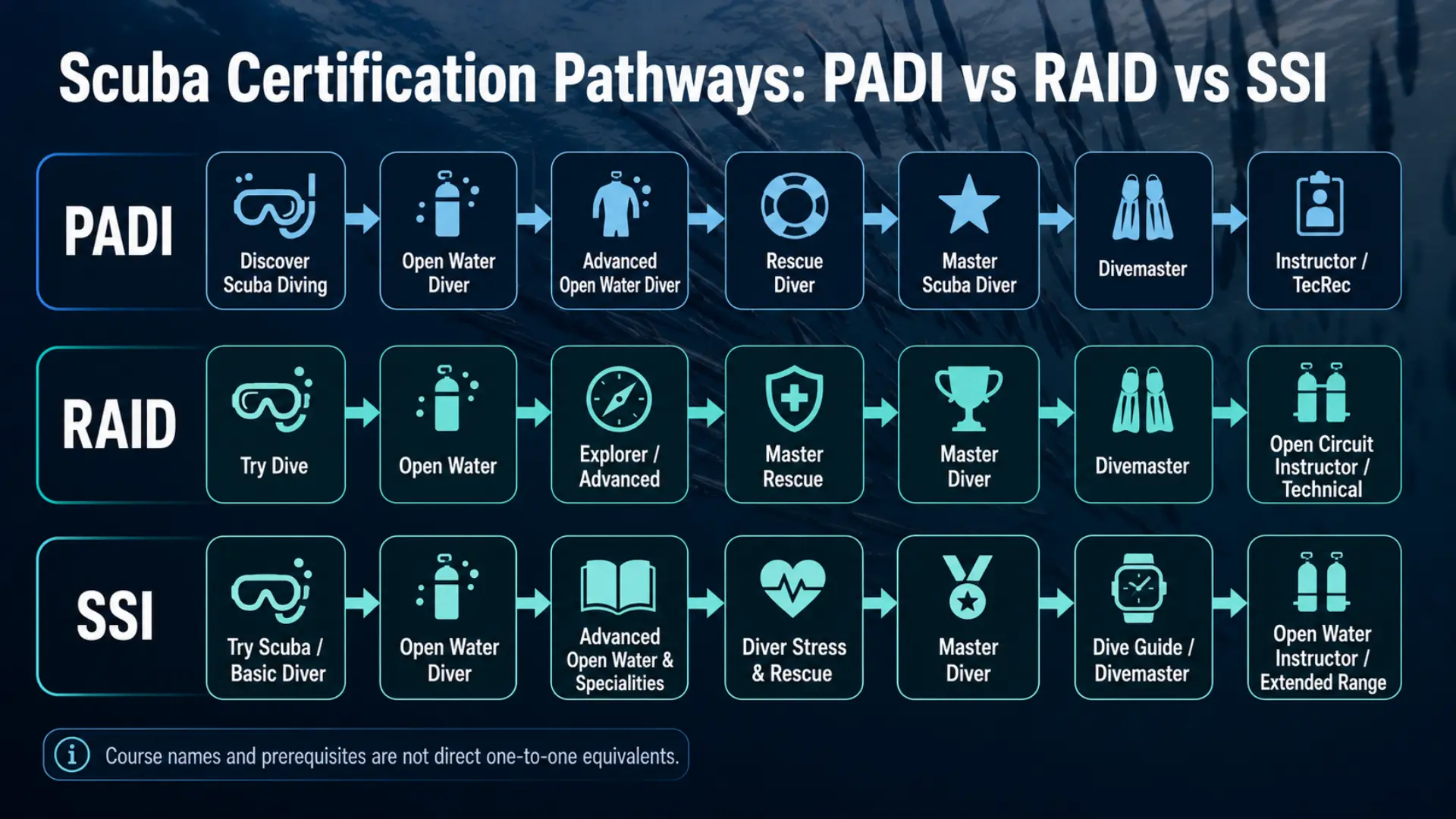
Scuba Certification Levels Compared: PADI vs RAID vs SSI
The three agencies cover broadly similar stages of diver development, but their course names and exact prerequisites are not identical.
Training stage
PADI
RAID
SSI
Main purpose
Introductory experience
Discover Scuba Diving
Bautizo
Try Scuba or Basic Diver
Experience scuba under direct supervision without completing a full independent-diver certification
Entry-level certification
Buceador de aguas abiertas
Open Water
Buceador de aguas abiertas
Learn the fundamental knowledge and skills required to dive with a suitably qualified buddy
Continuing development
Advanced Open Water Diver
Explorer and Advanced programs
Advanced Open Water Diver and specialities
Build experience in navigation, advanced planning and different types of diving
Speciality training
Individual PADI specialities
Individual RAID specialities
Individual SSI specialities
Develop skills for a particular environment, activity or equipment type
Rescue-level training
Rescue Diver
Master Rescue
Diver Stress & Rescue
Recognise, prevent and respond to diving problems
High recreational recognition
Master Scuba Diver
Master Diver
Master Diver
Recognise substantial training and logged diving experience
First professional pathway
Divemaster
Divemaster
Dive Guide and Divemaster
Develop leadership, guiding and course-assisting abilities
Instructor pathway
Assistant Instructor and Open Water Scuba Instructor
Open Circuit Instructor pathway
Assistant Instructor and Open Water Instructor
Learn to teach and certify divers within agency standards
Technical pathway
TecRec
Technical open-circuit and rebreather pathways
Extended Range and rebreather pathways
Train for more complex equipment, planning, environments and procedures
Note: This table should not be used as a direct equivalency chart. A training centre must review the diver’s actual certification, experience and course prerequisites before confirming eligibility for the next level.
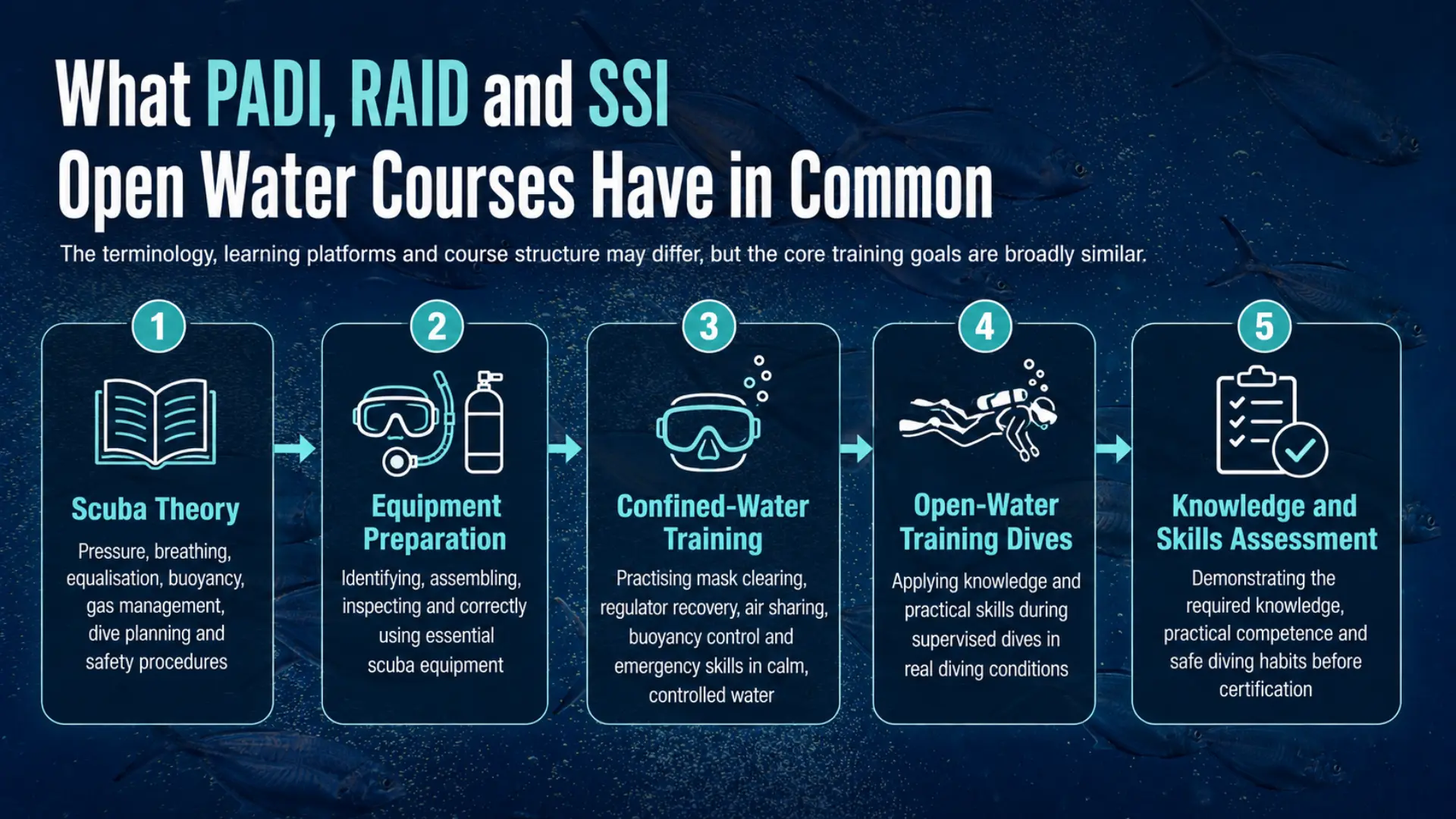
What Do PADI, RAID and SSI Courses Have in Common?
Although PADI, SSI, and RAID each have their own teaching style, learning platform, and course structure, their Open Water Diver courses are built around the same goal: helping beginners develop the knowledge, practical skills, and confidence needed to dive safely as recreational scuba divers.
The order of training and the terminology may vary slightly between agencies, but every Open Water course generally includes the following core components.
Scuba Theory
Before entering the water, students learn the fundamental principles of scuba diving, including:
How pressure affects the body and equipment
Equalisation techniques
Breathing safely underwater
Gas management
Buoyancy control
Basic dive planning
Safe ascent procedures
Scuba equipment and its purpose
Buddy system and underwater communication
Marine conservation and responsible diving
Recognising common diving problems
Emergency procedures and accident prevention
Depending on the certification agency and dive centre, theory may be completed through an eLearning platform, mobile app, classroom sessions, printed materials, or a combination of these methods.
Equipment Preparation
Students are taught how to correctly identify, assemble, inspect, and use the essential scuba equipment they’ll rely on underwater, including:
Buoyancy Control Device (BCD)
Regulator
Alternate air source
Scuba cylinder
Weight system
Mask
Fins
Exposure suit (wetsuit or similar protection)
Submersible pressure gauge
Dive computer (where included)
Good training goes beyond simply putting the equipment on. Students should understand what each component does, how to perform basic pre-dive safety checks, and how to recognise obvious equipment issues before entering the water.
Confined-Water Training
Confined-water training takes place in a swimming pool or another calm, controlled environment where beginners can develop their skills before diving in open water.
Students typically practise:
Breathing comfortably through a regulator
Clearing water from a mask
Recovering and replacing a regulator
Sharing air with a buddy
Establishing and maintaining neutral buoyancy
Controlled descents and ascents
Removing and replacing scuba equipment underwater
Responding to simulated underwater problems
Underwater communication signals
Assisting and monitoring a dive buddy
Students must demonstrate these essential skills confidently before progressing to open-water dives.
Open-Water Training
Once confined-water skills have been mastered, students complete their training in the ocean or another suitable open-water environment under instructor supervision.
During these dives, students gradually learn to apply their knowledge in real diving conditions while developing confidence and awareness.
Training typically includes:
Dive-site briefings and preparation
Safe water entries and exits
Controlled descents
Buoyancy control
Basic underwater navigation
Gas monitoring and air management
Maintaining buddy contact
Environmental awareness and responsible diving
Safe ascents and safety stops
Post-dive procedures and debriefing
While each agency sets minimum performance standards, the overall quality of training depends largely on the instructor, the student-to-instructor ratio, and the amount of meaningful practice provided throughout the course.
Knowledge and Skills Assessment
Open Water certification is competency-based, not attendance-based. Completing the scheduled sessions or paying the course fee does not automatically guarantee certification.
Before issuing a certification, the instructor must be satisfied that the student has successfully demonstrated the required knowledge, practical skills, and safe diving habits.
A responsible instructor will provide additional coaching, practice, or explanation whenever needed rather than advancing a student who is not yet ready. The goal is not simply to complete the course, but to ensure every new diver can dive safely and confidently after certification.
PADI vs SSI vs RAID: What Really Matters for Beginners?
Many comparisons between PADI, SSI, and RAID focus on brand recognition, popularity, or claims that one certification is “better” than another. In reality, these factors have very little impact on the quality of your first diving experience.
For most beginners, what matters is how you’re taught, how much time you have to practise, and how well your instructor prepares you to dive safely and confidently after certification. Here are the differences worth paying attention to.
1. How Skills Are Taught
Every certification agency requires students to master essential scuba skills, but the way those skills are introduced and practised can vary between agencies, instructors, and dive centres.
When comparing courses, consider questions such as:
Are skills taught while kneeling on the bottom or while maintaining neutral buoyancy?
Are skills introduced individually or combined into realistic diving scenarios?
Are skills practised repeatedly until they become comfortable, or only demonstrated once?
Does the training prepare you for real ocean diving rather than simply meeting the minimum certification requirements?
RAID places a strong emphasis on developing skills while maintaining neutral buoyancy, encouraging students to practise techniques in a way that closely reflects real diving conditions. PADI and SSI instructors can also adopt this teaching approach, although the learning experience often depends more on the individual instructor and dive centre than on the certification agency itself.
2. How Much Confined-Water Practice Do You Receive
The number of advertised training sessions doesn’t always reflect how much meaningful practice you’ll actually get.
Before booking, ask questions such as:
How long does the confined-water session last?
Is training conducted in a swimming pool or a sheltered open-water environment?
How many students share each instructor?
Is additional practice available if needed?
What happens if a student needs more time to master a skill?
Does the group progress together only when everyone is ready?
A course that allows plenty of time for practice often produces more confident and capable divers than one that simply focuses on completing the schedule as quickly as possible.
3. Digital Learning Experience
All three agencies offer digital learning, but their platforms and overall user experience differ.
PADI provides PADI eLearning, allowing students to complete theory online before finishing their practical training with an authorised instructor or dive centre.
RAID uses its FREE e-Learning platform and digital student account, giving learners access to course materials, quizzes, examinations, training records, and electronic certification in one place.
SSI delivers its training through the MySSI app and online platform, where students can access digital learning materials, certification cards, dive logs, and their complete training history.
The best platform is the one that suits your learning style. Check whether the course is available in your preferred language, whether offline access is supported, and how easy it is to revisit learning materials after certification.
4. Continuing Education and Career Pathways
If you plan to continue diving beyond your Open Water certification, it’s worth understanding how each agency structures its training pathway.
PADI follows a well-known progression from Open Water Diver to Advanced Open Water, Rescue Diver, speciality courses, Master Scuba Diver, Divemaster, and professional instructor programmes.
RAID offers its own progression through Explorer, Advanced, Master Rescue, Master Diver, leadership programmes, and technical diving pathways.
SSI combines core recreational courses with speciality certifications and recognition levels based on both completed training and logged diving experience.
For someone planning to dive occasionally while travelling, these differences may have little practical impact. However, divers interested in technical diving, professional training, or becoming an instructor may wish to compare each agency’s long-term development pathway more closely.
5. Instructor Flexibility and Teaching Approach
Every certification agency has standards that instructors must follow, but experienced instructors can still adapt their teaching to meet the needs of individual students.
This may include adjusting the pace of training based on:
Student confidence
Learning speed
Water conditions
Language requirements
Equipment fit and comfort
Group size and ability
Dive-site conditions
Good flexibility doesn’t mean skipping required skills or lowering certification standards. Instead, it means adapting the teaching process while ensuring every student achieves the required level of knowledge, competence, and confidence before earning their certification.
Is RAID as Internationally Recognised as PADI and SSI?
Yes. RAID is an internationally recognised scuba certification agency, and its recreational and professional certifications are accepted by dive centres around the world. Like PADI and SSI, RAID follows internationally recognised training standards, allowing certified divers to continue their education and dive with operators in many countries.
However, international recognition doesn’t mean automatic access to every dive or activity. Regardless of whether you hold a RAID, PADI, or SSI certification, a responsible dive centre will assess whether your training and experience are appropriate for the dive you want to undertake.
Before allowing you to dive, operators may consider factors such as:
Your certification level
How recently you’ve been diving
Your logged diving experience
The types of dives you’ve previously completed
The conditions at the planned dive site
Whether a scuba refresher is recommended
Whether a speciality certification is required
Your comfort and skills during a check dive, if requested
A scuba certification demonstrates that you’ve successfully completed the required training, but safe diving also depends on maintaining your skills and having experience appropriate for the conditions. That’s why reputable dive centres focus on both your certification and your current diving ability before approving certain dives or advanced activities.
Can a RAID-Certified Diver Dive With a PADI or SSI Dive Centre?
Yes. In most cases, a diver certified through RAID can dive with a PADI- or SSI-affiliated dive centre, just as PADI- and SSI-certified divers can dive with centres affiliated with other internationally recognised training agencies.
For recreational fun dives, the certification agency is usually less important than whether your training and experience are suitable for the planned dive. Before accepting a booking, a dive centre may consider:
Your certification level
Your logged diving experience
How recently you’ve been diving
The conditions at the planned dive site
Whether a refresher dive is recommended
Whether a speciality certification is required for the activity
The dive centre may also ask to verify your certification through a digital account or request your certification card as proof of qualification.
In most situations, you won’t need to repeat your Open Water course simply because the dive centre teaches through a different certification agency. As long as your certification is from a recognised agency and your experience matches the planned dive, you can generally continue diving without any issues.
Are Scuba Certifications Transferable Between PADI, SSI and RAID?
Yes, in most cases. Recreational scuba certifications from internationally recognised agencies such as PADI, SSI, and RAID are generally accepted as prerequisites for continuing your training with another agency. Rather than converting your certification, the new training provider assesses whether your existing qualification meets the entry requirements for the course you want to take.
For example:
A RAID Open Water Diver can usually enrol in an eligible PADI continuing education course.
A PADI Open Water Diver can continue training through SSI.
An SSI Open Water Diver can progress with RAID.
Divers may also enter another agency’s professional training pathway if they meet the published equivalency requirements.
At the recreational level, switching agencies is usually straightforward. However, before accepting you into an advanced or professional course, the dive centre may review factors such as:
Your current certification level
Completed training and course prerequisites
Logged diving experience
Rescue Diver qualification (where required)
First aid and CPR certification
Relevant speciality certifications
Medical clearance, if applicable
Professional qualifications for leadership courses
Professional-level crossovers, such as becoming an instructor with a different agency, are typically more structured than recreational training. Most agencies require candidates to complete additional agency-specific standards training, assessments, or instructor evaluations before they are authorised to teach under the new organisation.
Does the Certification Agency Matter for Future Fun Dives?
For most recreational fun dives, the certification agency itself is usually less important than your qualification level, recent diving experience and overall comfort in the water.
Before allowing you to join a dive, a responsible dive operator or guide may focus on questions such as:
When was your last dive?
How many dives have you completed?
Have you previously dived from a boat?
Have you experienced currents or limited visibility?
Are you comfortable using a dive computer?
Have you completed specialised dives, such as night dives?
Do you have experience at deeper or more challenging dive sites?
Would you benefit from a refresher session?
Your certification card confirms that you completed the required training at a certain point in time. However, it does not show how recently you have used those skills or how comfortable you are underwater today.
A diver who was certified several years ago but has limited recent experience may require more guidance than an active diver with regular dive practice — regardless of whether their certification is from PADI, RAID, or SSI. For future fun dives, your current ability and confidence often matter more than the logo on your certification card.
Do PADI, RAID and SSI Certifications Expire?
Recreational scuba certifications are generally issued as lifetime qualifications rather than short-term licences that require annual renewal. PADI states that its scuba certifications do not expire, while RAID and SSI provide digital certification records that remain accessible after completion.
However, having a permanent certification does not mean your diving skills stay automatically current.
A dive centre may recommend or require a refresher session if:
You have not been diving for a long time
You completed only a few dives after certification
You feel unsure about setting up or using your equipment
You cannot remember key safety procedures
The planned dive site involves stronger currents, greater depth or other challenging conditions
You are using unfamiliar equipment or diving in a new environment
Note: A refresher does not replace your original certification. Instead, it helps refresh important knowledge, rebuild underwater confidence, review essential skills and allows the dive team to understand your current comfort level before entering the water.
Is One Certification Agency Safer Than Another?
It is not accurate to say that one major recreational scuba certification agency is universally safer than another. Safety depends less on the name of the agency and more on how training standards are applied in practice.
A diver’s safety is influenced by factors such as:
Agency training standards
Instructor experience and teaching quality
Student-to-instructor ratio
Course duration and learning pace
Local environmental conditions
Equipment quality and maintenance
Accurate medical screening
Skill practice and confidence development
Dive planning and risk assessment
Appropriate supervision
Good decision-making before and during dives
PADI, RAID and SSI all provide structured recreational scuba training systems designed to teach safe diving practices.
Does Instructor Quality Matter More Than the Agency?
For many students, the quality of the instructor has a greater impact on the overall learning experience than the name of the certification agency.
A good instructor should:
Explain concepts clearly and patiently
Demonstrate skills accurately
Observe students closely throughout training
Correct mistakes in a constructive way
Allow enough time for students to learn without rushing
Encourage questions and build confidence
Adapt their communication to different learning styles
Maintain appropriate supervision in the water
Make conservative, safety-focused decisions
Help students develop good buoyancy and overall diving skills, rather than simply complete course requirements
Decline certification if the required standards have not been met
A certification agency provides the training standards, course structure and educational materials. The instructor is responsible for applying those standards and turning them into a safe, effective and enjoyable learning experience.
This does not mean the agency is unimportant. Factors such as course design, educational resources, quality assurance and instructor training all contribute to the overall standard of the programme. However, when choosing a dive course, it is worth evaluating both the certification agency and the instructor or dive centre delivering the training.
Which Agency Is Best for Nervous Beginners?
No certification agency automatically provides the best experience for every nervous beginner. The quality of the learning environment, instructor approach and pace of training often matter more than the agency name itself.
A nervous beginner should look for a dive centre that offers:
Patient and supportive instructors
Clear, easy-to-understand briefings
Small or well-managed groups
Properly fitted equipment
Enough time for confined-water practice
A gradual progression from basic skills to open-water dives
The ability to pause, ask questions or repeat skills
Calm and reassuring communication
No pressure to continue if they feel uncomfortable
Additional practice when needed
A good instructor understands the difference between normal first-dive anxiety and a student who is genuinely uncomfortable, overwhelmed or not ready to progress. Building confidence should be part of the training process, not something expected from the student immediately.
IMPORTANT NOTE: One beginner may feel more comfortable with a patient RAID instructor, while another may have a better experience with a supportive PADI or SSI instructor. The best choice is usually the dive centre and instructor who create a safe, encouraging learning environment, not simply the agency logo on the certification card.
PADI vs RAID vs SSI for Different Types of Divers
Your priority
Agency or factor to consider
Why
Strongest mainstream brand familiarity
PADI
PADI has a large international network and high recognition among travellers
Buoyancy and trim emphasised throughout skill development
RAID
RAID publicly requires core skills to be demonstrated while neutrally buoyant
Integrated learning, certification and dive-log app
SSI
MySSI combines education, certification records and logging
Continuing education linked to both training and logged experience
SSI
SSI awards recognition ratings based on speciality education and experience milestones
Straightforward core recreational sequence
PADI
Open Water, Advanced Open Water and Rescue provide a familiar progression
Interest in performance-based or technical development
RAID
RAID connects recreational training with performance, technical and rebreather pathways
Future professional training
Compare the actual centre
Mentorship, course duration, real experience and instructor development matter more than the entry-level agency alone
Nervous first-time diver
Compare instructors and group structure
Patience, pace and individual attention are more important than agency branding
International fun diving
Any of the three
Appropriate certifications are generally usable across recognised dive-centre networks
Unsure about long-term goals
Choose the best local course delivery
Recreational divers can usually change agencies later
Which Scuba Certification Is Best for International Travel?
PADI, RAID and SSI certifications can all support international recreational diving.
For travel, consider:
Whether your digital card is accessible offline
Whether your profile details match your passport
Whether the centre can verify your record
Whether you have a logbook
Whether your recent experience suits the planned dive
Whether speciality training is required
Whether a refresher is advisable
PADI has the strongest mainstream consumer familiarity of the three. SSI also has a substantial international training-centre network and digital verification system. RAID has international electronic certification and courses that accept recognised cross-agency equivalents at higher levels.
For most recreational travel, choosing a well-taught course is more important than selecting an agency solely because you think another operator may not recognise the card.
PADI vs RAID vs SSI: Balanced Verdict
PADI, RAID and SSI are all credible choices for scuba education in Koh Tao. None is automatically the best agency for every diver.
PADI may appeal to travellers who value strong global brand familiarity, a large training network and a widely understood recreational pathway.
RAID may appeal to divers who value a strong stated emphasis on neutral buoyancy, trim, performance skills and a direct connection to technical and rebreather education.
SSI may appeal to divers who prefer an integrated digital platform, speciality-based progression and recognition levels linked to both training and logged experience.
However, agency differences should not distract you from the factors that most directly influence your course:
Instructor quality
Group size
Training time
Equipment fit
Confined-water practice
Skill-development approach
Safety procedures
Medical screening
Student support
Course pace
Honest certification decisions
A patient instructor delivering a complete and well-structured course is more valuable than a famous logo attached to rushed training.
Conclusion: Choosing Scuba Training in Koh Tao
The right scuba certification depends on what you want from diving.
A beginner may need patience, clear instruction and a manageable schedule. A certified recreational diver may care more about speciality choices and future travel. A Divemaster candidate should examine mentorship, leadership experience and professional development. A future technical diver should evaluate the agency pathway, instructor background and equipment philosophy in much greater detail.
PADI, RAID and SSI can all provide routes from first certification to advanced recreational, rescue, professional and specialised training. Rather than asking which agency is universally best, compare how each course is delivered and whether it supports your individual goals.
Buceo en La Bombona Koh Tao provides training through RAID, including beginner, continuing-education, rescue and professional development options. Travellers interested in the RAID approach can explore the available cursos o contact the La Bombona Diving team to discuss their experience, schedule and future diving plans without pressure to select a course before their questions have been answered.
Frequently Asked Questions (FAQs)
Is PADI Better Than RAID or SSI?
PADI is not automatically better than RAID or SSI. While PADI has one of the most widely recognised names in recreational scuba diving and a large global network of dive centres, certification quality depends on more than the agency logo on your card.
PADI, RAID and SSI all provide structured recreational scuba training programmes based on established safety standards, skill development and knowledge requirements.
The main differences are often related to:
Recognition and availability: PADI has extensive global brand recognition, which can make it familiar to dive centres and travellers worldwide. SSI also has a broad international presence, while RAID is recognised in many diving communities and has a strong focus on digital learning and flexible training approaches.
Training approach: Each agency has its own course structure, learning materials and instructor standards, but the quality of training often depends on how well the instructor delivers the programme.
Instructor and dive centre quality: A skilled, patient instructor who provides thorough training can have a greater impact on your experience than the certification agency itself.
Your future diving goals: If you plan to dive while travelling frequently, a widely recognised certification may feel convenient. If you value a specific teaching style, smaller groups or a particular instructor, another agency may be equally suitable.
Is RAID Recognised Internationally?
Yes, RAID is an internationally recognised scuba certification agency that provides recreational, professional and technical diving programmes. Its certifications are issued electronically, allowing divers to access and verify their training records through RAID’s digital system.
A RAID-certified diver can generally use their certification to participate in suitable recreational dives, even when booking with a dive centre that teaches through another recognised agency. As with any certification, acceptance may depend on the dive operator’s policies, the type of dive planned and whether the diver meets the experience requirements for that activity.
For most recreational diving, operators are typically more concerned with your certification level, recent dive experience, number of logged dives and comfort in the water than the specific agency name on your card. A current and appropriately qualified RAID diver can join suitable dives alongside divers certified through agencies such as PADI or SSI.
Can I Dive with a PADI Centre After Completing RAID Open Water?
Yes, generally you can dive with a PADI dive centre after completing your RAID Open Water certification. Recreational dive centres usually recognise certifications from other internationally established training agencies, provided your qualification matches the requirements of the planned dive.
When booking a dive, the PADI centre may verify your RAID certification and ask about factors such as:
Your certification level
Number of logged dives
Date of your last dive
Recent diving experience
Comfort level in the water
Experience with conditions similar to the planned dive
For example, a newly certified RAID Open Water diver may be suitable for a standard guided fun dive in calm conditions, while a deeper, current-heavy or more technical dive may require additional experience or qualifications.
Your certification agency is only one part of the assessment. Dive operators generally focus more on whether you have the right training, recent experience and skills needed to complete the dive safely. A RAID Open Water certification allows you to continue your recreational diving journey with suitable dive centres, including those operating under PADI or SSI.
Can an SSI Diver Take a PADI or RAID Course Later?
Yes, usually. An SSI-certified diver can continue training with PADI, RAID or another recognised agency. The new training centre will review the diver’s existing certification and experience level and confirm that the SSI qualification meets the prerequisites for the planned course. Additional skills, assessments or refresher training may be recommended depending on the course level and the diver’s recent experience.
What Should Travellers Check Before Booking a Scuba Course in Koh Tao?
Use this checklist before paying.
Course and Certification
Which agency issues the certification?
What is the exact certification name?
What will I be qualified to do after completing it?
Is the certification fee included?
Are learning materials included?
Will I receive a digital certification card?
Schedule
How many calendar days does the course use?
What time does training begin and finish?
Must eLearning be completed before arrival?
How much confined-water time is planned?
How many open-water dives are included?
Is the schedule flexible when weather changes?
Instructor and Group
Who will teach the course?
What languages does the instructor teach in?
What is the maximum group size?
Will an assistant be present?
How are nervous students supported?
Can the instructor provide additional practice?
Equipment
Is all standard equipment included?
Are dive computers included?
Can equipment be exchanged when it does not fit?
Is there suitable equipment for different body sizes?
Who checks and maintains the equipment?
Safety and Medical Process
Must I complete a medical form before arriving?
Where can I obtain medical clearance if needed?
Is emergency oxygen available?
How are weather and dive-site decisions made?
What happens if I cannot complete a skill?
What happens if I become unwell?
Price and Terms
What is the total price?
Are there any certification or material surcharges?
Are accommodation or meals included?
Is insurance included?
What is the refund policy?
What happens if the course is interrupted?
Are extra training sessions chargeable?
Do You Need to Be a Strong Swimmer to Get a Scuba Certification?
You do not need to be an expert swimmer or have competitive swimming ability to learn scuba diving. However, you must be comfortable enough in the water to complete the required water-fitness assessment and handle basic in-water situations safely.
Entry-level scuba courses typically assess:
Ability to swim continuously for a set distance
Ability to float or tread water without assistance
General comfort and confidence in the water
Basic stamina and physical control
Ability to follow instructions during water activities
The exact requirements vary depending on the certification agency and course level. PADI, for example, includes a swimming assessment and a timed float or tread-water exercise in its entry-level training. SSI also requires students to complete a water-fitness evaluation before progressing to open-water training.
If you are nervous about swimming, have limited experience or feel uncomfortable in the water, inform the dive centre before booking. A good instructor can explain the requirements, recommend suitable preparation and help you choose a course pace that matches your confidence level.
What Medical Requirements Should Beginners Expect Before Scuba Diving?
Before starting a scuba course, beginners are usually required to complete a scuba medical questionnaire. This helps the dive centre and instructor identify any health conditions that could affect diving safety and determine whether additional medical advice is needed.
The questionnaire may ask about:
Respiratory or lung conditions
Heart or circulation problems
Ear, sinus or pressure-related issues
Previous surgeries or injuries
Neurological conditions
Current medications
Pregnancy
Fainting, dizziness or loss of consciousness
Recent illness or medical changes
Any other condition that could affect underwater activities
Answering “yes” to a question does not automatically mean you cannot scuba dive. In many cases, it simply means you may need written clearance from a qualified medical professional before participating.
Recognised scuba training agencies, including PADI, use medical screening procedures to help assess diver fitness before training begins.
Always complete medical forms honestly and accurately. Sharing relevant information allows the instructor to make appropriate safety decisions, recommend precautions and ensure you have the right support during your course.
Bucea con LBD: tu puerta a la exploración submarina
Tanto si eres un principiante curioso como un profesional experimentado, nuestra escuela es tu portal a las maravillas del submarinismo. Únete a nosotros en el mundo bajo las olas.
Is your old scuba certification still valid? Learn about scuba certification validity, when you need a refresher dive in Koh Tao, & how the Reboot Course works.
Is your old scuba certification still valid? Learn about scuba certification validity, when you need a refresher dive in Koh Tao, & how the Reboot Course works.
Is your old scuba certification still valid? Learn about scuba certification validity, when you need a refresher dive in Koh Tao, & how the Reboot Course works.
Para ofrecer las mejores experiencias, utilizamos tecnologías como las cookies para almacenar y/o acceder a la información del dispositivo. El consentimiento a estas tecnologías nos permitirá procesar datos como el comportamiento de navegación o identificaciones únicas en este sitio. La falta de consentimiento, o la retirada del mismo, puede afectar negativamente a determinadas características y funciones.
Funcional
Siempre activo
El almacenamiento o acceso técnico es estrictamente necesario para el fin legítimo de permitir el uso de un servicio específico explícitamente solicitado por el abonado o usuario, o con el único fin de llevar a cabo la transmisión de una comunicación a través de una red de comunicaciones electrónicas. .
Preferencias
El almacenamiento o acceso técnico es necesario para el fin legítimo de almacenar preferencias no solicitadas por el abonado o usuario.
Estadísticas
El almacenamiento o acceso técnico que se utiliza exclusivamente con fines estadísticos.Almacenamiento o acceso técnico que se utiliza exclusivamente con fines estadísticos anónimos. Sin un requisito, el cumplimiento voluntario por parte de su proveedor de servicios de Internet o registros adicionales de un tercero, la información almacenada o recuperada exclusivamente con este fin no puede utilizarse para identificarle.
Marketing
El almacenamiento o acceso técnico es necesario para crear perfiles de usuario para enviar publicidad, o para seguir al usuario en un sitio web o en varios sitios web con fines de marketing similares.



 ES
ES  EN
EN