What is the Difference Between Scuba Diving and Snorkelling?
Por Bryan Roseman
20 July 2026
Table of Contents
Principales conclusiones
Snorkelling lets you explore the ocean from the surface, while scuba diving lets you explore underwater.
Snorkelling is easier to learn and doesn’t require certification.
Scuba diving requires training or a supervised Try Dive for beginners.
Snorkelling is more affordable, while scuba diving offers a deeper and longer underwater experience.
Snorkelling is ideal for beginners and casual explorers, while scuba diving is best for those who want to explore beyond the surface.
Many people start with snorkelling before trying scuba diving.
If you are standing on a pier in Koh Tao trying to decide between a mask and snorkel afternoon and a full scuba course, you are asking the right question.
Scuba diving and snorkelling both let you explore the ocean, but they offer very different experiences and require different equipment.
We’ll compare everything that matters from breathing and depth to equipment, certification, safety, cost, and which activity is right for your trip.
By the end of this guide, you’ll know:
Which activity is easier to learn
How much each costs
How deep you can go
Whether certification is required
Which option is the best fit for your trip
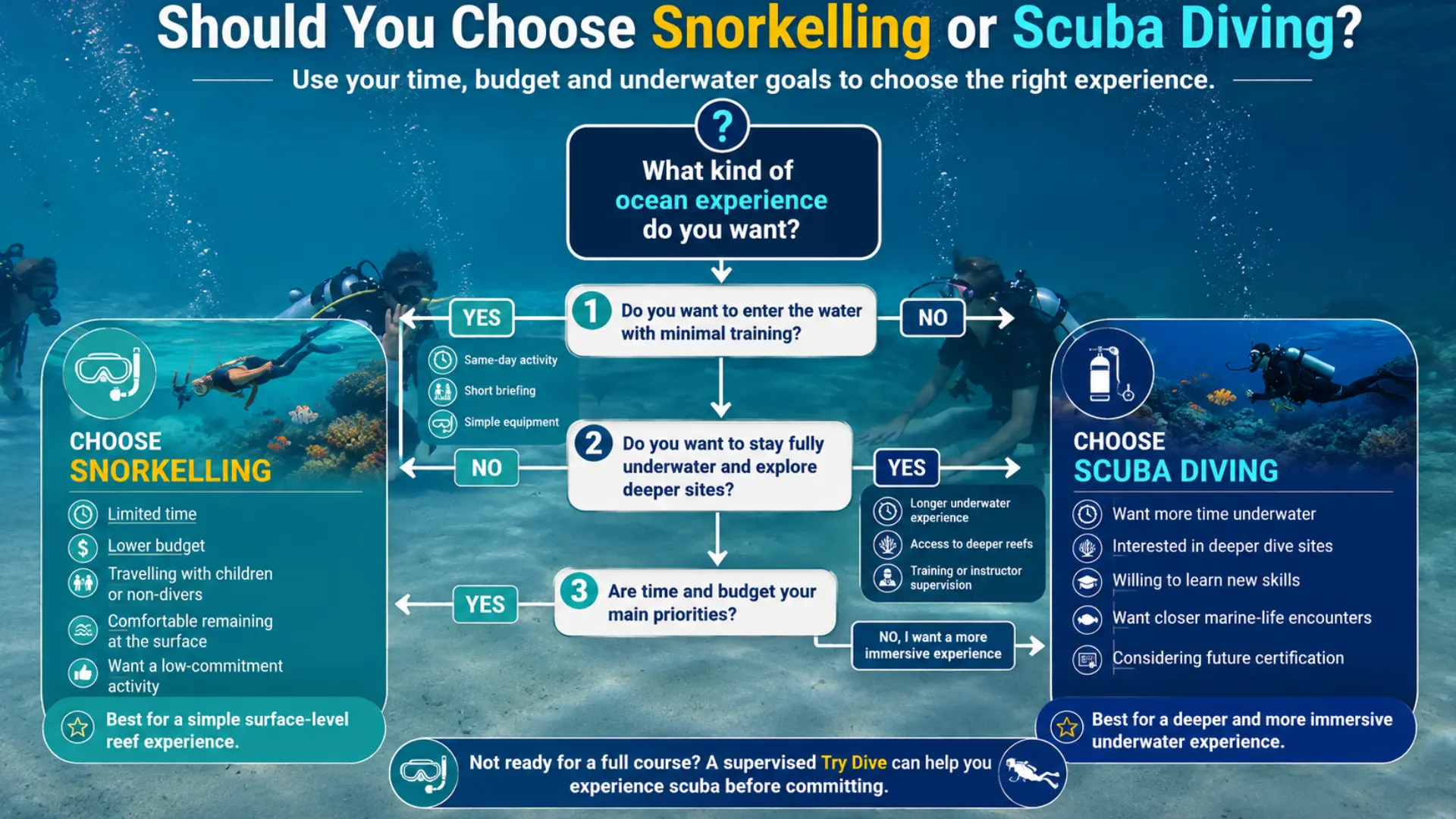
Scuba Diving vs Snorkelling: Quick Comparison
Snorkelling
Scuba Diving
Where You Are in the Water
Floating at the surface
Fully submerged
How You Breathe
Snorkel tube, from the air above
Regulator connected to a tank
Typical Depth
1–4 metres (a strong snorkeler might hit 7m)
12–30m as a recreational diver, deeper with advanced certs
Training Needed
None, a quick briefing is enough
Certification course required
Time Underwater
As long as you want, no air limit
30-60 minutes per tank
Equipment
Mask, snorkel, fins
Mask, fins, tank, regulator, BCD, weights, often a wetsuit
Certified divers, deeper sites, longer time underwater
Is Snorkelling Easier Than Scuba Diving?
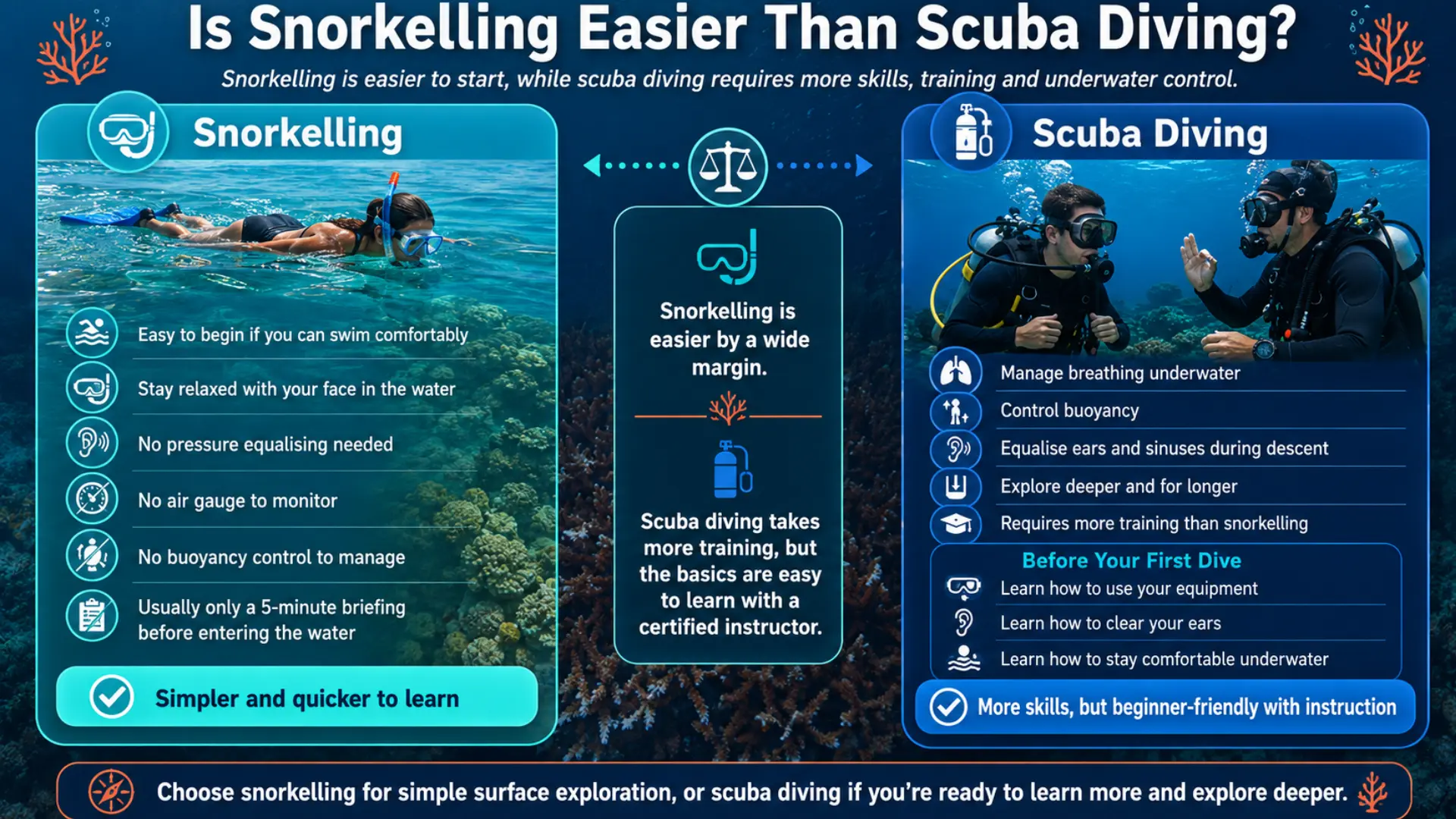
Yes, by a wide margin. You can snorkel if you can swim comfortably and stay relaxed with your face in the water. You don’t need to equalise pressure, monitor an air gauge, or manage your buoyancy. Your guide gives a five-minute safety briefing before you enter the water.
This makes snorkelling ideal for people who want a relaxed way to explore the ocean without learning new technical skills. Most beginners feel comfortable after a short safety briefing.
On the other hand, scuba diving is a different kind of skill. You have to manage your breathing, your buoyancy, and pressure changes on your ears and sinuses as you descend. It takes a little more training because you’ll be exploring underwater for longer and at greater depths.
Before your first dive, you will learn a few basic skills, such as:
How to use your equipment
How to clear your ears as you descend
How to stay comfortable
A certified instructor can teach these skills quickly and safely. It is also helpful to read a few common questions before your first dive to help you feel more prepared.
Do you need to be fit?
Neither activity requires exceptional fitness. If you’re comfortable swimming and in generally good health, most beginners can enjoy snorkelling or complete a Try Dive after a medical questionnaire and a short instructor briefing.
Do You Need Certification for Snorkelling vs. Scuba Diving?
Snorkelling
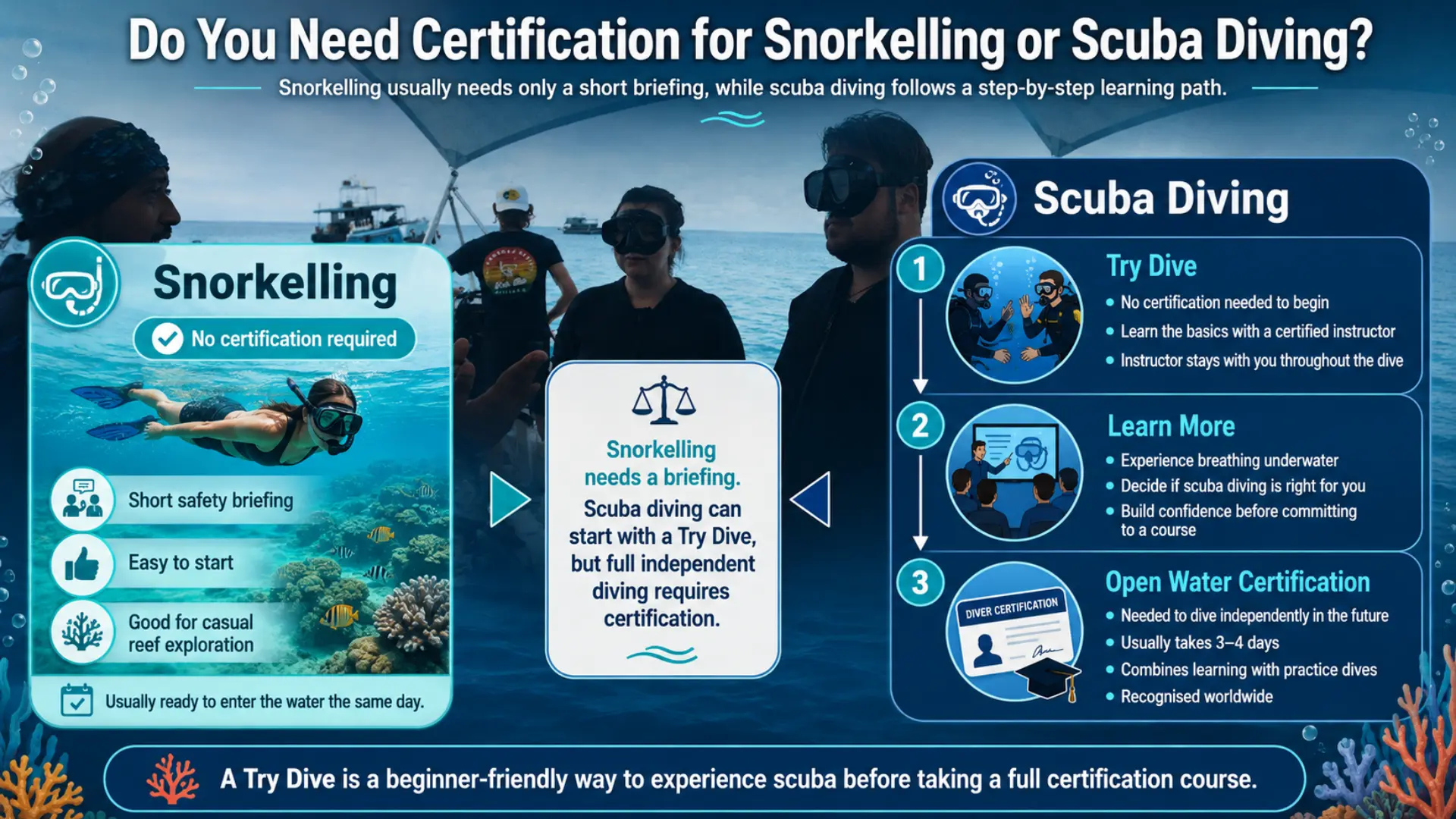
You don’t need a certification for snorkelling. A short safety briefing is all you need before getting in the water.
Scuba Diving
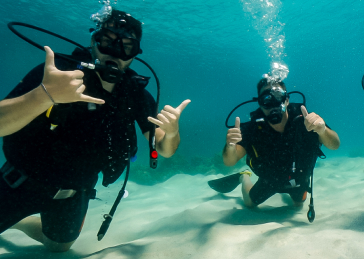
If you are curious about scuba diving, you don’t need to sign up for a certification course right away. Most dive schools offer a Bautizo, where a certified instructor teaches you the basics and stays with you throughout the dive.
It’s an easy way to experience breathing underwater and see if scuba diving is right for you.
If you decide to dive independently in the future, you will need an Certificación Open Water Diver. Most courses take three to four days and combine classroom learning with practice dives. Once you earn your certification, it’s recognised worldwide.
NOTE: Not every diving certification agency teaches the course the same way. Before you choose a dive school, it is worth comparing SSI vs RAID y PADI vs RAID. The main differences are in the teaching style, course structure, and learning materials. All major certifications are recognised at dive centres around the world.
Which Is Safer, Snorkelling or Scuba Diving?
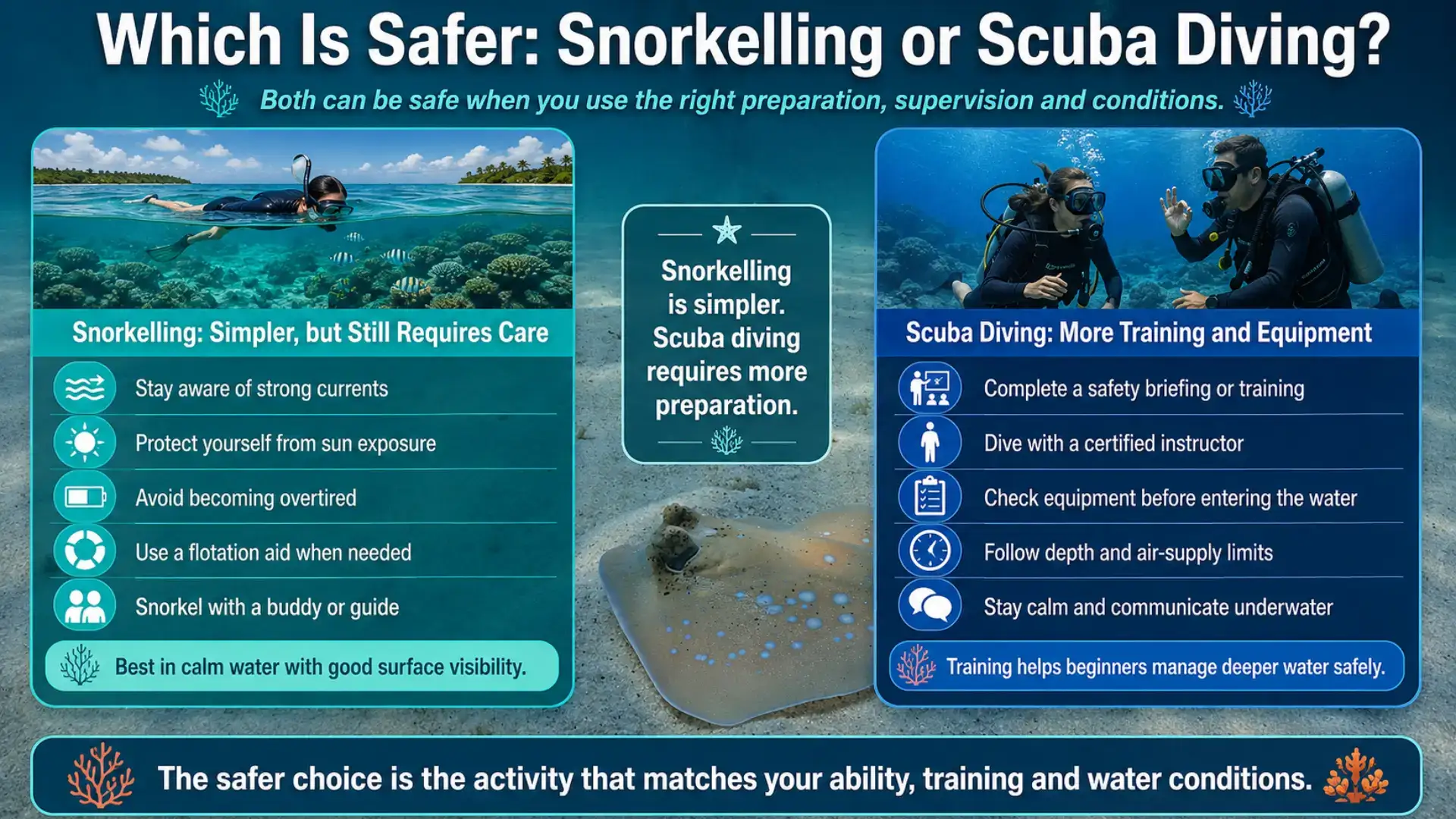
Both snorkelling and scuba diving are generally safe when done responsibly. Snorkelling is simpler because you stay at the surface and use very little equipment.
The main things to watch for are:
Strong currents
Sun exposure
Fatigue in the water
Scuba diving involves more equipment and deeper water, so you will receive proper training or dive with a certified instructor before going underwater. By following the safety guidelines, beginners can safely enjoy scuba diving too.
Many first-time divers worry about running out of air underwater. In reality, instructors regularly monitor your air supply throughout the dive and teach you how to check it yourself, making this situation extremely unlikely during a supervised beginner dive.
NOTE: Your safety also depends on the dive school you choose. Before you book, check the instructor-to-student ratio, equipment quality, and class size. These factors are more important than choosing the cheapest course. A good gut-check is to run through 10 questions to ask before booking a dive school in Koh Tao and choose one that puts safety first.
Common Beginner Mistakes
Snorkelling
Standing on coral reefs
Swimming too far from the group
Ignoring currents
Forgetting sun protection
Scuba Diving
Descending too quickly
Forgetting to equalise
Holding your breath
Focusing only on marine life instead of monitoring your air supply
Snorkelling vs. Scuba Diving: Cost Comparison
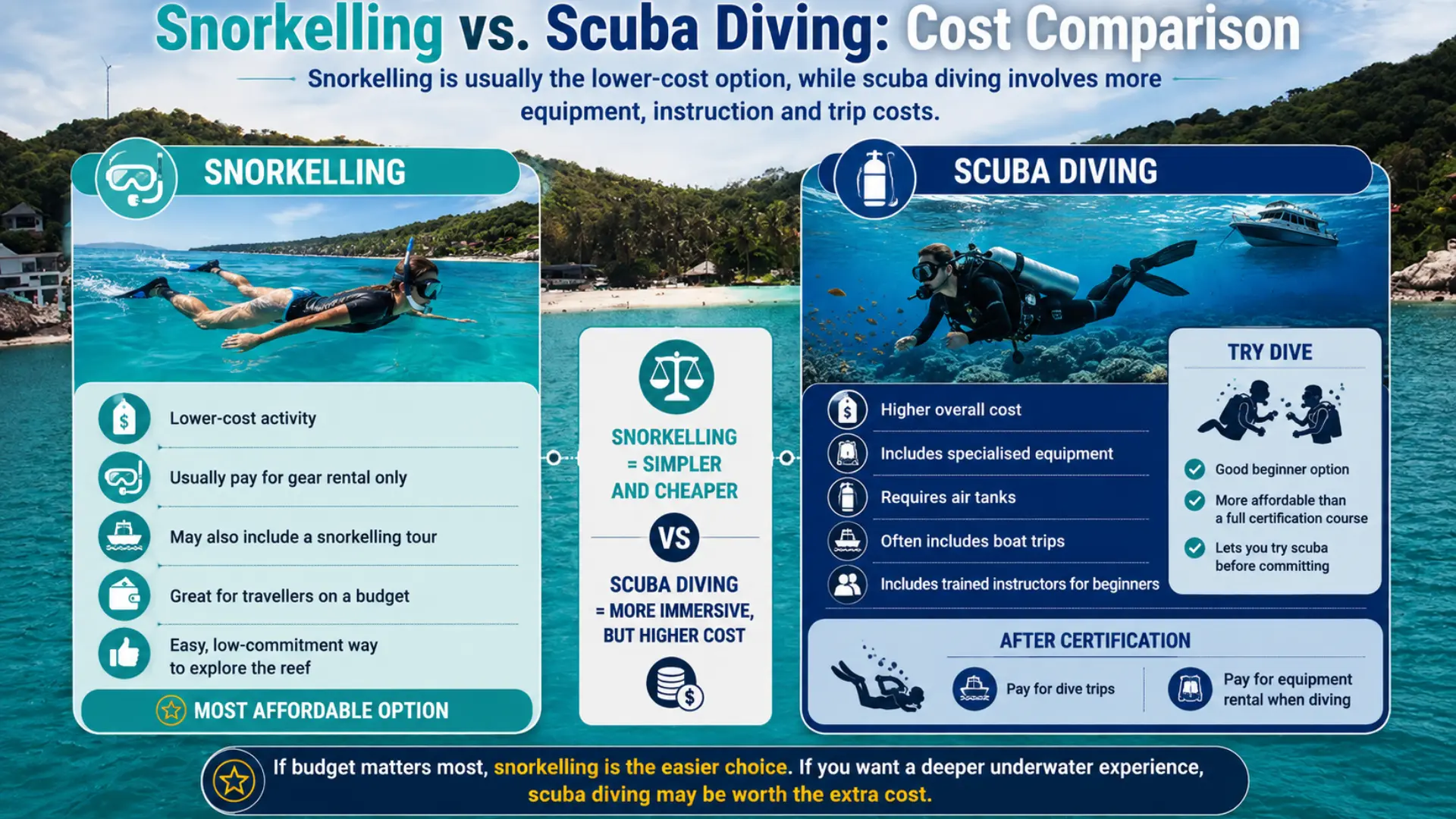
Snorkelling is the more affordable option. You will usually only pay for gear rental or a snorkelling tour, making it a great choice if you are on a budget.
Scuba diving costs more because your course fee covers:
Professional instruction
Specialised equipment
Air tank fills
Buceo desde barco
Equipment maintenance
Certificación reconocida internacionalmente
While the upfront cost is higher, it provides skills you can use on dive trips around the world.
Once you are certified, you only need to pay for dive trips and equipment rental when you go diving. If you are planning your budget, check how much scuba diving costs in Koh Tao. Course fees, gear rental, and boat trip prices can vary between dive schools.
What Equipment Is Needed for Scuba Diving and Snorkelling?
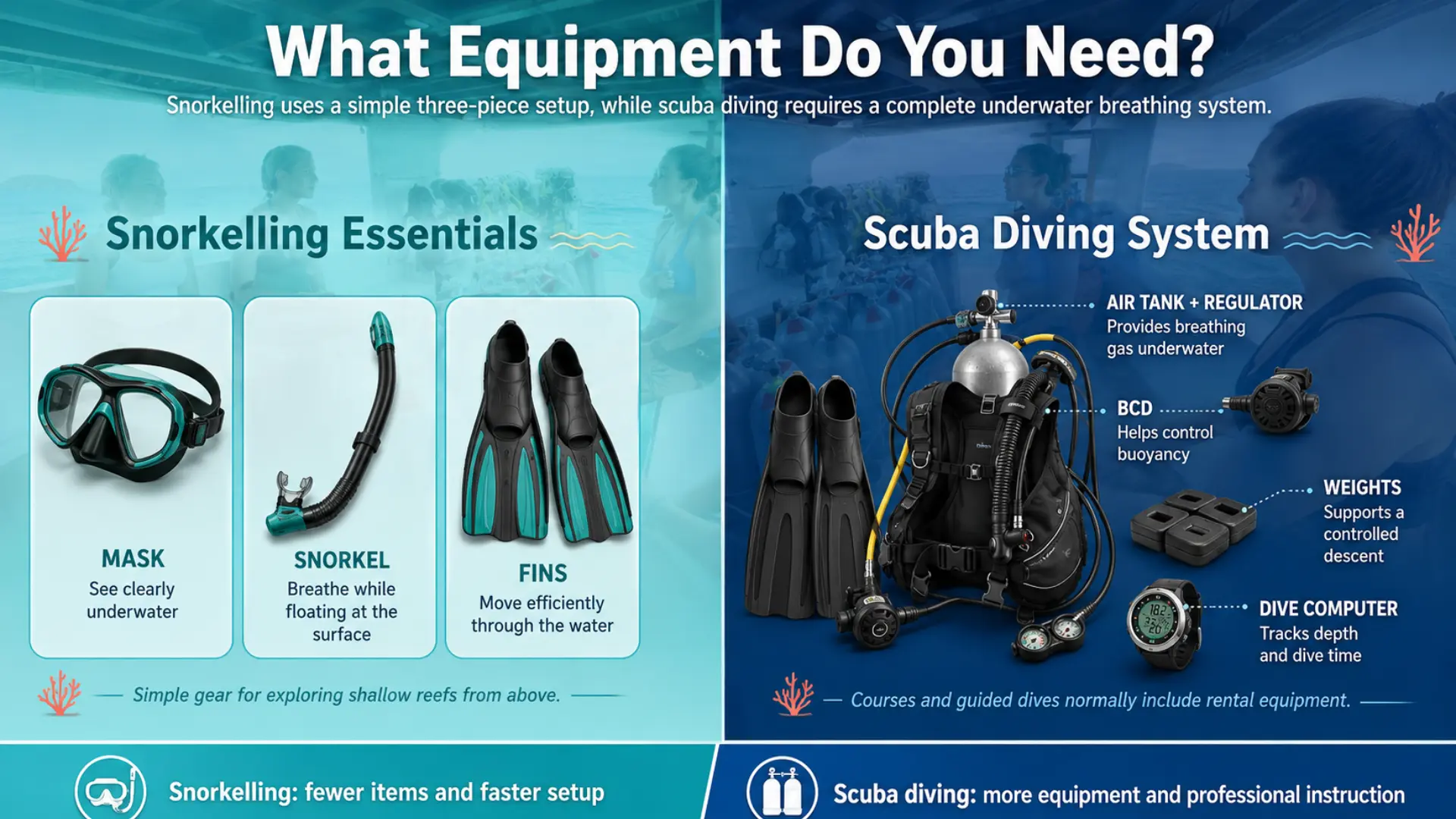
Snorkelling
Mask: lets you see clearly underwater.
Snorkel: allows you to breathe while floating at the surface.
Fins: help you swim efficiently with less effort.
In warm destinations like Koh Tao, that’s usually all you need.
Scuba Diving
Mask: provides clear underwater vision.
Fins: improve movement underwater.
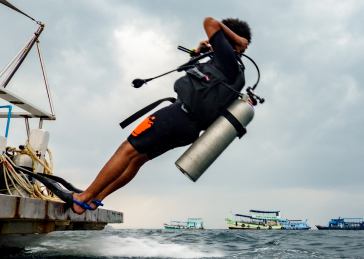
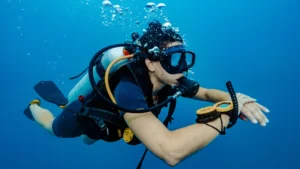
Air tank: stores compressed breathing air.
Regulator: delivers air from the tank.
Buoyancy control device (BCD): helps you control your buoyancy underwater.
Weights: help you descend comfortably.
Dive computer: tracks your depth and dive time for safety.
If you are taking a course or joining a guided dive, the dive school provides all the equipment, so there’s no need to buy your own gear.
NOTE: If you plan to bring a camera, read a beginner’s guide to underwater photography first. You will learn about buoyancy control, lighting, and how to get close to marine life without disturbing it. These skills are useful whether you are snorkelling at the surface or scuba diving underwater.
Scuba Diving vs Snorkelling: Depth Comparison
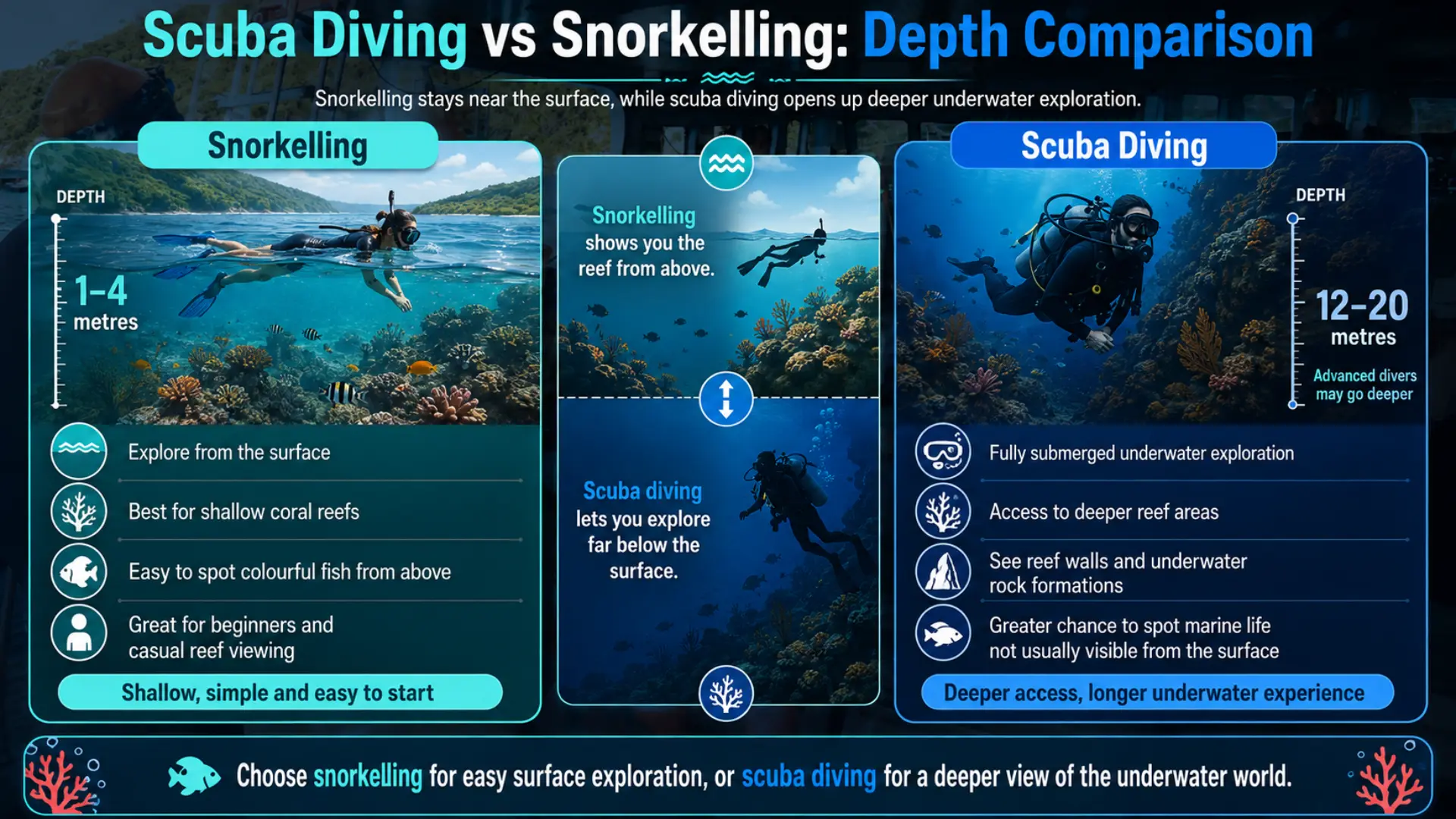
Snorkelers stay at the surface and usually explore water that is 1 to 4 metres deep. This makes it ideal for viewing shallow coral reefs and colourful fish from above.
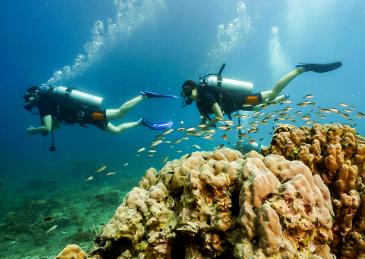
Scuba divers can explore much deeper. Certified recreational divers usually dive between 12 and 20 metres, with advanced divers able to go even deeper. Greater depth also means seeing marine life that rarely comes close to the surface, such as larger reef fish, turtles resting beneath coral overhangs, and underwater rock formations that snorkellers can’t easily reach.
Diving conditions change throughout the year. Before you book your trip, check the best time to dive in Koh Tao. Visibility, water temperature, and the marine life you can see all vary by season.
Can You Scuba Dive If You Know How to Snorkel?
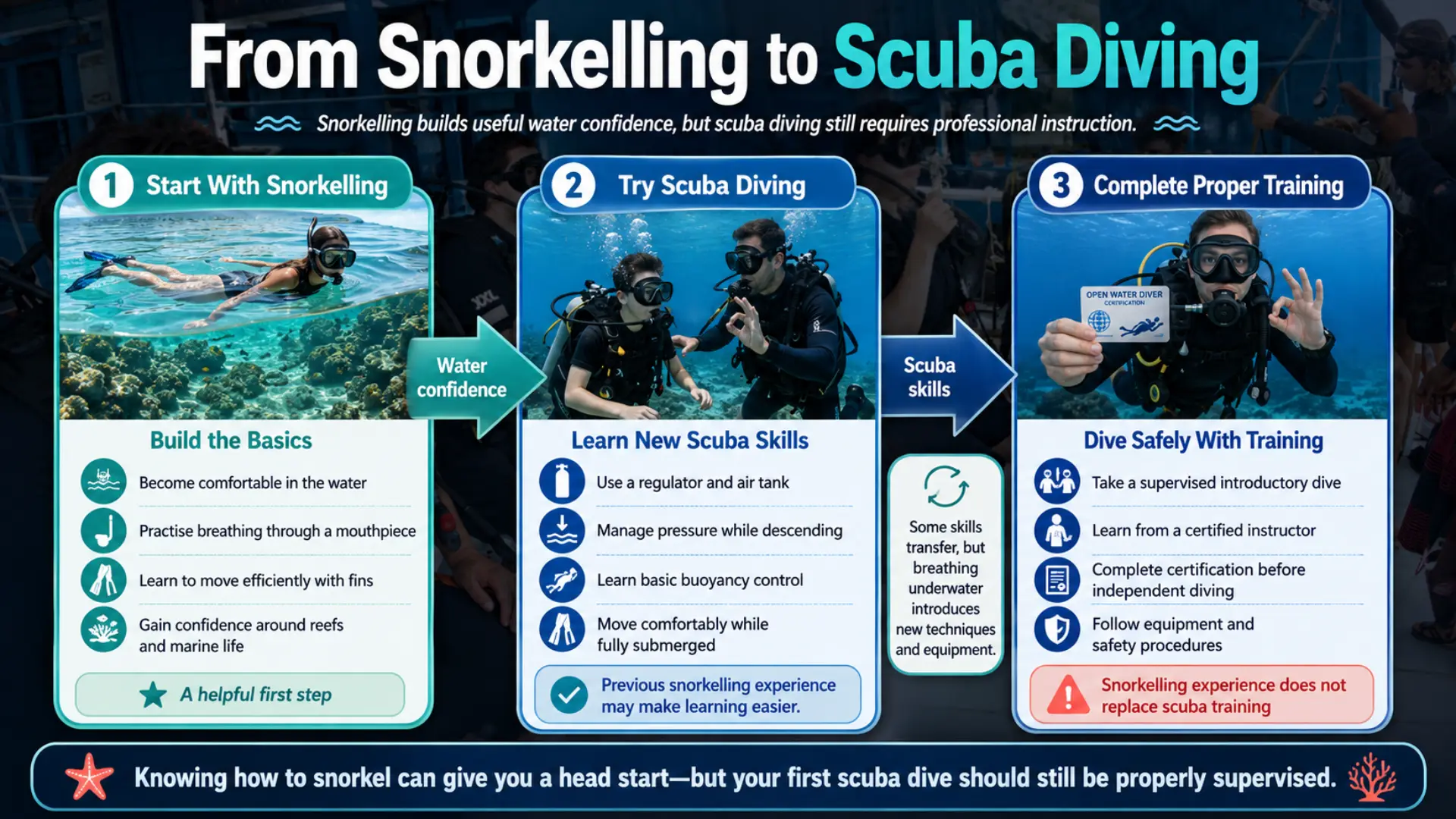
Yes. In fact, snorkelling is a great way to prepare for scuba diving. It helps you become comfortable in the water and get used to breathing through a mouthpiece.
Scuba diving builds on those basics by teaching you how to use scuba equipment and move comfortably underwater.
If you have snorkelled before, you may find it easier to learn scuba diving. That’s because you’ll already be familiar with wearing a mask, breathing through a mouthpiece, and staying relaxed in the water. Scuba training then builds on those skills by teaching buoyancy control, underwater communication, and safe diving practices.
When Should You Choose Snorkelling Instead of Scuba Diving?
Snorkelling makes the most sense when:
You are short on time and want to get in the water the same day
You are travelling with kids or non-divers in the group
You want a low-cost, no-commitment way to see the reef
You’d rather stay relaxed at the surface than manage new underwater skills
Scuba diving is a better choice if you want to stay underwater longer and explore deeper dive sites. You will need to spend a few days learning the basic skills. Koh Tao is one of the best places to learn scuba diving because the water is calm, warm, and clear throughout the year. The island also has one of the highest concentrations of dive schools in the world.
Which Activity Is Right for You?
If you are…
Best Choice
Why
Short on time
Snorkelling
Quick to start
Travelling with children
Snorkelling
Easier for beginners
Curious about scuba
Bautizo
Experience diving without certification
Want to dive worldwide
Curso Open Water
International certification
Love marine life
Scuba Diving
Access to deeper reefs
Conclusión
Both snorkelling and scuba diving offer unforgettable ways to experience the ocean, but they’re designed for different types of adventures. Snorkelling is perfect if you want an easy, affordable way to enjoy coral reefs from the surface. If you’re ready to spend more time underwater and explore a whole new world, scuba diving is well worth learning. If you’re still unsure, a Try Dive is an excellent way to experience scuba diving before committing to a full certification course.
Preguntas frecuentes
Which is better, snorkelling or scuba diving?
Neither is objectively better because they serve different purposes. Snorkelling wins on ease, cost, and flexibility. Scuba diving offers greater depth, more time underwater, and access to marine life you simply can’t see from the surface. Most divers started out as snorkelers first.
Can a non-swimmer do snorkelling?
It’s not recommended without extra support. Snorkelling still means floating face-down in open water, so basic swimming ability and comfort in the water matter. Non-swimmers can sometimes snorkel with a flotation vest and close guide supervision in calm, shallow conditions. It’s worth being upfront with your tour operator beforehand so they can set you up safely.
Is snorkelling easier than scuba diving?
Yes. Snorkelling is easier because it requires no certification and only basic water skills. Scuba diving involves additional training for skills like buoyancy control and equalising.
Can you go fully underwater with a snorkel?
You can briefly duck-dive a few metres below the surface while snorkelling, but you’re holding your breath the whole time. The snorkel tube only works when the top is above water. It’s not the same as sustained underwater breathing, which is made possible by a scuba tank and regulator.
What colour should you not wear when snorkelling?
Avoid all-white or very pale, shiny gear in open water. From below, it can resemble the underside of a fish or bait, which may draw unwanted attention from larger predators in some locations. Bright or high-visibility colours are generally better for safety because they make you easier for boats to see and reduce the chance of being mistaken for prey.
Is snorkelling good for your lungs?
Snorkelling involves steady, controlled breathing and light aerobic activity, which many people find pleasant and relaxing. However, it’s not a substitute for medical advice. Anyone with a respiratory or heart condition should check with a doctor before snorkelling because breathing through a tube against water resistance requires a bit of extra effort.
Who should avoid snorkelling?
People with serious heart or lung conditions, uncontrolled seizures, or a strong fear of open water should speak with a doctor or reconsider before snorkelling. Anyone who isn’t a confident swimmer should only snorkel with flotation support and close supervision.
What colour should you not wear when snorkelling?
At the surface, you can stay as long as you like because a snorkel provides continuous air from above, so there’s no time limit. If you duck-dive below the surface, you’re limited to a single breath-hold. For most people, that’s somewhere between 30 seconds and a couple of minutes.
What should you not do while snorkelling?
Don’t touch or stand on coral. Don’t chase or grab marine life. Don’t snorkel alone in open water, and don’t ignore currents or boat traffic. It’s also best to avoid snorkelling right after a large meal or after drinking alcohol. Whenever possible, snorkel with a buddy or guide instead of going alone.
Bucea con LBD: tu puerta a la exploración submarina
Tanto si eres un principiante curioso como un profesional experimentado, nuestra escuela es tu portal a las maravillas del submarinismo. Únete a nosotros en el mundo bajo las olas.
Is your old scuba certification still valid? Learn about scuba certification validity, when you need a refresher dive in Koh Tao, & how the Reboot Course works.
Is your old scuba certification still valid? Learn about scuba certification validity, when you need a refresher dive in Koh Tao, & how the Reboot Course works.
Is your old scuba certification still valid? Learn about scuba certification validity, when you need a refresher dive in Koh Tao, & how the Reboot Course works.
Para ofrecer las mejores experiencias, utilizamos tecnologías como las cookies para almacenar y/o acceder a la información del dispositivo. El consentimiento a estas tecnologías nos permitirá procesar datos como el comportamiento de navegación o identificaciones únicas en este sitio. La falta de consentimiento, o la retirada del mismo, puede afectar negativamente a determinadas características y funciones.
Funcional
Siempre activo
El almacenamiento o acceso técnico es estrictamente necesario para el fin legítimo de permitir el uso de un servicio específico explícitamente solicitado por el abonado o usuario, o con el único fin de llevar a cabo la transmisión de una comunicación a través de una red de comunicaciones electrónicas. .
Preferencias
El almacenamiento o acceso técnico es necesario para el fin legítimo de almacenar preferencias no solicitadas por el abonado o usuario.
Estadísticas
El almacenamiento o acceso técnico que se utiliza exclusivamente con fines estadísticos.Almacenamiento o acceso técnico que se utiliza exclusivamente con fines estadísticos anónimos. Sin un requisito, el cumplimiento voluntario por parte de su proveedor de servicios de Internet o registros adicionales de un tercero, la información almacenada o recuperada exclusivamente con este fin no puede utilizarse para identificarle.
Marketing
El almacenamiento o acceso técnico es necesario para crear perfiles de usuario para enviar publicidad, o para seguir al usuario en un sitio web o en varios sitios web con fines de marketing similares.



 ES
ES  EN
EN