
Key Takeaways
- Choosing a dive school based solely on price can be a mistake. Safety standards, instructor quality, group sizes, equipment condition, and learning support have a far greater impact on your overall diving experience.
- Small instructor-to-student ratios provide more personalised coaching, closer supervision, additional practice time, and greater confidence for beginner divers.
- Before booking, always verify what is included in the course fee, including equipment rental, certification fees, digital learning materials, confined-water training, and insurance, to avoid unexpected expenses.
- Divers who feel nervous or lack confidence benefit most from schools that offer patient instructors, gradual skill progression, small groups, and extra support throughout the training process.
- The best dive schools focus on long-term diver development, offering clear progression pathways from Try Dives and Open Water certifications to Advanced, Rescue, Divemaster, and professional-level training while promoting environmentally responsible diving practices
Koh Tao is one of Thailand’s most popular diving destinations, attracting thousands of people each year who want to learn scuba diving, earn a certification, improve their skills, or begin a professional diving career.
With dozens of dive schools across the island offering similar courses, choosing the right one can be challenging. Prices often appear comparable, websites promote similar experiences, and most dive centres showcase the same crystal-clear waters, colourful marine life, and smiling divers.
However, the quality of your experience is often determined by factors that are not immediately obvious.
Some of the most important questions that need to be addressed are –
- How many students are assigned to each instructor?
- What qualifications and experience does the teaching team have?
- How seriously does the school approach safety and diver education?
- What is included in the advertised course price?
- Does the school provide extra support for nervous or first-time divers?
- Are courses available in your preferred language?
- Can the school support your progression beyond your first certification?
This guide explains the most important factors to compare when evaluating dive schools in Koh Tao, helping you make an informed decision and choose a diving centre that matches your goals, learning style, and budget.
Why Choosing the Right Dive School in Koh Tao Matters
Choosing a dive school is about much more than finding a place that can take you underwater. The quality of your training, safety, confidence, and overall diving experience can vary significantly from one dive centre to another.
This is especially important if you are a first-time diver, feel nervous in the water, or are planning to complete your Open Water certification. A well-run dive school will create a supportive learning environment where you can develop skills at a comfortable pace while feeling safe and confident throughout the course.
The right dive school can influence:
|
For certified divers, choosing the right dive centre can also impact the quality of dive-site briefings, guide expertise, boat comfort, group sizes, and overall dive planning.
For those considering Divemaster training, the decision becomes even more significant. You are not simply booking a course; you are selecting a training environment, professional mentor team, learning culture, and diving community that may shape the start of your diving career.
A Quick Decision Table – Which Diving Option Is Right for You?
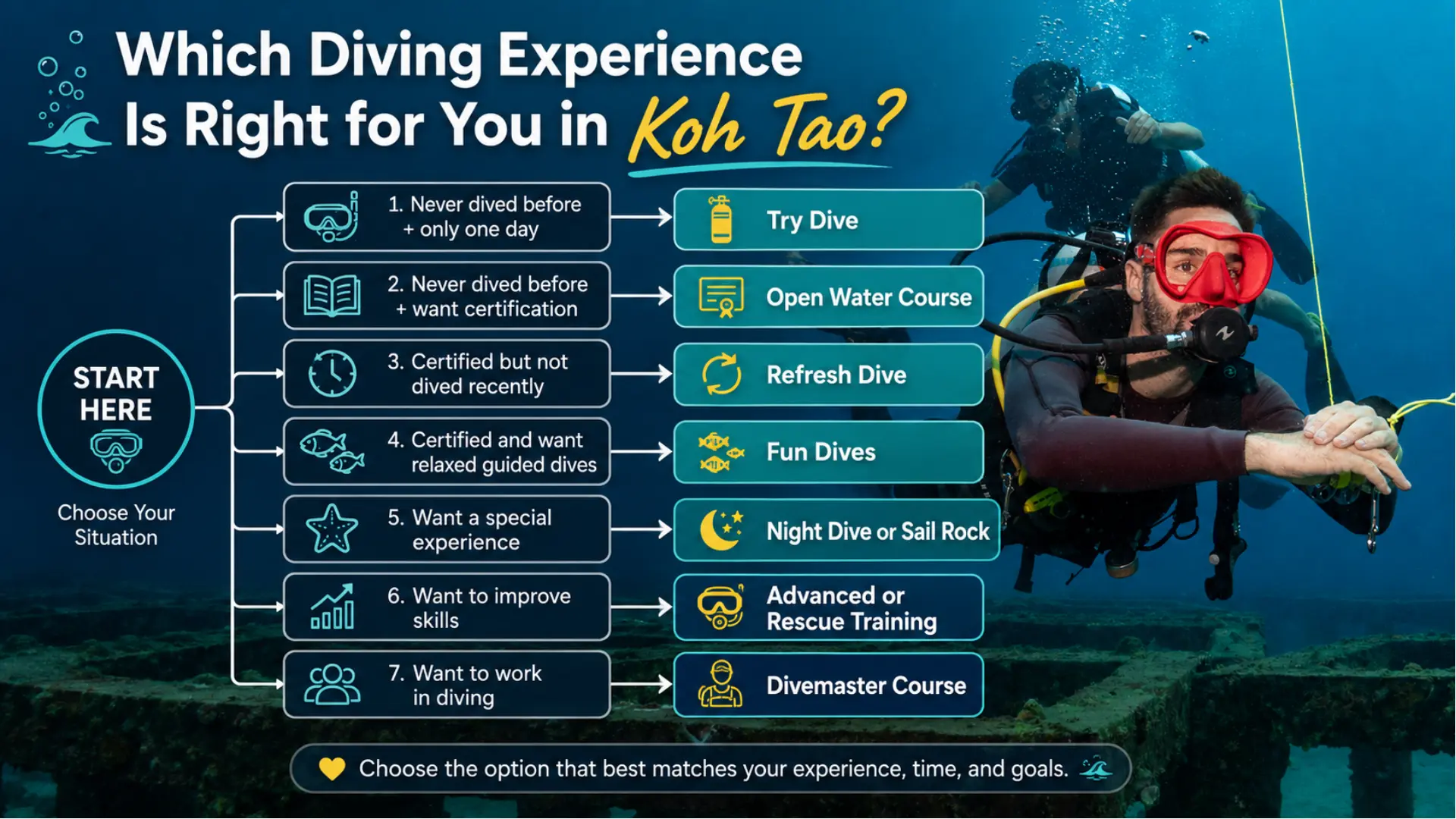
Your Situation | Best Option | Why It Makes Sense |
You have never dived before and only have one day | Try Dive | A simple first ocean experience without committing to a full course |
You have never dived before, but want certification | Open Water | The main beginner certification route for becoming a certified diver |
You are already certified but have not dived for a while | Refresh Dive | Helps rebuild confidence, skills, buoyancy and comfort |
You are certified and want relaxed guided dives | Fun Dives | Best for exploring Koh Tao diving without doing another course |
You want a memorable special experience | Night Dive or Sail Rock | Good for divers looking for something beyond regular local dives |
You want to improve your skills | Advanced/Rescue-style training | Helps with confidence, navigation, depth, awareness, and safety |
You want to work in diving | Divemaster | A professional training pathway for long-stay and career-focused divers |
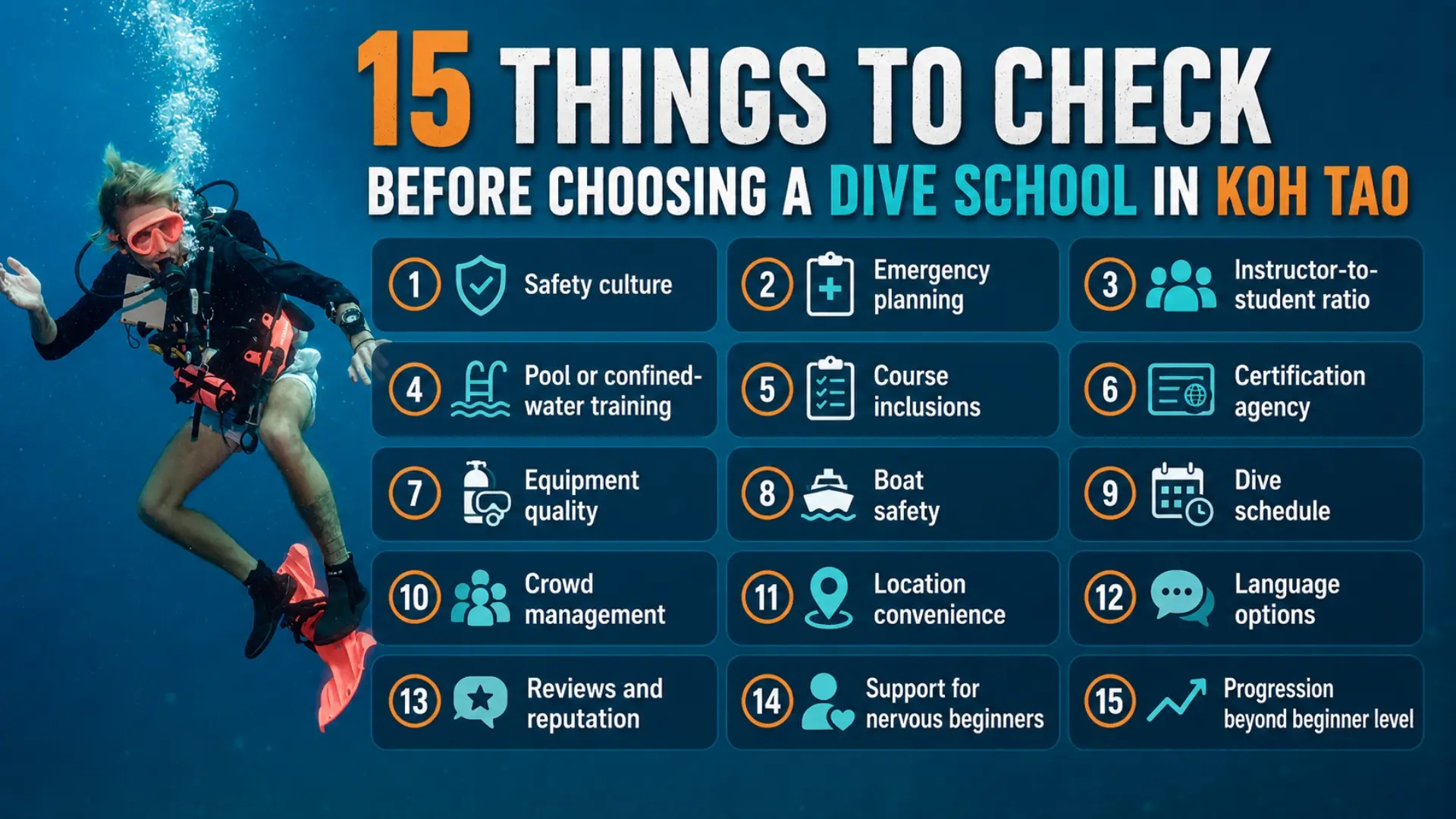
15 Important Things to Check Before Choosing a Dive School in Koh Tao
1. Check the School’s Safety Culture
A good dive school should be able to explain how safety works during training and dives.
Look for clear answers about:
- dive briefings
- emergency procedures
- oxygen and first-aid readiness
- instructor supervision
- maximum depth limits
- conservative dive planning
- what happens if someone feels uncomfortable
- how weather or sea conditions affect dive plans
A good instructor should never make you feel silly for asking safety questions.
What To Ask?
Factor to check | Why it matters | Questions to ask the dive school |
Safety culture | Shows how seriously the school handles risk | “What safety procedures do you follow before and during dives?” |
Emergency planning | Helps you understand how prepared the team is | “Do you carry oxygen and first-aid equipment on dive trips?” |
Conservative decisions | Prevents rushed or unsafe diving | “What happens if conditions are not suitable?” |
2. Ask About Instructor-to-Student Ratios
Group size can have a significant impact on your overall learning experience, particularly if you are new to scuba diving.
Smaller groups generally allow for more personalised instruction, giving you additional time to practise skills, ask questions, and build confidence at your own pace. They also make communication easier both above and below the water, while allowing instructors to provide more detailed feedback throughout the course.
Benefits of smaller groups in a diving school include:
- More individual attention from your instructor
- Additional time to practise essential diving skills
- A more comfortable experience for nervous or first-time divers
- Easier underwater communication and supervision
- Better feedback and coaching after each dive
This is especially valuable during an Open Water course, where learning fundamental skills and gaining confidence are key parts of the training process.
When comparing dive schools, do not focus solely on the course price. It is equally important to ask how many students will be assigned to each instructor and how training groups are organised.
Good Signs to Look For
- The school clearly explains its student-to-instructor ratios.
- They are transparent about maximum group sizes.
- They explain how Divemasters or assistants support instructors during training.
- They are honest about how group sizes may vary during busy periods.
- They provide additional support if a student needs extra time or practice.
3. Find Out Whether Beginners Start in a Pool or Confined Water
For first-time divers, the learning environment during the early stages of training can make a significant difference to confidence and comfort levels.
Before entering open water, beginners need time to become familiar with scuba equipment and practise essential skills in a controlled environment.
These skills typically include:
- Breathing comfortably through a regulator
- Equalising the ears during descent
- Clearing water from a mask
- Recovering and replacing a regulator
- Maintaining basic buoyancy control
- Communicating underwater using hand signals
- Staying calm and relaxed while using scuba equipment
Why This Matters for Nervous Divers
If you are concerned about breathing underwater, mask clearing, swimming ability, or simply feeling anxious about your first dive, a supportive training environment can make the experience far more enjoyable.
Having time to practise in calm conditions often helps reduce stress, improve confidence, and create a smoother transition to open-water diving.
4. Ask Exactly What Is Included in the Course Price
Before booking a diving course in Koh Tao, check exactly what is included in the price and whether there are any additional costs for certification, equipment, learning materials, or insurance.
Course Inclusion | Why it matters | What to confirm before booking |
Equipment rental | Avoids unexpected gear costs | “Is full equipment included?” |
Learning materials | Needed for theory and certification | “Are digital learning materials included?” |
Theory sessions | Helps you understand dive safety | “How is the theory taught?” |
Pool/confined-water practice | Builds beginner confidence | “Where do beginners practise first?” |
Ocean dives | Core part of the course | “How many ocean training dives are included?” |
Certification fees | Needed to receive your certification | “Is the final certification fee included?” |
Insurance, if applicable | Adds peace of mind | “Is diving insurance included or separate?” |
Snacks/refreshments, if applicable | Useful on boat days | “Are water, snacks or refreshments included?” |
Instructor support | Affects learning quality | “How many students per instructor?” |
Post-course guidance | Helps you continue diving | “What can I do after this course?” |
5. Compare RAID, PADI and SSI Without Getting Confused
One of the most common questions when choosing a dive school in Koh Tao is whether to learn with RAID, PADI, or SSI. Let’s understand this in detail.
RAID vs PADI vs SSI
Point | RAID | PADI | SSI |
Recognition | Internationally recognised, but less known than PADI | Most popular and widely known globally | Internationally recognised and common in many dive centres |
Beginner course depth | Open Water 20 usually trains up to 20m | Open Water usually trains up to 18m | Open Water usually trains up to 18m |
Learning style | More digital and skill/performance-focused | Very structured and standardised | Flexible digital learning, often dive-centre friendly |
Best for | Divers who want modern training and strong skill focus | Travelers who want the most familiar certification name | Divers who want flexible learning with global recognition |
While each agency has its own learning materials, course structure, and training approach, all three offer internationally recognised scuba certifications.
6. Check Equipment Quality and Maintenance
Well-maintained equipment improves comfort, safety, and confidence throughout your training.
Before booking, ask about the condition and maintenance of:
- Masks
- Fins
- Wetsuits
- BCDs (Buoyancy Control Devices)
- Regulators
- Dive Computers
- Tanks
- Boat Safety Equipment
Poorly fitting gear can negatively affect your diving experience. For example, a leaking mask, uncomfortable fins, or an ill-fitting wetsuit can create unnecessary stress and distract you from learning.
7. Ask About Dive Boats, Dive Schedules, and Crowd Management
Koh Tao is one of the world’s most popular diving destinations, and some dive sites can become busy during peak seasons. A professional dive school should have a clear plan for managing schedules, selecting suitable dive sites, and ensuring students have a comfortable learning environment.
Before booking, ask about:
- Boat departure and return times
- How dive sites are selected each day
- Whether training groups and certified fun divers are separated
- How the school avoids overcrowded dive sites
- What happens if the weather or sea conditions change
- Whether beginner divers are taken to suitable training sites
A good dive school will not simply promise to visit the “best” or most famous dive sites every day.
NOTE – If you are taking an Open Water course, the most suitable dive site is not necessarily the most famous one. The best training site is the one that offers calm conditions, good visibility, and an environment where you can safely practise skills, build confidence, and enjoy the learning process. |
8. Consider Location, But Do Not Choose Only by Location
A dive centre located close to your accommodation, the beach, the pier, or Koh Tao’s main walking areas can make your course more convenient. This is especially helpful for early morning departures, classroom sessions, equipment fittings, and multi-day courses.
However, convenience should never outweigh the quality of training and overall diving experience.
How to Prioritise Your Decision?
Factor | Importance |
Safety Standards | Highest Priority |
Instructor Quality & Experience | Highest Priority |
Small Group Sizes | High Priority |
Course Structure & Learning Support | High Priority |
Equipment Quality & Maintenance | High Priority |
Transparent Pricing & Inclusions | Medium-High Priority |
Reviews & Reputation | Medium-High Priority |
Location & Convenience | Secondary Consideration |
9. Check Language Options
Learning scuba diving involves safety information, theory, skills, signals and instructions.
If you are not fully comfortable in the teaching language, ask whether the school offers instruction in a language you understand well.
This is especially important for:
- nervous beginners
- families
- Spanish-speaking travelers
- French-speaking travelers
- German-speaking travelers
- Divemaster candidates
- people who prefer detailed explanations before entering the water
Why does language matter?
- Good communication helps you understand:
- What to do before the dive
- How to use your equipment
- What to do if you feel uncomfortable
- Underwater hand signals
- Safety rules
- How to continue after the course
NOTE – A multilingual dive school can be a major advantage if you feel more comfortable learning in your own language. |
10. Read Reviews Carefully
Reviews can help, but do not only look at the star rating. Read the actual comments and look for repeated patterns.
Good review patterns
Look for mentions of:
- patient instructors
- small groups
- calm teaching style
- clear safety briefings
- well-maintained equipment
- good organization
- no pressure
- beginner confidence
- fun but professional atmosphere
- helpful support after the course
Warning review patterns
Be careful if several reviews mention:
- rushed teaching
- poor communication
- overcrowded groups
- unclear pricing
- uncomfortable equipment
- disorganized schedules
- pressure to book
- lack of personal attention
A single bad review does not always tell the full story. Repeated patterns matter more.
11. Understand the Daily Course Schedule
Many travellers arrive in Koh Tao with limited time and want to fit a diving course into a short holiday. Before booking, make sure you understand exactly how the course is structured each day.
A clear schedule helps you plan your accommodation, transport, other activities, and travel arrangements while ensuring you have enough time to learn comfortably without feeling rushed.
Questions to Ask
- How many days does the course take to complete?
- How much classroom or theory study is required?
- When are the confined-water or pool training sessions?
- How many open-water dives are included?
- What happens if I need extra practice before progressing?
- Can I complete the theory portion before arriving in Koh Tao?
- How much free time will I have during the course?
Why This Matters
Not all dive schools run their courses in the same way. Some follow a relaxed schedule with plenty of time to practise and absorb new skills, while others operate on tighter timelines to accommodate more students.
Understanding the daily schedule helps you set realistic expectations and choose a course pace that suits your learning style. If you’re a first-time diver or feel nervous about diving, a school that allows extra practice and flexibility can make the experience far more enjoyable.
12. See Whether the School Supports Nervous First-Time Divers
Many new divers arrive in Koh Tao with concerns about being underwater, using scuba equipment, or learning new skills in an unfamiliar environment.
A professional dive school should recognise these concerns and address them with patience, clear communication, and supportive instruction.
What Nervous Beginners Should Look For:
Concern | What Helps |
Fear of panic underwater | Patient instructor, gradual progression, and thorough pre-dive briefings |
Limited swimming confidence | Honest discussion before training and close instructor supervision |
Mask discomfort or anxiety | Extra practice in shallow or confined water before open-water dives |
Difficulty adapting to breathing underwater | Time to relax, practise, and build comfort at your own pace |
Fear of being left behind | Small group sizes and attentive instruction |
Uncertainty about the course | Clear explanations of each step before entering the water |
Nervous About Your First Dive?If you’re not ready to commit to a full certification course, a Try Dive or Discover Scuba Diving experience can be an excellent first step. It allows you to experience breathing underwater and explore the ocean with an instructor before deciding whether a certification course is right for you. Speak with the La Bombona Diving team about your experience level, concerns, and available time in Koh Tao, and they’ll help recommend the option that best suits your comfort level. |
13. Check Whether the School Offers Progression Beyond Beginner Level
While your immediate goal may be a Try Dive or an Open Water course, it’s worth considering what opportunities the dive school offers beyond your first certification.
That’s because a dive school with a clear progression pathway can provide consistent guidance, familiar instructors, and ongoing support as your skills develop.
Typical Diving Progression:
Starting Point | Next Step |
Try Dive | Open Water Course |
Open Water Diver | Fun Dives or Advanced Training |
Advanced Diver | Rescue Diver Training |
Certified Diver | Night Dives, Sail Rock Trips, and Specialty Courses |
Long-Term or Frequent Diver | Divemaster Training |
Divemaster | Instructor Development Course |
NOTE – Schools that invest in long-term diver education often place greater emphasis on quality training, safety, and ongoing support rather than simply processing students through entry-level courses. |
14. Ask About Environmental Responsibility
A responsible dive school should actively teach environmentally friendly diving practices and encourage students to become responsible divers from the very beginning of their training.
Why This Matters for Beginners
Many new divers are unaware of how easily coral reefs and marine ecosystems can be damaged. Even accidental contact from a fin, hand, or dangling equipment can harm fragile coral or disturb marine life.
A quality dive school will teach environmental awareness alongside diving skills, helping students develop good habits from their very first dives.
Signs of a Responsible Dive School
Good Practice | Why It Matters |
Buoyancy training before reef dives | Reduces accidental contact with coral |
No-contact diving policy | Protects marine ecosystems and wildlife |
Environmental briefings | Helps divers understand responsible behaviour |
Instructor-led conservation awareness | Encourages long-term sustainable diving habits |
Respect for local marine regulations | Supports reef protection and conservation efforts |
Learning good environmental practices from the start helps protect Koh Tao’s reefs while making you a more skilled and aware diver.
15. Trust the Vibe, But Verify the Details
You should feel comfortable speaking with the staff, asking questions, and discussing any concerns you may have. A professional dive centre should feel welcoming, organised, transparent, and genuinely interested in helping you find the right course for your needs.
Make sure you receive clear answers about:
- Maximum group sizes
- Instructor qualifications and experience
- Daily course schedules and timelines
- What’s included in the course price
- The certification agency used
- Equipment rental and dive computer availability
- Weather, cancellation, and refund policies
- Support available for nervous or first-time divers
- Future training and progression opportunities
Choosing Koh Tao’s Diving Academy As Per The Experience Level
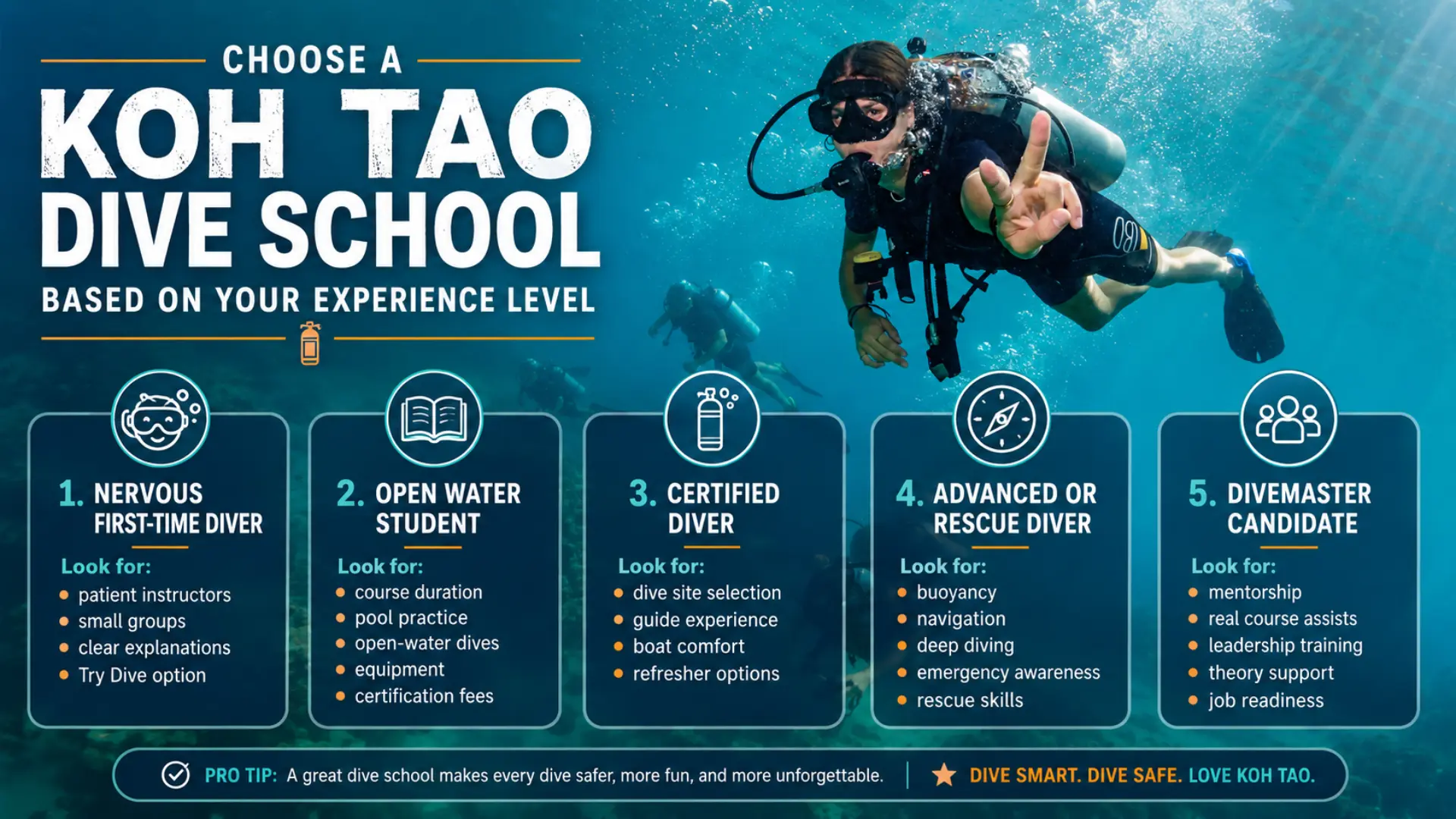
Different divers have different needs. A dive school that is perfect for one person may not be the best fit for another. Let’s understand how to choose a diving school as per your experience level.
If You Are a Nervous First-Time Diver
Choose a school that prioritises patience, clear communication, and small groups. Look for instructors who explain each step, allow plenty of practice time, answer questions clearly, and stay close during the dive.
If you are unsure about committing to a certification course, a Try Dive can be a good introduction before enrolling in Open Water.
If You Want an Open Water Course
Don’t choose based on price alone. Compare:
- Course duration
- Pool or confined-water training
- Number of open-water dives
- Certification agency
- Equipment inclusions
- Group size
- Instructor support
- Certification fees
A quality Open Water course should build confidence, safety awareness, and good diving habits, not just help you earn a certification.
If You Are Already Certified
Focus on the overall diving experience rather than the school itself. Consider:
- Dive site selection
- Guide experience
- Group size
- Boat comfort
- Current conditions
- Refresher options
- Access to specialty dives such as night dives or Sail Rock trips
The best diving experience often comes down to dive planning, conditions, and guide quality.
If You Want Advanced or Rescue Training
Choose a course that develops skills relevant to your goals, such as:
- Buoyancy control
- Navigation
- Deep diving
- Night diving
- Emergency awareness
- Rescue skills
- Dive planning and decision-making
The right course should help you become a more capable diver, not simply collect another certification card.
If You Want Divemaster Training
Divemaster training is a long-term commitment, so evaluate the training environment as well as the course itself.
Ask about:
- Course duration
- Minimum and average dive numbers
- Real course-assisting opportunities
- Leadership development
- Theory support
- Insurance and certification fees
- Equipment requirements
- Job-readiness preparation
- Candidate mentoring
Choose a school that provides structured mentorship and practical experience, not just the lowest price. For more information, check out – How to Choose the Best Divemaster Course in Koh Tao.
Ready to Start Diving in Koh Tao?
Whether you’re interested in a Try Dive, Open Water certification, fun dives, or professional-level training, the team at La Bombona Diving can help you find the option that best matches your experience level, goals, and schedule.
Get in touch with our instructors to discuss your diving plans and start your Koh Tao adventure with confidence!
Frequently Asked Questions (FAQs)
 EN
EN  ES
ES