

Key Takeaways:
- Prioritize programs that offer practical, real-world experience, including assisting live courses, preparing dive briefings, supporting instructors, supervising certified divers, and learning daily dive-center operations.
- Consider the course duration carefully, as longer programs often provide more repetition, mentorship, and in-water practice, helping trainees develop stronger judgment, confidence, and leadership skills.
- Compare PADI, SSI, and RAID pathways based on your career plans, but remember that instructor quality, safety standards, course structure, and mentorship are often more important than the certification agency alone.
- Review the full course cost before booking, including training materials, certification fees, professional membership, insurance, equipment rental, accommodation, visa expenses, and daily living costs.
- Choose a program that provides honest career guidance after certification, including job expectations, CV support, industry advice, instructor-pathway options, and realistic information about working legally as a Divemaster in Thailand.
Koh Tao is one of the world’s most popular places for professional scuba training. The island has warm water, regular dive schedules, affordable living costs, many dive sites close to shore, and a large community of instructors, Divemasters, and trainees. That makes it a strong place to start a scuba diving career in Thailand.
But not every Divemaster course in Koh Tao is the same.
Some programs are fast and certification-focused. Some are longer and more internship-based. Some include equipment, certification fees, and insurance. Others appear cheaper at first but add important costs later. Some schools train you mostly to pass assessments, while others give you repeated real-world experience assisting courses, leading briefings, helping customers, and working on a dive boat.
This guide explains how to compare Divemaster training in Koh Tao properly, what questions to ask before booking, how PADI, SSI and RAID pathways differ, what hidden costs to watch for and what a high-quality professional diving course should include.
Quick Answer: What Makes a Good Divemaster Course in Koh Tao
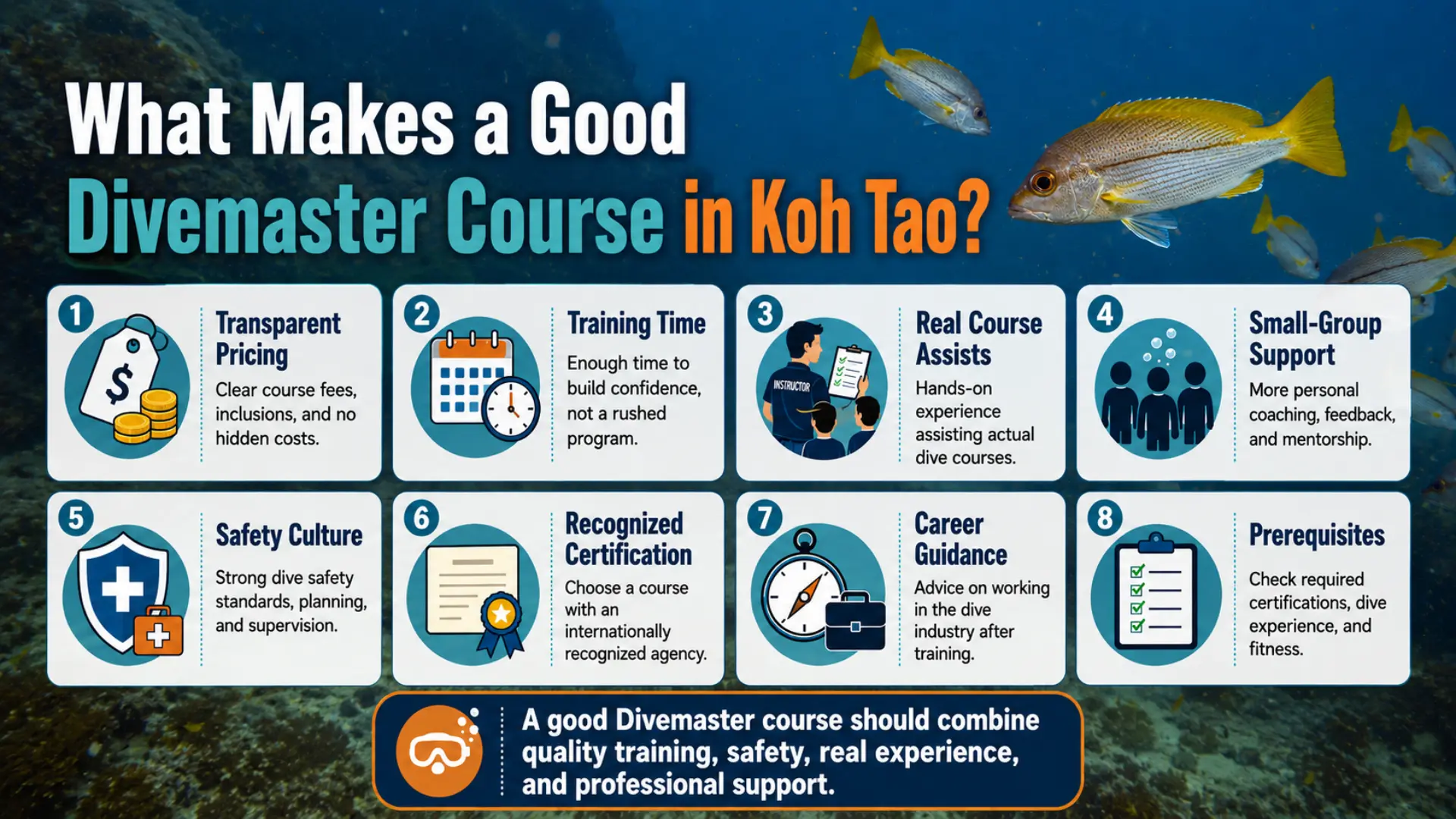
A good Divemaster course in Koh Tao should include professional-level theory, rescue refreshers, skill demonstrations, pool workshops, ocean training, dive briefings, navigation, search and recovery, buoyancy control, assisting real courses, supervising certified divers, and enough time to build confidence.
The best Divemaster course for you is usually the one that gives you:
What to check | Why it matters |
Clear price and inclusions | Avoids hidden costs for materials, certification, insurance, or equipment |
Enough training time | Divemaster confidence usually comes from repetition, not rushing |
Real course assists | You need to learn how instructors manage students in real situations |
Small-group support | Better feedback and more time with mentors |
Good safety culture | Professional diving is about judgment, not just diving ability |
Recognized certification | PADI, SSI and RAID are widely recognised agencies |
Career guidance | Helps you understand realistic job options after certification |
Transparent prerequisites | Prevents surprises if you still need Rescue, First Aid or specialities |
Note – If you are serious about becoming a dive professional, choose the course that gives you the most meaningful in-water practice, not just the fastest certification.
15 Practical Ways To Choose The Best Divemaster Course In Koh Tao
1. Choose a Course That Matches Your Real Goal
Before comparing prices or agencies, ask yourself why you want to become a Divemaster.
Different students need different training styles. Someone who wants personal development may not need the same course structure as someone planning to work in the dive industry.
Your goal | Best course type |
Improve your diving confidence | Standard Divemaster course |
Start working as a Divemaster | Longer internship-style training |
Become a scuba instructor later | Structured professional pathway |
Spend time diving in Koh Tao | Extended course with unlimited diving |
Train on a budget | Transparent all-inclusive package |
Build leadership slowly | 8-week or 2-month program |
Get certified quickly | Intensive 4-week course, only if already experienced |
Note – If your goal is a future scuba diving career in Thailand or abroad, choose a course that includes real-world assisting, dive briefings, customer interaction and leadership practice, not just minimum certification requirements.
2. Compare Divemaster Course vs Divemaster Internship
Many people search for a Divemaster internship in Koh Tao without knowing how it differs from a normal Divemaster course.
A standard Divemaster course usually focuses on completing agency requirements. A Divemaster internship usually includes more time inside the dive center, more course assisting, more boat experience and more exposure to daily dive operations.
Option | Best for | Advantages | Watch out for |
Standard Divemaster course | Divers with limited time | Faster route to certification | May offer less real-world practice |
Extended Divemaster course | Divers who want stronger preparation | More feedback and repetition | Requires more time and a living budget |
Divemaster internship | Future dive professionals | More practical dive centre experience | Quality varies by school |
Course + internship-style training | Career-focused trainees | Balanced certification and experience | Needs proper structure |
3. Check Whether the Course Is Long Enough to Build Confidence
Divemaster training is not only about passing assessments. It is about becoming reliable underwater and professional around customers.
Some divers can complete the course quickly, but many benefit from a longer schedule.
Duration | Best for | What to expect |
4 weeks | Very experienced divers | Fast certification, less time for repetition |
6 weeks | Confident Rescue Divers | Balanced training and some assists |
8 weeks | Career-focused trainees | More real practice and stronger confidence |
2 months | Future working Divemasters | Deeper mentoring, more dives and more real-world exposure |
Note – If you want to work after the course, longer training is usually more valuable. A rushed course may give you the certification, but not the calm decision-making that real Divemaster work requires.
4. Compare PADI, SSI and RAID Divemaster Pathways
When people search for PADI Divemaster Koh Tao, they often assume PADI is the only serious option. In reality, PADI, SSI and RAID all offer professional-level training pathways.
The agency matters, but the dive school and instructor quality matter more.
Agency | Common professional pathway | Strengths | Good for |
PADI | Divemaster | Strong global brand recognition and a clear professional ladder | Students who specifically want a PADI professional rating |
SSI | Dive Guide + Science of Diving + Divemaster | Flexible digital system and strong academic structure | Students training with SSI-focused centres |
RAID | Divemaster | Modern online learning and a strong skill-focused approach | Students who want structured, practical professional training |
Ask the dive school:
Question | Why it matters |
Which agency will certify me? | Helps you understand the pathway |
Are materials included? | Avoids extra learning-material costs |
Are certification and membership fees included? | These can affect the real price |
Can I work internationally with this certification? | Important for career planning |
What are the prerequisites? | Prevents arrival surprises |
5. Look Beyond the Cheapest Divemaster Course Price
The cheapest course is not always the best value.
That’s because a low headline price may not include learning materials, certification fees, professional membership, equipment rental, insurance, required accessories or extra dives.
Price factor | What to check before booking |
Course fee | Is this the full price or only tuition? |
Learning materials | Included or charged separately? |
Certification fee | Included or paid later? |
Professional membership | Included or extra? |
Equipment rental | Is full gear included for the full course? |
Insurance | Included during training? |
Ocean dives | Limited or unlimited? |
Pool sessions | Included or extra? |
Accommodation | Included, discounted or separate? |
Required accessories | Do you need to buy a dive computer, compass, SMB or reel? |
Note – When comparing the Divemaster course cost in Koh Tao, always compare the complete cost, not just the advertised fee.
6. Ask What Is Included in the Course Fee
A high-quality Divemaster course should clearly explain what is included before you pay a deposit.
Should be included | Why it matters |
Theory lessons | Builds professional-level knowledge |
Digital learning materials | Lets you study properly |
Pool training sessions | Helps develop demonstration-quality skills |
Ocean training dives | Builds real leadership ability |
Dive briefings | Develops communication and planning |
Course assisting | Teaches real student management |
Search and recovery practice | Builds problem-solving skills |
Navigation workshops | Essential for guiding certified divers |
Rescue refreshers | Strengthens emergency readiness |
Equipment rental | Reduces upfront cost if you do not own gear |
Diving insurance | Important for professional-level training |
Certification fees | Prevents surprise costs at the end |
One example of a transparent Divemaster training setup in Koh Tao is La Bombona Diving, which offers a structured 2-month RAID Dive Master program with clear inclusions, small-group support, unlimited ocean diving during the course, comprehensive diving insurance, full equipment rental, and all certification and membership fees included with no hidden costs. |
7. Watch Out for Hidden Costs
Hidden costs are one of the biggest problems when choosing a Divemaster course.
Some courses look affordable online but become more expensive once you add missing requirements and personal expenses.
Possible extra cost | Why it matters |
Certification fees | May not be included in the base course price |
Learning materials | Digital manuals can cost extra |
Agency membership | Professional registration may be separate |
Equipment rental | Some schools expect you to own or rent gear separately |
Dive computer | Often required for professional-level training |
Compass | Useful or required for navigation work |
DSMB/SMB and reel | Important for safety and professional practice |
Insurance | May be required but not included |
Rescue course | Needed if not already certified |
First Aid/CPR | Usually must be current |
Nitrox or Deep specialty | May be recommended or required by some pathways |
Accommodation | Usually separate from the course price |
Visa extension | Important for longer stays |
Food and transport | Daily living costs add up over 1–2 months |
Before booking, ask the dive centre for a written breakdown of included and excluded costs.
8. Make Sure You Meet the Prerequisites
A Divemaster course is professional-level training, so you need to meet certain requirements before certification. Exact requirements vary by agency, but most pathways include rescue training, first aid, logged dives and medical fitness.
Requirement | Why it matters |
Minimum age | Professional responsibility usually requires adult status |
Advanced-level experience | You need comfort beyond beginner diving |
Rescue Diver or equivalent | Essential for safety awareness |
CPR and First Aid | Needed for emergency response |
Logged dives | Shows real experience in different conditions |
Medical fitness | Helps ensure safe participation |
Comfort in the water | Needed for stamina, rescue and skill assessments |
9. Choose a Dive School With Real Instructor Mentorship
The instructor or mentor can make or break your Divemaster experience. Good mentors do not just sign off on requirements. They help you improve your judgment, communication, awareness and professionalism.
What to ask | Why it matters |
Who will mentor me? | You should know who is responsible for your training |
How often will I receive feedback? | Feedback turns dives into learning |
How many candidates train together? | Smaller groups often mean more attention |
Can I assist with real courses? | Real students teach you things simulations cannot |
Will I practice briefings? | Divemasters must communicate clearly |
Will I lead dives under supervision? | Builds guiding confidence |
How are rescue skills refreshed? | Safety is central to professional diving |
Do mentors have local Koh Tao experience? | Local knowledge improves training quality |
Note – When choosing a dive centre for Divemaster training in Koh Tao, prioritise mentorship over marketing.
10. Compare Small Dive Schools vs Large Dive Schools
Koh Tao has both large dive schools and smaller boutique dive centres. Neither is automatically better. The right choice depends on how you learn.
Factor | Large dive school | Small dive school |
Course frequency | Often very frequent | May be more flexible |
Social environment | Bigger trainee community | More personal atmosphere |
Instructor team | Larger team | Smaller, more consistent team |
Feedback | Can vary depending on group size | Often more individual attention |
Facilities | Often larger | Usually simpler but focused |
Atmosphere | Busy and social | Calm and personal |
Best for | Students who like big communities | Students who want close mentoring |
Note – If you are comparing the best diving schools in Koh Tao, do not just look at size. Look at how much attention, structure and feedback you will actually receive.
11. Check How Much Real Course Assistance You Will Get
Assisting with real courses is one of the most valuable parts of Divemaster training.
Watching an instructor manage real students teaches you how beginners behave underwater, how problems develop, and how professionals prevent small issues from becoming serious.
Course assist type | What you learn |
Open Water course assists | Student positioning, basic skill control and confidence-building |
Advanced course assists | Dive planning, deeper dives and navigation support |
Rescue course assists | Emergency response awareness and surface management |
Fun dive supervision | Group control, customer care and dive site briefings |
Pool/confined-water assists | Skill demonstration and student problem-solving |
A course with little or no real assisting may leave you underprepared for actual Divemaster work.
Ask the school how many assists you can expect and what kind of courses you may observe or support.
12. Review the Dive Sites Used During Training
The best Divemaster course does not need the most famous dive sites every day. It needs a variety of sites that help you build different skills.
Dive site type | Training value |
Shallow training sites | Skill demonstrations, buoyancy and student awareness |
Navigation-friendly sites | Compass work, natural navigation and dive planning |
Deeper sites | Gas planning, group control and professional awareness |
Sites with mild current | Positioning, communication and decision-making |
Busy sites | Boat awareness and diver management |
Calm sites | Controlled workshops and confidence-building |
Note – Good Divemaster training should help you understand why a site is chosen, how to brief it, how to plan it and how to manage divers there.
13. Ask What Career Support Is Offered After Certification
A Divemaster certification can help you start a scuba diving career, but it does not guarantee a job.
Good dive schools are honest about this. They should help you understand the industry realistically.
Career support | Why it helps |
Honest job advice | Prevents unrealistic expectations |
CV or dive resume guidance | Helps you apply professionally |
Reference if earned | Adds credibility |
Instructor pathway advice | Useful if you want to continue training |
Local industry guidance | Helps you understand seasonality |
Professional feedback | Shows whether you are work-ready |
Advice on languages | Multilingual Divemasters may have more opportunities |
Work permit guidance | Important for legal employment abroad |
Be careful with any school that promises guaranteed work. Dive jobs depend on experience, attitude, languages, season, customer demand and legal requirements.
14. Look for Green Flags and Red Flags Before Booking
This is one of the easiest ways to compare dive centres quickly.
Green flags | Red flags |
Clear price breakdown | Vague or incomplete pricing |
Written list of inclusions | “We’ll explain when you arrive” |
Structured course timeline | No clear training plan |
Named instructors or mentors | No clear person is responsible for your development |
Small-group feedback | Large groups with little individual support |
Real course assists | Only fun diving with no professional structure |
Safety workshops | Little mention of rescue or emergency practice |
Honest career advice | Guaranteed job promises |
Divemaster-specific reviews | Only beginner-course testimonials |
Clear equipment policy | Surprise gear purchases after arrival |
A trustworthy dive school should be happy to answer detailed questions before you pay.
15. Ask the Right Questions Before Paying a Deposit
Before booking any professional diving course in Koh Tao, ask practical questions.
Question | A good answer should include |
What is the full course price? | Exact cost and what it includes |
Are materials included? | Clear answer on digital/manual learning |
Are certification fees included? | Yes/no with details |
Is professional membership included? | Clear explanation |
Is equipment rental included? | Full gear or list of excluded items |
Do I need my own dive computer? | Honest answer before arrival |
Is diving insurance included? | Clear insurance information |
How long is the course? | Realistic timeline, not only the minimum duration |
How many course assists will I complete? | Real examples |
Who will mentor me? | Named instructor or mentor structure |
What happens if I need more time? | Flexible support policy |
Can I continue to instructor training later? | Clear pathway guidance |
Do you help with accommodation? | Practical local support |
What career support do you offer? | Honest, non-guaranteed advice |
Best Months for Divemaster Training in Koh Tao
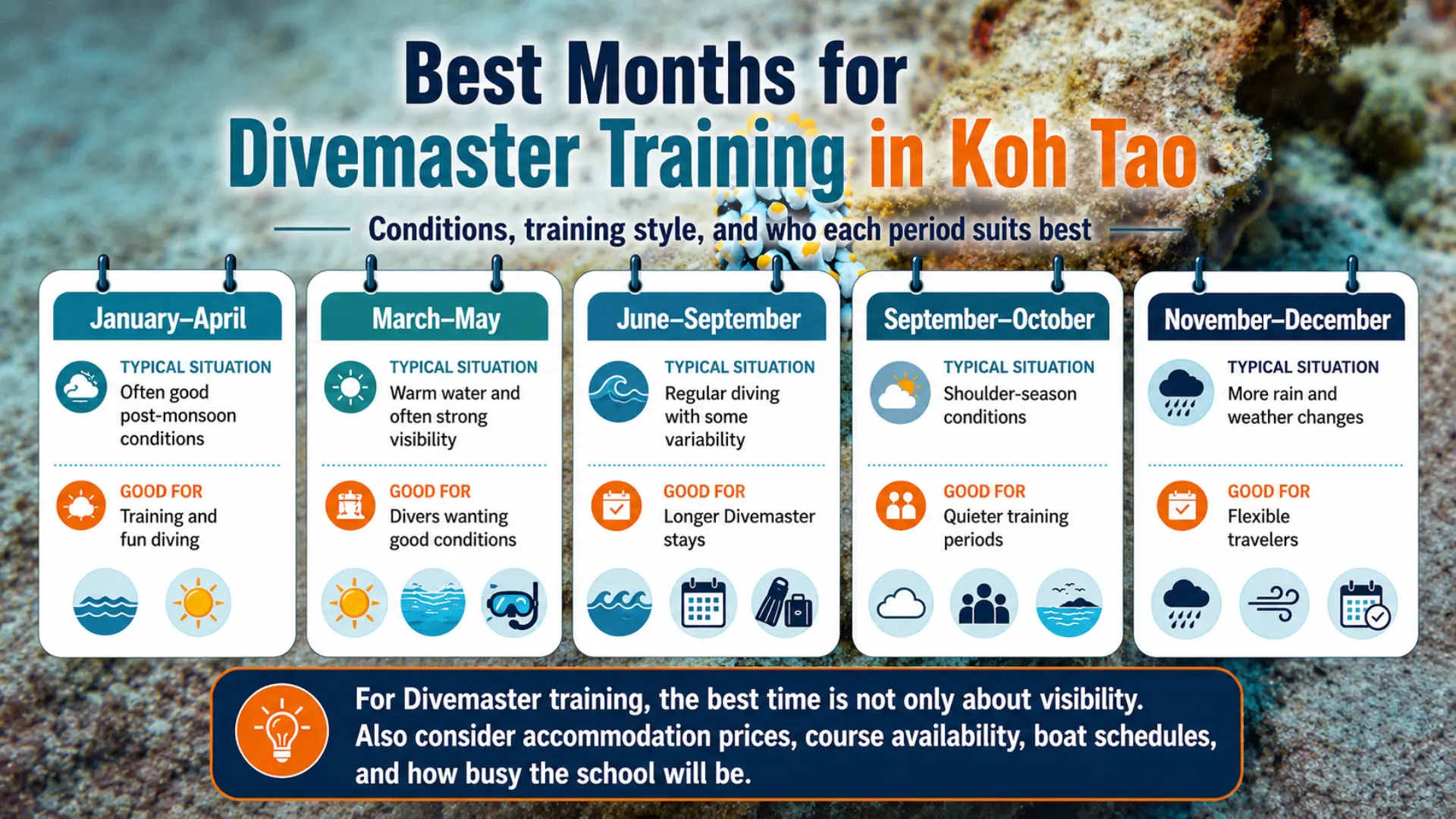
Koh Tao diving is possible throughout the year, but conditions and crowds change.
Period | Typical situation | Good for |
January–April | Often good post-monsoon conditions | Training and fun diving |
March–May | Warm water and often strong visibility | Divers wanting good conditions |
June–September | Regular diving with some variability | Longer Divemaster stays |
September–October | Shoulder-season conditions | Quieter training periods |
November–December | More rain and weather changes | Flexible travelers |
For Divemaster training, the best time is not only about visibility. You should also consider accommodation prices, course availability, boat schedules, and how busy the school will be.
Ready to Start Divemaster Training in Koh Tao?
Choosing the best Divemaster course in Koh Tao is about much more than finding the lowest price or the fastest certification. The right program should help you develop confidence, leadership, safety awareness and the practical skills needed to guide and support other divers in real-world situations.
Take the time to compare course structures, mentorship quality, real course-assist opportunities, inclusions and overall training value. A well-designed Divemaster program can become the foundation of your future diving career and open the door to becoming a more capable, knowledgeable and professional diver.
If you are looking for transparent, all-inclusive Divemaster training in Koh Tao, La Bombona Diving offers a structured 2-month RAID Divemaster program with small-group support, unlimited ocean diving during the course, included diving insurance, equipment rental and clear pricing with certification-related fees included.
Frequently Asked Questions (FAQs)
 EN
EN  ES
ES